Nikos Kazantzakis - Zorba The Greek
Здесь есть возможность читать онлайн «Nikos Kazantzakis - Zorba The Greek» весь текст электронной книги совершенно бесплатно (целиком полную версию без сокращений). В некоторых случаях можно слушать аудио, скачать через торрент в формате fb2 и присутствует краткое содержание. Жанр: Современная проза, на английском языке. Описание произведения, (предисловие) а так же отзывы посетителей доступны на портале библиотеки ЛибКат.
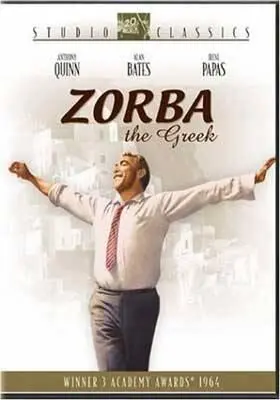
- Название:Zorba The Greek
- Автор:
- Жанр:
- Год:неизвестен
- ISBN:нет данных
- Рейтинг книги:3 / 5. Голосов: 1
-
Избранное:Добавить в избранное
- Отзывы:
-
Ваша оценка:
Zorba The Greek: краткое содержание, описание и аннотация
Предлагаем к чтению аннотацию, описание, краткое содержание или предисловие (зависит от того, что написал сам автор книги «Zorba The Greek»). Если вы не нашли необходимую информацию о книге — напишите в комментариях, мы постараемся отыскать её.
Zorba The Greek — читать онлайн бесплатно полную книгу (весь текст) целиком
Ниже представлен текст книги, разбитый по страницам. Система сохранения места последней прочитанной страницы, позволяет с удобством читать онлайн бесплатно книгу «Zorba The Greek», без необходимости каждый раз заново искать на чём Вы остановились. Поставьте закладку, и сможете в любой момент перейти на страницу, на которой закончили чтение.
Интервал:
Закладка:
He turned to the café proprietor.
"Two rakis, Manolaki!" he said.
We sat down. The wild shepherd, seeing strangers present, withdrew into his shell and was silent.
"Well, chief Nikoli, didn't you go to the theater, too?" the schoolmaster said, to make him talk. "What did you think of it?"
Sfakianonikoli stretched out his great hand, seized his glass of wine, gulped it down and plucked up courage.
"Not go to the theater?" he shouted. "Of course I did! They all kept talking about Kotopouli this and Kotopouli that. So one evening I crossed myself and said: 'All right, why don't I go and see for myself? What the devil is she for them to make all this fuss about Kotopouli?'" [12]
"So what did you see, young fellow?" uncle Anagnosti asked. "What was it? Tell us, for God's sake."
"Well, upon my soul, not much of anything. You hear 'em all talking about this 'theater,' and you think to yourself, 'Now I'm going to see something.' But, I tell you, you're wasting your money. There's a great tavern of a place, but round, like a threshing floor, all full of chairs and lights and people. I didn't know where I was and the lights dazzled me and I couldn't see. 'The devil,' I said to myself, 'they'll be casting a spell on me next; I'll be off.' But just then a girl, as frisky as a wagtail, gets hold of me by the hand. 'Hi! Where are you taking me?' I called out, but she just pulls me along and at last she turns round and tells me to sit down. So I sat down. Just think of it. Nothing but people in front of me and behind and both sides, and right up to the ceiling. 'I'm going to stifle,' I told myself, 'I'll bust. There's no air at all.' Then I turn to my neighbor and ask him, 'Can you tell me, friend, where do these permadonnas [13]come out from?'
"'Why, from inside there,' he tells me, pointing to the curtain. And he was right, too, for the next thing a bell rings, and the curtain opens and there's this Kotopouli as they say, up in front of you on the stage. But don't ask me why they call her a chicken: she's a woman, all right, with all the bits and pieces. So she just turns around and wags her tail up and down, and when they've had enough of that, they start clapping their hands and she scuttles off."
The villagers rocked with laughter. Sfakianonikoli was annoyed and looked shamefaced. He turned to the door.
"Look at that rain coming down," he said, to change the subject.
Everyone's eyes followed his. At that very moment a woman ran by, with a mass of hair hanging over her shoulders and holding her black skirts up to her knees. She had a good, round figure, her clothes clung to her, revealing a firm, alluring body.
I started. What beast of prey is that? I thought. She appeared to me lithe and dangerous, a devourer of men.
The woman turned her head for an instant and gave a rapid, dazzling look into the café.
"Holy Virgin!" muttered a callow youth with a soft, downy beard, who was sitting near the window.
"A curse on that vamp!" roared Manolakas, the village constable. "A curse on you; you set a man on fire and then let him burn!"
The youth by the window began to hum, at first softly and hesitatingly. Gradually his voice became hoarse:
… The widow's -pillow has a fragrant smell of quincel I too have known that scent and never have slept since!
"Shut up!" Mavrandoni shouted, brandishing his hookah tube.
The young man kept quiet. An old man leaned over Manolakas, the constable.
"Now your uncle's getting angry," he whispered. "If she ever falls into his hands he'd hack the poor wretch to pieces. May God have mercy on her!"
"Ah, old Androulio," said Manolakas, "I do believe you are trailing after the widow's skirts, too. And you a verger! Aren't you ashamed?"
"Listen to me. God have mercy on her! Maybe you haven't noticed the kind of children who are born in the village of late?… Blessed be the widow, I say! She's, as you might say, the mistress of the whole village: you put out the light and you imagine it's not the wife you take in your arms, but the widow. And, mark you, that's why our village brings into the world such fine children nowadays!"
After a moment's silence, old Androulio murmured:
"Good luck to the thighs that embrace her! Ah, my friend, if only I were twenty, like young Pavli, Mavrandoni's boy!"
"Now we'll see her double back home!" someone said, laughing.
They all turned towards the door. The rain was pelting down. The water was gurgling over the stones. Now and then lightning flashed across the sky. Zorba was breathless since the passing of the widow. He could not contain himself any longer, and he sighed to me:
"The rain's stopping, boss," he said. "Let's go!"
A young boy, barefoot, dishevelled and with great wild-looking eyes appeared at the door. That was just how the icon painters portray St. John the Baptist-with eyes enormously enlarged by hunger and prayer.
"Hello, Mimiko!" several shouted, laughing.
Every village has its simpleton, and if one does not exist they invent one to pass the time. Mimiko was the simpleton of this village.
"Friends," Mimiko stuttered in his effeminate voice. "Friends, the widow Sourmelina has lost her ewe. A reward of a gallon of wine for whoever finds it!"
"Get out!" shouted old Mavrandoni. "Get out!"
Terrified, Mimiko curled up in a corner near the door.
"Sit down, Mimiko, have a drink of raki, so you don't catch cold!" uncle Anagnosti said, feeling sorry for him. "What'd become of our village if we had no idiot?"
A weedy-looking young man, with watery blue eyes, appeared on the threshold. He was out of breath and his hair, which was flattened on his forehead, was dripping with water.
"Hello, Pavli!" Manolakas shouted. "Hello, cousin! Take a seat."
Mavrandoni looked round at his son and frowned.
"Is that my son?" he muttered to himself. "That little pip-squeak! Who the devil does he take after? I'd like to pick him up by the scruff of his neck and thump him on the ground like a young octopus!"
Zorba was like a cat on hot bricks. The widow had inflamed his senses, he could no longer stand being within these four walls.
"Let's go, boss, let's go," he whispered every second. "We'll burst in here!"
It looked to him as if the clouds had dispersed and the sun come out.
He turned to the café proprietor:
"Who is that widow?" he asked, feigning indifference.
"A brood mare," Kondomanolio replied.
He put his fingers to his lips and gave a meaning glance at Mavrandoni, who had once more riveted his eyes on the floor.
"A mare," he repeated. "Don't let's speak of her, lest we be damned!"
Mavrandoni rose and wound the smoking-tube round the neck of his nargileh.
"Excuse me," he said. "I'm going home. Pavli, follow me!"
He led his son away. They passed in front of us and immediately disappeared in the rain. Manolakas also rose and followed them.
Kondomanolio settled in Mavrandoni's chair.
"Poor old Mavrandoni!" he said, in a voice so low it could not be heard from the neighboring tables. "He'll die of rage. It's a great misfortune which has struck his house. Only yesterday I heard Pavli myself, with my own ears, saying to his father: 'If she won't be my wife, I'll kill myself!' But that jade doesn't want to have anything to do with him. She tells him to run along and wipe his nose."
"Let's go," Zorba repeated. At every word said about the widow he became more excited.
The cocks began to crow; the rain was not quite so heavy.
"Come on, then," I said, rising.
Mimiko leapt from his corner and slipped out after us.
The pebbles were gleaming; the doors running with water looked black; the little old women were coming out with baskets to look for snails.
Mimiko came up to me and touched my arm.
Читать дальшеИнтервал:
Закладка:
Похожие книги на «Zorba The Greek»
Представляем Вашему вниманию похожие книги на «Zorba The Greek» списком для выбора. Мы отобрали схожую по названию и смыслу литературу в надежде предоставить читателям больше вариантов отыскать новые, интересные, ещё непрочитанные произведения.











Обсуждение, отзывы о книге «Zorba The Greek» и просто собственные мнения читателей. Оставьте ваши комментарии, напишите, что Вы думаете о произведении, его смысле или главных героях. Укажите что конкретно понравилось, а что нет, и почему Вы так считаете.