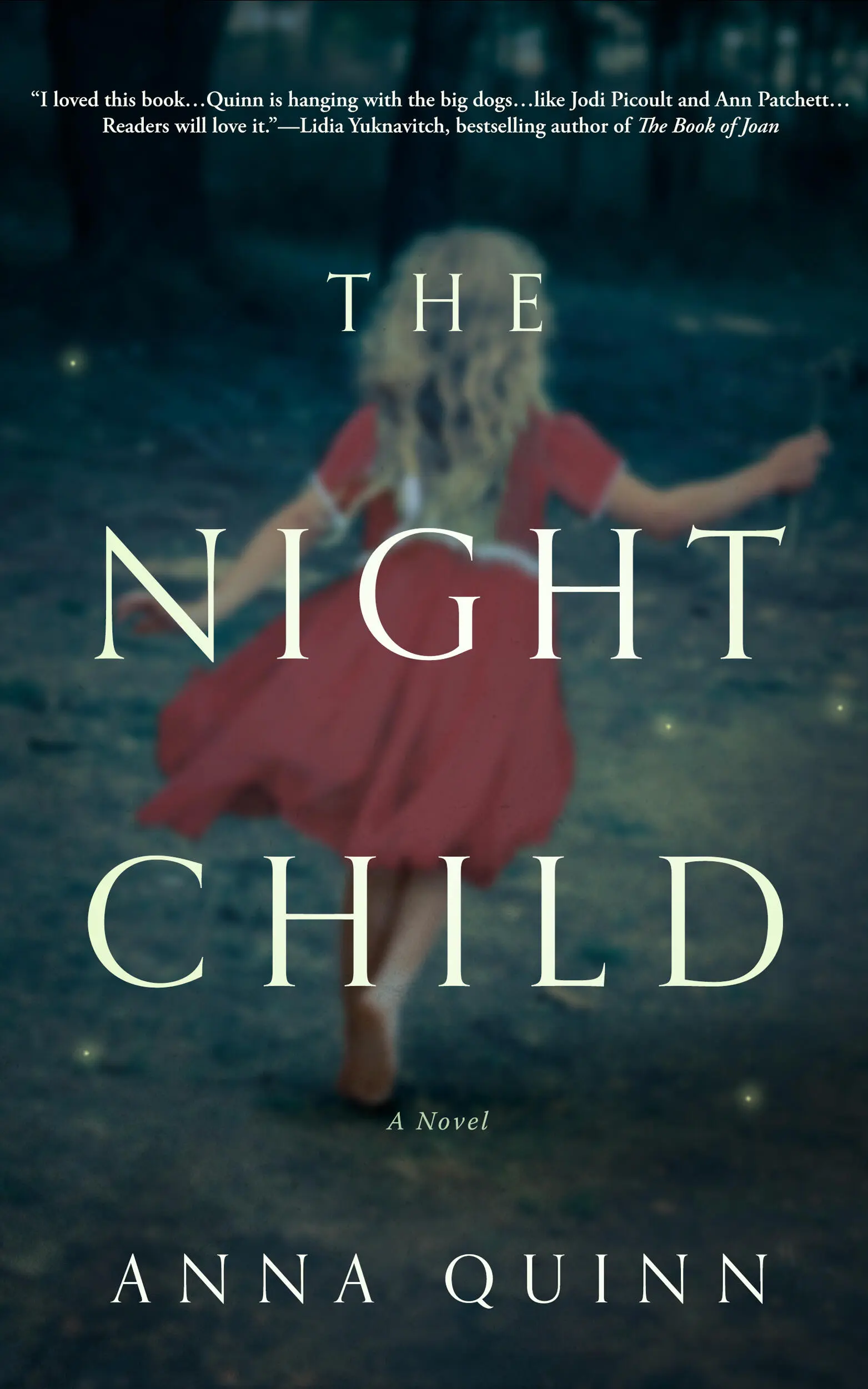
Anna Quinn - The Night Child
Здесь есть возможность читать онлайн «Anna Quinn - The Night Child» весь текст электронной книги совершенно бесплатно (целиком полную версию без сокращений). В некоторых случаях можно слушать аудио, скачать через торрент в формате fb2 и присутствует краткое содержание. Город: Ashland, OR, Год выпуска: 2017, ISBN: 2017, Издательство: Blackstone Publishing, Жанр: Современная проза, на английском языке. Описание произведения, (предисловие) а так же отзывы посетителей доступны на портале библиотеки ЛибКат.
- Название:The Night Child
- Автор:
- Издательство:Blackstone Publishing
- Жанр:
- Год:2017
- Город:Ashland, OR
- ISBN:978-1-5384-3433-8
- Рейтинг книги:4 / 5. Голосов: 1
-
Избранное:Добавить в избранное
- Отзывы:
-
Ваша оценка:
The Night Child: краткое содержание, описание и аннотация
Предлагаем к чтению аннотацию, описание, краткое содержание или предисловие (зависит от того, что написал сам автор книги «The Night Child»). Если вы не нашли необходимую информацию о книге — напишите в комментариях, мы постараемся отыскать её.
Twenty-four hours later, while on Thanksgiving vacation, the face appears again. Shaken and unsteady, Nora meets with neurologists and eventually, a psychiatrist. As the story progresses, a terrible secret is discovered—a secret that pushes Nora toward an even deeper psychological breakdown.
This breathtaking debut novel examines the impact of traumatic childhood experiences and the fragile line between past and present. Exquisitely nuanced and profoundly intimate, The Night Child is a story of resilience, hope, and the capacity of the mind, body, and spirit to save itself despite all odds.
The Night Child — читать онлайн бесплатно полную книгу (весь текст) целиком
Ниже представлен текст книги, разбитый по страницам. Система сохранения места последней прочитанной страницы, позволяет с удобством читать онлайн бесплатно книгу «The Night Child», без необходимости каждый раз заново искать на чём Вы остановились. Поставьте закладку, и сможете в любой момент перейти на страницу, на которой закончили чтение.
Интервал:
Закладка:
From that day on, Nora worried so much about collapsing into mortal sin that when she felt even a hint of her Irish rising up, she hid in her closet until the temper went away.
But now Maeve’s Irish is up, and she yanks Nora by her arm and throws her away from the table. “Get outside. Now.”
Nora runs to the screen door, kicks it open, and lets it bang LOUD behind her. She runs to the crabapple tree and wraps her arms around it, tears streaming down her cheeks.
And now, the sound of the screen door banging again, and she watches her father trudge with his briefcase to the garage. He is not going to look for her. He gets into his car, starts the engine, and backs up slowly. When he is next to her, he rolls the window down and calls, “Princess, it’ll be okay. I promise.”
She runs to him then, stands on her bare tip-toes and grips the bottom of the window frame with her small hands. The cold steel of the car presses through her cotton nightgown.
“Daddy, please don’t go. Please don’t leave me. Please, Daddy.”
“I’ll be home soon, princess,” he says, and he removes her fingertips from the window frame, puts his foot on the gas, and backs out of the driveway, leaving her there.
CHAPTER TEN: January 24, 1997
“It sounds like you were close to your father,” David says, taking off his glasses and cleaning them with the hem of his brown cardigan. It’s been a month since she’s seen him. She’d canceled two appointments, hadn’t felt she needed his help, hadn’t heard voices, hadn’t seen any floating faces. Even after throwing The Crabapple Fairy in the fire and realizing her father was still out there somewhere, she’d been okay, managed just fine. But lately, the anxiety was creeping back in, stealing her sleep, making her hard to get along with, making her pretend things—smiling while Fiona poured Cheerios and milk into her bowl, spilling half of it all over the table, and biting her tongue when she watched the evening news with Paul, him flipping channels and cursing at Clinton’s inauguration and Albright’s confirmation as first female secretary of state.
And so here she is. She’s told David about the fairy book and the crabapple tree. She stares at the window even though the blinds are shut, the flattened metal slats thick with dust. Yes, she had been close to her father. For years she’d thought of nothing but him, but then he had deserted her, left her suspicious and suspended between truth and reality. The angry fist of her heart begins to pummel her chest. He is twenty-seven years too late.
“Tell me what you remember.”
Her father’s hands on the wires of his cello. Music in their house on Sundays. Brahms and Beethoven and Mozart through the walls and ceiling. And sometimes his mouth on a harmonica. Once, a buddy of his from the war, Clem, came to visit. At dinner Clem told them how her father had played the harmonica in the barracks at night. “Soothed us low and smooth to sleep,” Clem said. “Low and smooth like cream.” Her father’s blue eyes had looked at his pork chops then, shy and quiet.
She pulls the raven pillow onto her lap, folds her hands on the raven’s wings. “He was a good businessman, I think. A vice president at Bank of Chicago.” She finds the zipper on the pillow and slowly zips and unzips it. Zip. Unzip. Zip. “And he had lots of friends. They’d come over on Saturday nights and drink scotch and play poker at the kitchen table once James and I were in bed.” Zip. Unzip. Zip. “He told us once how he was an only child, how lonely he was, how his parents died young in a car accident and he went to Marymount Military Academy in Tacoma because an uncle recognized his musical talent and Marymount had one of the finest music programs.”
Nora became aware that she was zipping and unzipping the pillow fast. She released it, tossed it to the other end of the couch. “He helped out a lot at church too—built a new sign and fixed the cross once when it broke in a tornado. The priest told me once how lucky I was to have such a kind father.”
“Did you feel lucky?”
Heat creeps into her face and crouches there. Sweat drips under her breasts.
“Yes,” she says, focusing on her folded hands. “Until he disappeared. I loved him more than anyone—until he disappeared.” It is difficult to say this aloud, and she wishes she still had the pillow to hold.
“I’m sorry,” David says.
“Anyway,” she says and shrugs.
“Nora,” he says, his voice soft. “Would you look at me for a moment?”
A slant of sun has slipped through a crack in the blinds, and she watches it light up his white hair. Another streak of light from a different crack stripes across his beard.
“What would you do if you ran into him on the street?” David asks. From the hallway the sound of a door slamming makes her jump. Her father could be right outside this building. And she is not ready. She is not ready to face the cauterized truth of him.
It is then that Nora sees the same disturbing twist in the air that blurred her vision in the classroom, in the hotel. She blinks, blinks, blinks rapidly to bring David’s face into her line of vision.
“Stay with the feeling,” David is saying. “Stay with the feeling, Nora. You are safe,” but it’s becoming difficult to hear him and she is going away and a gauzy curtain unrolls slowly, slowly from the ceiling and it is floating, floating between them, swaying there and now she is fading, fading like a memory into silence. Her eyes close.
“Just let go,” he says, sounding farther and farther away. “Let go. I’m right here. You are safe.”
She lets go.
And now a huge startling movement in her head, as if a sliding door has opened along her cerebral cortex, a continental shift from her left hemisphere to the right. She opens her eyes.
“Nora, can you hear me?”
“I am Margaret,” says a tiny voice.
“Nora?”
Margaret’s heart is banging, banging.
“Nora, is that you?”
“I am Margaret.”
“Margaret?”
“Please. Move away from me.”
David moves to the green chair by the window. “How’s that?” he says.
Now she doesn’t know what to say. He is acting very nice.
He asks softly, “Margaret, why are you here?”
Silence.
She wants to talk to him. She wants to tell him things.
“How old are you, Margaret?”
“Six.”
“Six. Well, Margaret, is there something you’d like to tell me?”
Margaret pulls her knees up to her chest and wraps her arms around them. She hides her face on her knees. She will be in big trouble now. She is not supposed to talk to anyone.
“It’s all right. You are safe,” he says.
She says nothing.
“Margaret?” he says. “Hello?” And then, a bit louder, “Nora?”
From a distance Nora hears David calling her name. She opens her eyes, slowly, her lids heavy. She is disoriented, the way one feels upon waking up in a hotel room. The kind of hotel room you stay in at the last minute because nothing else is available.
“Nora,” David says gently. “Just breathe.”
She fixes her eyes on him, and after a few moments, remembers where she is, who he is. He looks worried. She realizes her arms are wrapped around her knees, which are folded into her chest, and a ripple of confusion shoots through her. She thrusts her feet to the ground and folds her hands on her lap, trembling.
After a long silence he says, carefully, “What are you feeling?”
“I … I … I don’t know.” She brings her shaking hand up to her cheek, touches it as if she is unsure she exists.
“You’re okay. Take some deep breaths.”
Nora looks at him and shudders. Through chattering teeth she asks, “Why are you sitting over there?”
Читать дальшеИнтервал:
Закладка:
Похожие книги на «The Night Child»
Представляем Вашему вниманию похожие книги на «The Night Child» списком для выбора. Мы отобрали схожую по названию и смыслу литературу в надежде предоставить читателям больше вариантов отыскать новые, интересные, ещё непрочитанные произведения.









Обсуждение, отзывы о книге «The Night Child» и просто собственные мнения читателей. Оставьте ваши комментарии, напишите, что Вы думаете о произведении, его смысле или главных героях. Укажите что конкретно понравилось, а что нет, и почему Вы так считаете.