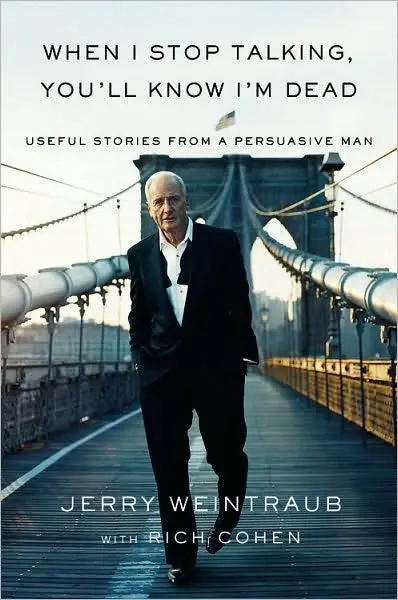
Jerry Weintraub - When I Stop Talking You
Здесь есть возможность читать онлайн «Jerry Weintraub - When I Stop Talking You» весь текст электронной книги совершенно бесплатно (целиком полную версию без сокращений). В некоторых случаях можно слушать аудио, скачать через торрент в формате fb2 и присутствует краткое содержание. Жанр: Современная проза, на английском языке. Описание произведения, (предисловие) а так же отзывы посетителей доступны на портале библиотеки ЛибКат.
- Название:When I Stop Talking You
- Автор:
- Жанр:
- Год:неизвестен
- ISBN:нет данных
- Рейтинг книги:4 / 5. Голосов: 2
-
Избранное:Добавить в избранное
- Отзывы:
-
Ваша оценка:
When I Stop Talking You: краткое содержание, описание и аннотация
Предлагаем к чтению аннотацию, описание, краткое содержание или предисловие (зависит от того, что написал сам автор книги «When I Stop Talking You»). Если вы не нашли необходимую информацию о книге — напишите в комментариях, мы постараемся отыскать её.
In WHEN I STOP TALKING, YOU'LL KNOW I'M DEAD, we follow Weintraub from his first great success at age twenty-six with Elvis Presley, whom he took on the road with the help of Colonel Tom Parker; to the immortal days with Sinatra and Rat Pack glory; to his crowning hits as a movie producer, starting with Robert Altman and Nashville, continuing with Oh, God!, The Karate Kid movies, and Diner, among others, and summiting with Steven Soderbergh and Ocean's Eleven, Twelve, and Thirteen.
Along the way, we'll watch as Jerry moves from the poker tables of Palm Springs (the games went on for days), to the power rooms of Hollywood, to the halls of the White House, to Red Square in Moscow and the Great Palace in Beijing-all the while counseling potentates, poets, and kings, with clients and confidants like George Clooney, Bruce Willis, George H. W. Bush, Armand Hammer, Brad Pitt, Matt Damon, Bob Dylan, Led Zeppelin, John Denver, Bobby Fischer…well, the list goes on forever.
And of course, the story is not yet over…as the old-timers say, "The best is yet to come."
As Weintraub says, "When I stop talking, you'll know I'm dead."
With wit, wisdom, and the cool confidence that has colored his remarkable career, Jerry chronicles a quintessentially American journey, one marked by luck, love, and improvisation. The stories he tells and the lessons we learn are essential, not just for those who love movies and music, but for businessmen, entrepreneurs, artists… everyone.
When I Stop Talking You — читать онлайн бесплатно полную книгу (весь текст) целиком
Ниже представлен текст книги, разбитый по страницам. Система сохранения места последней прочитанной страницы, позволяет с удобством читать онлайн бесплатно книгу «When I Stop Talking You», без необходимости каждый раз заново искать на чём Вы остановились. Поставьте закладку, и сможете в любой момент перейти на страницу, на которой закончили чтение.
Интервал:
Закладка:
"This is Jerry Weintraub," I told her. "I've got to talk to Frank."
"I'm sorry," she said. "Mr. Sinatra is not available."
"What the hell are you talking about?" I said. "We have a show tonight! At 8:00 P.M., we go live around the world."
"I'm sorry," she said "but he's indisposed."
Click.
I kept calling, but he never got on the phone.
At 2:00 P.M. a note arrived from Sinatra. It was his set list, the songs he planned to sing. It was ridiculous, absurd. I could not believe what was on there. "Crocodile Rock," "Disco Inferno."
To hell with this! I jump in a cab and head over to the Waldorf.
I went through the lobby, up the elevator, knocked on the door. I was in a panic. Clearly, Sinatra was not. He was, in fact, sitting in his bathrobe, smoking a cigarette as he read the newspaper. I went over, holding the set list.
"What is this?" I asked.
"What's what?" he said.
"These songs."
He laughed. His hair was pushed back and every part of him glittered. His funk had clearly lifted. "Forget the list," he said. "I wanted to see you, and figured that list would get you here quicker than a phone call."
"Okay, great," I said, "why did you want to see me?"
"Because you've been calling every eight minutes. What do you need, Jerry?"
"Well, I'll tell you," I said. "We have a live show in five hours, Frank. I need you to come to the Garden."
"No, Jerry, you said no rehearsal, remember? Live?"
"Yeah, I remember, but this thing has grown."
"Don't worry, Jerry."
Sinatra obviously had a plan in mind, but he was not sharing it with me.
"Well, I am worried," I said. "Can't we just do a quick run-through?"
"No, Jerry, no rehearsal. That's what you said. I will be there when the show starts. That's when you need me. Not before."
At 7:30 P.M., his limo pulled into Madison Square Garden. The streets were filled with scalpers and fans-and that special electricity only Frank could generate. He had arrived with a police escort, sirens, flashing lights. He climbed out, straightened his tux, tossed away a cigarette, took my arm, and asked, "How you doing, kid?"
"Not great," I said.
"We'll fix that in a minute," he told me. "First, remember to tell your wife, Jane, to get in the car when I start singing 'My Way.' I want to go by Patsy's and pick up some pizzas for the plane."
So that was what he was thinking about-not the show, not the commercial breaks, not the slender thread that was holding me above the flames of oblivion, but the pizzas he would eat on the way back to Palm Springs.
As we were walking to the dressing room, his entourage trailing behind us, he said, "Okay, Jerry. What's the problem?"
"We're going to commercial six times in this hour," I told him, "and this is a live show, and you don't know when to break."
"Jerry, is there a kid around here with a red jacket?" he asked.
"I'm sure we can get one," I said. "Why?"
"Have a kid in a red coat stand up ringside with a sign that says 'five minutes,' " he said. "When I see him, I will start 'My Way.' "
"Okay," I said, "but what are you going to do during the six commercial breaks?"
He said, "I'm going to sing, Jerry. That's what I am going to do. When you go to commercial, I will be singing and when you come back, I will still be singing. That's live."
He taught me about spontaneity that night-this, too, helped me as a film producer. Live, let it happen. There's never a better take than the first: Sinatra knew that in his bones.
If you watch a tape of the "Main Event," you see me and Sinatra walk out of the dressing room and down the aisle side by side. He is Muhammad Ali and I am Cus D'Amato, the trainer, the cut man, the voice in the ear, saying, "You are the champ! It's yours! Now get in there and murder the bum!" I was, in fact, as white as a sheet, shuffling as if to my own funeral. You hear Cosell going though his routine: "… Here, coming through the same tunnel that so many champions have walked before, the great man, Frank Sinatra, who has the phrasing, who has the control, who knows what losing means, who made the great comeback, and now stands still, eternally, on top of the entertainment world…" Just before we went out, when the music started Sinatra leaned over me-well, I was a lot taller than Frank, so he looked up, but it felt like he was leaning over me, you know? And he asked, "How you doing now? Better?"
"No," I said, "not better."
"What the hell's the matter with you?" he said.
"Frank"-or Francis, that's what I said-"this is going live around the world, we have not rehearsed and have no markers or breaks. It could be the end of my career."
He pinched my cheek and said, "Listen, kid. You got me into this, and I'm going to get you out."
And he went through the ropes, and the music started, and it was all Frank from there. He was a genius. He held the crowd in his hand. "The Lady Is a Tramp," "Angel Eyes," "My Kind of Town," they poured out of him like Norse sagas. When he sang "Autumn in New York," it was as if he were leaning on a bar, spilling his guts out to a late-night, Hopperesque bartender.
Who thought this could work, intimacy in an arena filled with thousands and thousands of people, but he pulled it off. He turned the Garden into a shadowy, three-in-the-morning, Second Avenue saloon. You could have heard a pin drop.
Then, just like that, when it seemed no more than a moment had passed, the kid walked the aisle in the red coat and Frank launched into "My Way." The ignition was turned in the limo, the pizzas were pulled from the ovens, the plane raced down the runway, and we were laughing and eating pepperoni as the jet climbed into the stratosphere.
Firing Ferguson
Around this time, in 1978, Jane and I purchased land in Malibu and built the house where she still spends much of the year. I describe it as a beach shack, but it really is one of the great California houses, a compound more than a house, with stables and guest quarters and trails that run across six acres on the Pacific coast, where the land juts out and Catalina Island rises into view. If you leave Beverly Hills at 2:00 P.M., heading north on the Pacific Coast Highway, with the sea on your left and the hills rising steeply on your right, you will arrive before three, finally passing through a gate marked "Blue Heaven."
In the midseventies, Jane and I threw a lot of parties. She calls it the era of "extreme entertaining." We had people over most nights, the rooms filled with music and movie types, the windows glittering, laughter spilling onto the beach, where I stand with a bottle of wine knee deep in the surf. In the garage in Malibu, we have posterboard-size pictures taken in those bygone days. Jane with Walter Winchell. Jane with Darryl Zanuck and John Wayne. Jane, at a dinner party, with three different kinds of crystal in front of her, seated between Frank Sinatra and Cary Grant.
By then, my touring company, Concerts West, was booming. But no matter how well I was doing, I was always on the lookout for the new artist, the next big thing. When I think back on those years, it's me going from club to club, sitting at cocktail tables, meeting artists in cramped dressing rooms, pitching, cajoling, selling. (Breaking a new act is a special high; some agents spend their careers chasing it.) My most noteworthy find of those years was John Denver, who, as far as I am concerned, I cooked from scratch. By examining how I dealt with John Denver you can get a pretty good sense of the task and challenge of the manager, how he finds and builds an act, and how that act will eventually break his heart.
John was a military brat. His childhood was spent moving base to base, New Mexico, Arizona, Alabama, Texas. His real name was John Deutschendorf Jr. His father was an amazing guy, a test pilot and flight instructor who often seemed confused by his kid. The love of music and songwriting, the long hair and pursuit of beauty-where did they come from? John left home as soon as he was of age. He traveled the country with a guitar and a notebook of songs. He was going to write about everything, all of it, the mountains and plains, the continental divide, set it to music. He made a few solo records, which went nowhere, then scored one big success, "Leaving on a Jet Plane," which went top ten when recorded by Peter, Paul, and Mary, who, by the way, I managed. But his first real break came in the midsixties, when, answering an open audition, he won a spot in the Chad Mitchell Trio, a hot New York folk act.
Читать дальшеИнтервал:
Закладка:
Похожие книги на «When I Stop Talking You»
Представляем Вашему вниманию похожие книги на «When I Stop Talking You» списком для выбора. Мы отобрали схожую по названию и смыслу литературу в надежде предоставить читателям больше вариантов отыскать новые, интересные, ещё непрочитанные произведения.
![Сьюзан Кейн - Quiet [The Power of Introverts in a World That Can't Stop Talking]](/books/33084/syuzan-kejn-quiet-the-power-of-introverts-in-a-wo-thumb.webp)










Обсуждение, отзывы о книге «When I Stop Talking You» и просто собственные мнения читателей. Оставьте ваши комментарии, напишите, что Вы думаете о произведении, его смысле или главных героях. Укажите что конкретно понравилось, а что нет, и почему Вы так считаете.