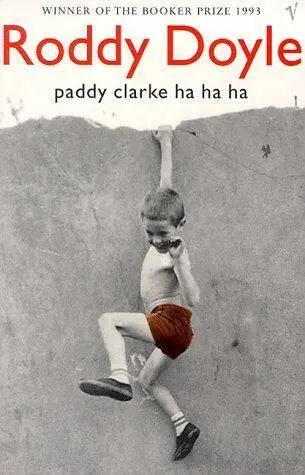
Roddy Doyle - Paddy Clarke, Ha Ha Ha
Здесь есть возможность читать онлайн «Roddy Doyle - Paddy Clarke, Ha Ha Ha» весь текст электронной книги совершенно бесплатно (целиком полную версию без сокращений). В некоторых случаях можно слушать аудио, скачать через торрент в формате fb2 и присутствует краткое содержание. Жанр: Современная проза, на английском языке. Описание произведения, (предисловие) а так же отзывы посетителей доступны на портале библиотеки ЛибКат.
- Название:Paddy Clarke, Ha Ha Ha
- Автор:
- Жанр:
- Год:неизвестен
- ISBN:нет данных
- Рейтинг книги:5 / 5. Голосов: 1
-
Избранное:Добавить в избранное
- Отзывы:
-
Ваша оценка:
Paddy Clarke, Ha Ha Ha: краткое содержание, описание и аннотация
Предлагаем к чтению аннотацию, описание, краткое содержание или предисловие (зависит от того, что написал сам автор книги «Paddy Clarke, Ha Ha Ha»). Если вы не нашли необходимую информацию о книге — напишите в комментариях, мы постараемся отыскать её.
The 1993 Booker Prize-winner. Paddy Clarke, a ten-year-old Dubliner, describes his world, a place full of warmth, cruelty, love, sardines and slaps across the face. He's confused; he sees everything but he understands less and less.
Paddy Clarke, Ha Ha Ha — читать онлайн бесплатно полную книгу (весь текст) целиком
Ниже представлен текст книги, разбитый по страницам. Система сохранения места последней прочитанной страницы, позволяет с удобством читать онлайн бесплатно книгу «Paddy Clarke, Ha Ha Ha», без необходимости каждый раз заново искать на чём Вы остановились. Поставьте закладку, и сможете в любой момент перейти на страницу, на которой закончили чтение.
Интервал:
Закладка:
– What did she mean?
– It’s none of her business what we do with it, said Liam.
We got Edward Swanwick onto the ground and tried to get his mouth open. It was easy; there were ways of doing it. Keeping it open was the problem. Kevin started pouring the Persil onto his face; Liam held Edward Swanwick’s head by the ears so he couldn’t get his face away; I held his nose and pinched his diddy. Some of the Persil got in. Edward Swanwick was gagging and shuddering, trying to shake us off. It was in his eyes as well. The box was empty. Kevin shoved it up Edward Swanwick’s jumper and we let him up. He didn’t say anything. He couldn’t; if he didn’t pretend he’d enjoyed himself he was gone, out of the gang. He got sick; not much, mostly the Persil.
That was the type of thing we robbed, mostly. Sweets were hard, up at the counter, hard to get at because of the glass and the women. They guarded the sweets because they thought that no one would be bothered robbing the other stuff. They didn’t understand. They didn’t understand that robbing had nothing to do with what we wanted; it was the dare, the terror, the getting away with it.
It was always women. There were about six shops between Raheny and Baldoyle that we raided. There were no supermarkets yet, just grocers and shops that sold everything. Once, when we were out on a walk, Ma asked for the Evening Press, four Choc-pops, a packet of Lyons Green Label and a mouse trap and the woman was able to get them all without stretching. I was a bit nervous: I’d robbed a box of Shredded Wheat out of there a few days before and I was afraid she’d recognise me. I minded the pram while my ma talked to her, about the weather and the new houses.
We only robbed when the weather was nice. We never robbed in Barrytown. That would have been stupid. There was Missis Kilmartin’s one-way glass, but that wasn’t all; the people in the shops were friends with our parents. They’d all got married and moved to Barrytown at the same time. They were all pioneers, my da said. I didn’t know what he meant but he liked saying it; he loved going down to the shops and meeting and talking to the owners, except Missis Kilmartin. He told me that Mister Kilmartin was locked up in the attic.
– Don’t listen to him, said my ma. -He’s in the British Navy.
– In a ship?
– I think so.
– Anywhere except at home, said my da.
He’d just fixed the wonky kitchen chair so he was feeling a bit proud of himself; you could tell by the way he kept sitting on it and looking down at the legs and trying to rock it.
– That’s grand now, he said. -Isn’t it?
– Smashing, said my ma.
The grocer in Barrytown was a man, a nice one, Mister Fitzpatrick. He gave you more broken biscuits than you were entitled to. He was huge. He leaned over you. I remembered when I was small, he stepped over me. We’d never have robbed off Mister Fitz. He’d have known what we were up to, and everyone loved him. Our parents would have killed us. Missis Fitz sat on a chair in the front door when the weather was nice, like an ad for the shop. She was lovely looking. They had a daughter, Naomi; she was in secondary school. She was as nice looking as her mother. She worked in the shop on Saturdays, after school; filled the cardboard boxes, the weekend orders for all the houses in Barrytown. Kevin’s brother did the deliveries on a colossal black bike with a basket in the front. He got seven and six for it. He said Naomi could open bottles of Fanta with her gee. I wanted to kill him when he said that. I wanted to save Naomi.
Get the biggest box. It was Kevin’s idea. It was great. Whoever got the thing in the biggest box out of the shop, he won. It had to be a full box; that was one of the first rules, after Liam came out of a shop with an empty one, a huge one that had had boxes of Cornflakes inside it. You couldn’t do this in any shop. You had to be careful. Most of the shops had their own specialities, although the women behind the counter didn’t know this. The one in Raheny was great for robbing magazines; the comics were up on the counter, too near the noses of the three ancient women that patrolled the counter. The magazines, though, were much easier. The women were saps: they thought that we wouldn’t be interested in women’s magazines and knitting magazines, so they put them on a rack right beside the door so they’d look nice in the window. Another thing, they served grown-ups first, always. I waited for the right moment. I was outside, tying my lace. A woman went in; the three old women dashed to serve her and I leaned in and grabbed five Women’s Weeklys. I brought them down the lane beside the new library and we tore them up. I once got a Football Monthly out of the window rack. I couldn’t believe it when I saw it there. They must have run out of room on the counter. I thought for a sec that they might have put it there as bait. I thought about it; I looked around. I took it. There was another shop that invited you to rob their biscuits. It was in Baldoyle. The tins of biscuits – the loose ones – were on a ledge that ran along the counter, just under it. You could fill your pockets while the woman counted your aniseed balls. One box had Milk-choc Goldgrain in it, the only chocolate ones. We’d queue up in front of that box, waiting our turn. She thought we were being polite. It was dark in the shop; she must never have seen the crumbs.
For boxes, we went to Tootsie’s.
– A quarter of jelly babies, Tootsie; all boys.
Tootsie was in charge of this big manky shop up a bit from where we swam at the seafront. The windows were wasps’ graveyards; they dried and cracked in the sun. We added some. We collected them, and bees, in jars, watched them dying and milling each other, then went up to Tootsie’s and poured them all over the stuff in the window when Tootsie wasn’t looking. We’d have done it even if she was looking; she looked at you and didn’t see anything; it took ages for her face to catch up. Tootsie didn’t own the shop. She minded it for someone. She did everything in slow motion, everything. Sometimes there was even an action replay; she’d pick up something again, dead slow-ow-owly, to check the price again. She wrote the price of everything on a paper bag, real neat; she used a ruler to do the line under the numbers. Then she did the sum, but she stopped and started again all the way, like she was climbing down a ladder with wobbly rungs. That was when you could have walked out of the shop with anything. We robbed her steps, the ones she used for the top shelves. I took one end and Kevin took the other. The woman Tootsie was serving wasn’t from our place. We didn’t know her. We made it look like we were helping Tootsie, kept our faces serious. We threw the steps into the sea. It made a good noise but not much of a splash. We stood on them when the tide was half-in to make it look like we were walking on the water. You could ask Tootsie anything.
– D’you sell cars, Tootsie?
– No.
She thought about it first.
– Why not?
She just looked.
– D’you sell rhinoceroses, Tootsie?
– No.
You could see the track-marks of Tootsie’s fingers in the cream in the cakes on the tray on the fridge behind the counter. The cream was yellow, the tracks hard and permanent. The fridge was small and fat, for ice-pops and blocks of ice-cream. I crept behind the counter and pulled out the plug.
There was a bakery in Raheny guarded by two women. It had the best smell of any shop. It wasn’t bread; it wasn’t a rushing smell, like steam surrounding you. It was quieter, part of the air, not warm and smothering and upsetting. The smell made me feel good. The cakes were on shelves inside the all-glass counter, not stacks of them, a few of each on plates two feet apart down the shelves; small cakes, not huge things exploding with cream. The cakes were bright, hard in a nice way – biscuits that were too good to be called biscuits. Like cakes in a fairy tale; you could have built things out of them. I didn’t know where the baking got done. There was a door at the back but the women always closed it when they were coming and going, never together – there was always one of them behind the counter, knitting. They both knitted. They might have been having a race. They were very fast. We couldn’t go in there to look around; we couldn’t pretend we were looking for something. There was just the counter, and the shelves under it. We looked in the window. Sometimes I’d have enough money for a cake. They weren’t as nice as they looked. And I’d have to share. You had to hold the cake so that most of it was behind your fingers, safe, so the others could only get a small bite.
Читать дальшеИнтервал:
Закладка:
Похожие книги на «Paddy Clarke, Ha Ha Ha»
Представляем Вашему вниманию похожие книги на «Paddy Clarke, Ha Ha Ha» списком для выбора. Мы отобрали схожую по названию и смыслу литературу в надежде предоставить читателям больше вариантов отыскать новые, интересные, ещё непрочитанные произведения.





Обсуждение, отзывы о книге «Paddy Clarke, Ha Ha Ha» и просто собственные мнения читателей. Оставьте ваши комментарии, напишите, что Вы думаете о произведении, его смысле или главных героях. Укажите что конкретно понравилось, а что нет, и почему Вы так считаете.