David Storey - Saville
Здесь есть возможность читать онлайн «David Storey - Saville» весь текст электронной книги совершенно бесплатно (целиком полную версию без сокращений). В некоторых случаях можно слушать аудио, скачать через торрент в формате fb2 и присутствует краткое содержание. Жанр: Современная проза, на английском языке. Описание произведения, (предисловие) а так же отзывы посетителей доступны на портале библиотеки ЛибКат.
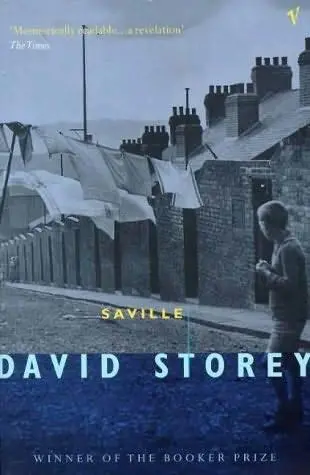
- Название:Saville
- Автор:
- Жанр:
- Год:неизвестен
- ISBN:нет данных
- Рейтинг книги:5 / 5. Голосов: 1
-
Избранное:Добавить в избранное
- Отзывы:
-
Ваша оценка:
Saville: краткое содержание, описание и аннотация
Предлагаем к чтению аннотацию, описание, краткое содержание или предисловие (зависит от того, что написал сам автор книги «Saville»). Если вы не нашли необходимую информацию о книге — напишите в комментариях, мы постараемся отыскать её.
The Man Booker Prize
Set in South Yorkshire, this is the story of Colin's struggle to come to terms with his family – his mercurial, ambitious father, his deep-feeling, long-suffering mother – and to escape the stifling heritage of the raw mining community into which he was born. This book won the 1976 Booker Prize.
Saville — читать онлайн бесплатно полную книгу (весь текст) целиком
Ниже представлен текст книги, разбитый по страницам. Система сохранения места последней прочитанной страницы, позволяет с удобством читать онлайн бесплатно книгу «Saville», без необходимости каждый раз заново искать на чём Вы остановились. Поставьте закладку, и сможете в любой момент перейти на страницу, на которой закончили чтение.
Интервал:
Закладка:
Reagan had grown taller over the previous year; he too, in response to Bletchley’s challenge, had taken to wearing long trousers; they emphasized his now almost skeletal figure with its massive, bulbous head. Occasionally he could be seen walking across the backs, his hands in his pockets, glancing in windows and open doors and recoiling abruptly whenever someone called. He had been moved to a private school in the city, and each morning his mother took him to the station to catch the train, waiting for him on the platform of the village station each evening and walking back up to the village with him, hand in hand.
‘They mu’n be getting married soon,’ his father said whenever he saw them pass the window. ‘Reagan’s not got a look-in where yon lad’s concerned.’
‘It’s because he’s sensitive,’ his mother said. ‘He’s always been sensitive, even as a baby. She’s always had to look after him,’ she added.
‘He’d be less sensitive if he’d had a boot up his backside,’ his father said. ‘I’d de-sensitize him inside a week if I had him in this house.’
‘Oh, we know how sensitive you are,’ his mother would add.
‘Sensitive? I’m sensitive,’ his father said. ‘I’m more sensitive than yon streak o’ whitewash.’
‘Yes: and we know that, Colin, don’t we, love? We know how sensitive your father is,’ she’d tell him.
‘I’m sensitive enough to work in that pit,’ he’d add.
‘Are you?’
‘And give you a decent living.’
‘Do you?’
‘And you can’t get more sensitive’, he’d say, ‘than that.’
Steven had started school. He spent a lot of his time now out of the house, coming in at meal-times. But for the fact that they slept together Colin would scarcely have seen him. His brother had a pale, feather-like existence: built broadly like himself, he floated from one interest to another, running constantly from one demand to another, from one group of boys to another, his laughter frequently, whenever he was excited, filling the backs, a loud, harsh, almost hen-like cackle.
The baby he scarcely noticed. It was almost standing, prematurely, straight-backed, its tiny legs thrust out, its eyes light blue; it had a ferocious, almost obsessive energy; if it wasn’t watched it would crawl out to the yard, and once in the yard would disappear, finding its way to the street, on some occasions to the Battys’ kitchen, on others across the field to the street the other side. His mother would endlessly be endeavouring to restrain it, her cries of vexation ringing round the house while Colin in his room would be trying to do his work, calling down to her in the end, ‘Mother, I can’t work if you go on shouting.’
‘And what am I supposed to do? Talk to it in sign language?’ she’d call from the stairs.
‘I just can’t work with all that noise.’
‘Richard, come here!’ she’d shout, distracted immediately by the child again.
He took it for walks occasionally on Sunday mornings. Sometimes, if he had nothing better to do, Bletchley came with him; they would go to the Park.
‘The Park and nothing else,’ his mother would say. ‘I might be walking out that way and I’ll be popping in to have a look.’
‘You could take him in that case, then,’ he’d say.
‘Harry,’ his mother would call, ‘can you hear the way he talks?’
‘Just hold your tongue when you talk to your mother,’ his father would add.
‘It’s that I feel silly pushing out the pram,’ he said.
‘And you’d feel silly doing some of the things I’ve had to do,’ his father would call, invariably, during these incidents, preoccupied in some other room of the house.
‘Why can’t we just leave him in the yard?’ he would ask his mother.
‘Because he never stays in the yard,’ his mother said. ‘In any case, I would have thought you’d have been proud to take your brother out.’
‘Well, I’m not,’ he said, yet beneath his breath, afraid of the retribution this sentiment might bring.
‘I don’t know why you have to bring him,’ Bletchley would add, kicking the wheels of the pram as they walked along.
Yet, despite his resentment, he and Bletchley and Richard, and sometimes even Steven, continued to go to the Park on Sunday mornings. Groups of other children would be wandering there, girls from Bletchley’s school with whom Bletchley himself exchanged insults and occasionally, whenever he could get near them, blows. It was the prospect of seeing the girls from the school which took them there and which, later, sustained them during the tedious hour and a half of Sunday School; afterwards, freed of the pram, they would wander round the paths of the Park, and occasionally along the tracks that led across the fields beyond, following diminutive, skirted figures who, to Bletchley’s taunts and jeers, would frequently, turning, call insults of their own: ‘Fatty,’ and ‘Belcher,’ and ‘Who’s your friend, then, Belch? Hasn’t he got his pram?’
Bletchley gave him glowing accounts of his life at school, of episodes in the bushes which surrounded the building, a converted manor, and of even more lurid incidents which took place in the actual rooms. It was a long way from King Edward Grammar, and even farther from the impression he got of Bletchley himself, who, by reputation, was as actively despised at school as he was in the village; he felt a strange loyalty to his friend, his portly figure, and felt drawn to defend him whenever, in Bletchley’s presence, he was ridiculed or attacked.
‘Belcher’s all right,’ he would say to Batty who whenever he saw the gargantuan figure, would immediately run after him shouting, ‘Show us your knee-caps, Belch,’ or, ‘Lend us half your suit.’
‘He’s all right: he’s all right as an advertisement for plum-puddings,’ Batty would tell him, adding on one occasion, ‘Do you want a fight or something? If I want to shout after Belch I bloody shall.’
They’d fought then for half an hour; the fight had drifted from the street: they fought in the yard of a house and then the field. He fought Batty as if he had been preparing for it now for years; he felt calm, preoccupied, self-possessed, hitting Batty strongly, refusing to be bound up in his looping arms. Blood came out on Batty’s face; he was aware of Batty’s brothers coming to the field, and of other figures standing in the yard and along the fences. Reagan’s voice called out: ‘Hit him, hit him harder,’ his waist-coated figure collarless, red-faced, standing by the fence.
Batty finally had pinned him to the floor, beating him about his eyes and mouth: he flung his fists up at the reddened figure but Batty knelt casually above him, out of reach.
‘Go on, go on, our kid,’ his brothers called.
Batty got up. Aware of his brothers’ shouts he paused. He wiped his mouth on the back of his hand.
‘Go on, bash him,’ his brothers called.
Batty turned aside; he glanced back at Colin briefly as he got to his feet, then went on towards his house.
‘Go on, our kid,’ his brothers called.
‘Nay, he mu’n have fought him fair.’ His father had come out from the house and stood by the fence.
Reagan had already turned towards his door.
‘He fought fair: you can’t say better than that,’ his father called.
Farther along the terrace he saw Batty climbing the fence.
‘Thy ought to have beaten him,’ his father said. ‘Go under his guard, not try to stand outside. With fellers like that you’ve to go beneath.’
‘I suppose you’re satisfied,’ his mother said, standing at the door as they reached the house. ‘And what was it all about?’ she added.
‘Nothing,’ he said.
‘It looks like nothing. Just look at your eyes: they’re almost closed.’
Читать дальшеИнтервал:
Закладка:
Похожие книги на «Saville»
Представляем Вашему вниманию похожие книги на «Saville» списком для выбора. Мы отобрали схожую по названию и смыслу литературу в надежде предоставить читателям больше вариантов отыскать новые, интересные, ещё непрочитанные произведения.









Обсуждение, отзывы о книге «Saville» и просто собственные мнения читателей. Оставьте ваши комментарии, напишите, что Вы думаете о произведении, его смысле или главных героях. Укажите что конкретно понравилось, а что нет, и почему Вы так считаете.