Eugene Vodolazkin - The Aviator
Здесь есть возможность читать онлайн «Eugene Vodolazkin - The Aviator» весь текст электронной книги совершенно бесплатно (целиком полную версию без сокращений). В некоторых случаях можно слушать аудио, скачать через торрент в формате fb2 и присутствует краткое содержание. Город: London, Год выпуска: 2018, ISBN: 2018, Издательство: Oneworld Publications, Жанр: Современная проза, на английском языке. Описание произведения, (предисловие) а так же отзывы посетителей доступны на портале библиотеки ЛибКат.
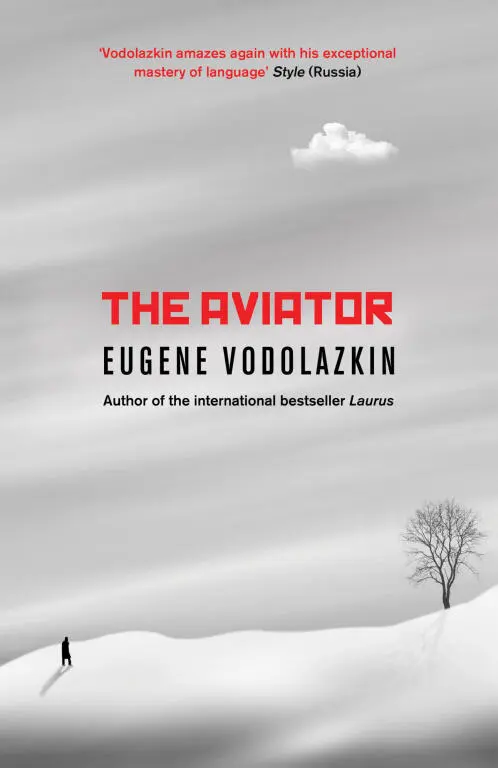
- Название:The Aviator
- Автор:
- Издательство:Oneworld Publications
- Жанр:
- Год:2018
- Город:London
- ISBN:978-1-78607-271-9
- Рейтинг книги:4 / 5. Голосов: 2
-
Избранное:Добавить в избранное
- Отзывы:
-
Ваша оценка:
The Aviator: краткое содержание, описание и аннотация
Предлагаем к чтению аннотацию, описание, краткое содержание или предисловие (зависит от того, что написал сам автор книги «The Aviator»). Если вы не нашли необходимую информацию о книге — напишите в комментариях, мы постараемся отыскать её.
Reminiscent of the great works of twentieth-century Russian literature, with nods to Dostoevsky’s
and Bulgakov’s
,
cements Vodolazkin’s position as the rising star of Russia’s literary scene.
The Aviator — читать онлайн бесплатно полную книгу (весь текст) целиком
Ниже представлен текст книги, разбитый по страницам. Система сохранения места последней прочитанной страницы, позволяет с удобством читать онлайн бесплатно книгу «The Aviator», без необходимости каждый раз заново искать на чём Вы остановились. Поставьте закладку, и сможете в любой момент перейти на страницу, на которой закончили чтение.
Интервал:
Закладка:
Geiger is a person of rules. He likes a phrase because it formulates a rule. His strength (he is absolutely reliable) is in rules, but there is a weakness there, too: he fears exceptions. I am sure that Geiger understands that life is more complicated than any diagrams, but at the same time, he values them. For him, this is a question of the world’s orderliness. In Russian life, though, the exception is the rule, it’s just that Geiger doesn’t understand that. Or rather he does not accept it.
One topic yesterday was bumps and bruises that allegedly automatically engender experience. Bruises subjected to processing are what experience is: that is exactly what was said. But that isn’t how it seems to me. Meaning it’s possible that bruises can engender experience. But they might not. My main impressions, for example, are not connected with bruises, though I had oh so many bruises. In the literal sense, at that.
MONDAY [NASTYA]
Today I managed to reach an agreement for renting out my grandmother’s apartment. It all came together quickly, what can I say. I told Platosha that I hadn’t run up the price and was rewarded for moderation. He kissed me on the nose. His gaze was absent; details like that don’t interest him. I rubbed my nose on his chin.
‘Do you understand, you bonehead, that it’ll be easier for us to live now?
‘The main thing,’ he answered, ‘is to live, the rest will somehow follow.’
‘Effort, by the way, is needed for it to follow.’
It works out that I’m earning the riches for the two of us. Does that make me bitter? Not at all. It would be a catastrophe if Platosha began earning the riches, too. He and I are both strong in that we’re different and complement one another. That’s called an ideal marriage. I envelop his life in comfort and he makes up for everything he missed out on when he was frozen.
He reads a lot. There are two stacks of books by our bed: the one on his side is large and, well, mine is small. I flipped through Platonov’s collection yesterday: history, philosophy, literature. Nothing to sneeze at. And what’s in my pile… it’s mortifying to even talk about that. Detective and romance novels. Items predominantly for us ladies. Written in Russia.
My books can always be set aside, even thrown away, but Platosha’s, well, no can do. Ugh… This is something that makes me jealous. I crawl under his hand and whisper:
‘Are you very busy, Innokenty Petrovich?’
He laughs. Asks forgiveness. He asks this very zealously and I resist feebly. It turns out that I’m more interesting than the book that’s flying to the floor. It lies there, flattened, its cover facing up, observing our finale and apotheosis. I look at it from time to time. And so, on a nice high note, my eyes meet with Arnold Toynbee, for example. This disheartens me a little. The most touching thing is that a minute later my Platonov reaches over me for the book and gets down to reading again. Right now, as I write, he’s reading a book about how the USSR conquered the cosmos. Somehow unexpected.
Is it very awful that I, a pregnant woman, am doing gymnastics like this? I’ll need to ask the doctor.
TUESDAY [INNOKENTY]
Today I read a book about Solovki: it describes the Kem transit camp. That, as it happens, is the place I last saw my cousin Seva. Somehow, I do not want to write about that.
WEDNESDAY [GEIGER]
Innokenty told me that ‘a certain Belkov’ from the government called him. He spoke with him for a fairly long time.
Of course he meant Zheltkov. A person who’s well known to everyone but Innokenty. Zheltkov offered all kinds of support. He left his phone number so Innokenty can call him if need be. He promised to ‘stop by for tea’ if he’s in Petersburg.
Sehr demokratisch. [4] Very democratic (Germ.).
WEDNESDAY [NASTYA]
Zheltkov from the government called Platosha. Zheltkov himself. He offered ‘all kinds of support.’ True, as someone noted, it’s worth doubting when they offer all kinds of support: a proposal like that carries no obligation. But I think Zheltkov’s beside the point here: what can he offer if Platosha doesn’t need anything?
And Platonov’s quite something himself: he talked without any particular emotion, quite impassively, one might say. Without exaggerated (ah!) joy, even without any agitation that’s difficult to suppress, meaning v. calmly. I waved a hand in front of him, to say: Come back to life a little. Inside, I was proud of my Platonov: the country’s leadership is calling him and he’s talking like that, no fuss. Like a man.
THURSDAY [INNOKENTY]
Of course Geiger isn’t as straightforward as I described him in recent days. I’m striking back at him about Nastya’s pragmatism. He already understands that words like that wound me and now he’s keeping quiet. It is best to be quiet, Geiger… And so: though I exaggerated something in my notes, in the main, I do not think I was mistaken. Geiger is a smart and shrewd person who believes in social ideals that are reflected in his various types of statements, not infrequently in fairly pompous pronouncements. As I have noted, Geiger knows a lot of them. Outwardly, he utters them offhandedly, but in his soul he values them very highly.
What he seems not to understand is that reality tires of pronouncements and then tends to evaporate from them. Only phrases remain and they are not used at all as one might expect. Let us suppose that in my time we liked the phrase about peace to the people and land to the peasants. And what happened? Instead of peace, they received civil war and instead of land, there was requisitioning of farm produce followed by collective farming. Nobody could have even contemplated that, even Geiger if he had lived then. How would he have adapted his slogans to reality?
Or those discussions of his about experience: I keep thinking about those. Maybe bruises do engender some sort of experience but I continue to think that kind of experience is not the most important thing. Let’s say that in childhood I often saw the deceased in church: that’s a bruise, too, if you will. But as I remember now, those deceased did not engender a fear of death in me. I examined them carefully and was not even afraid of stretching to touch them. One time I stroked an old man on the forehead: his forehead was cold and rough. My mother was scared and dashed over to pull me away, but I didn’t really understand why.
Only years later, when I was maturing, did I discover death and feel horrified about it, but that was not a result of my meetings with the deceased. The discovery was predicated on the logic of my inner development.
SATURDAY [GEIGER]
The topic of experience touched our Innokenty very seriously. We had yet another conversation on that score. Innokenty said it wasn’t the beatings in the camp that formed him. It was other things entirely. A grasshopper’s chirping in Siverskaya, for example. The smell of a samovar that’s boiled.
I attempted to explain to him that this is taken into consideration, too. In the end, any action takes place set against some sort of backdrop. He just waved me off, though. The grasshopper, he says, is the main action. And the samovar, too.
‘Good.’ I asked, ‘Do you acknowledge history as a chain of events?’
‘I acknowledge that,’ answered Innokenty. ‘There’s just the question of what to consider an event.’
For Innokenty, history is not just outside time. Its particularity also lies in that it consists not of events but of phenomena.
Or there’s this: a historical event is anything that can exist in the whole wide world. Including, it stands to reason, a grasshopper and a samovar. Why? Well, because, as it turns out, both those things disseminate calmness and peace. And in that, he said, lies their historical role.
Читать дальшеИнтервал:
Закладка:
Похожие книги на «The Aviator»
Представляем Вашему вниманию похожие книги на «The Aviator» списком для выбора. Мы отобрали схожую по названию и смыслу литературу в надежде предоставить читателям больше вариантов отыскать новые, интересные, ещё непрочитанные произведения.









Обсуждение, отзывы о книге «The Aviator» и просто собственные мнения читателей. Оставьте ваши комментарии, напишите, что Вы думаете о произведении, его смысле или главных героях. Укажите что конкретно понравилось, а что нет, и почему Вы так считаете.