Eugene Vodolazkin - The Aviator
Здесь есть возможность читать онлайн «Eugene Vodolazkin - The Aviator» весь текст электронной книги совершенно бесплатно (целиком полную версию без сокращений). В некоторых случаях можно слушать аудио, скачать через торрент в формате fb2 и присутствует краткое содержание. Город: London, Год выпуска: 2018, ISBN: 2018, Издательство: Oneworld Publications, Жанр: Современная проза, на английском языке. Описание произведения, (предисловие) а так же отзывы посетителей доступны на портале библиотеки ЛибКат.
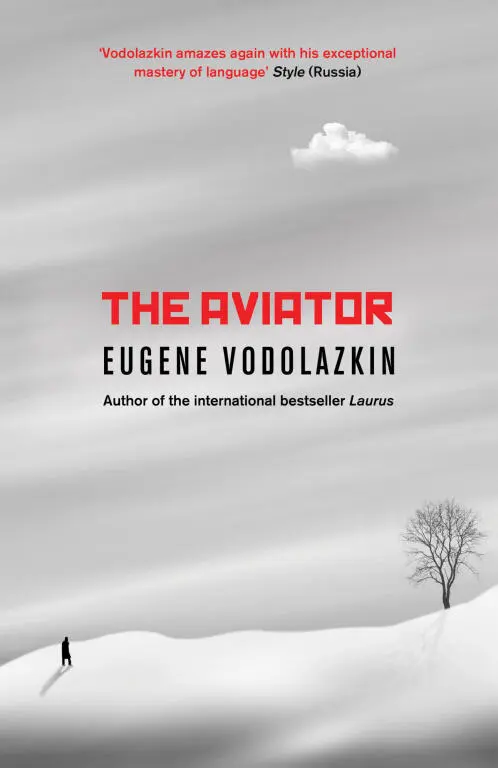
- Название:The Aviator
- Автор:
- Издательство:Oneworld Publications
- Жанр:
- Год:2018
- Город:London
- ISBN:978-1-78607-271-9
- Рейтинг книги:4 / 5. Голосов: 2
-
Избранное:Добавить в избранное
- Отзывы:
-
Ваша оценка:
The Aviator: краткое содержание, описание и аннотация
Предлагаем к чтению аннотацию, описание, краткое содержание или предисловие (зависит от того, что написал сам автор книги «The Aviator»). Если вы не нашли необходимую информацию о книге — напишите в комментариях, мы постараемся отыскать её.
Reminiscent of the great works of twentieth-century Russian literature, with nods to Dostoevsky’s
and Bulgakov’s
,
cements Vodolazkin’s position as the rising star of Russia’s literary scene.
The Aviator — читать онлайн бесплатно полную книгу (весь текст) целиком
Ниже представлен текст книги, разбитый по страницам. Система сохранения места последней прочитанной страницы, позволяет с удобством читать онлайн бесплатно книгу «The Aviator», без необходимости каждый раз заново искать на чём Вы остановились. Поставьте закладку, и сможете в любой момент перейти на страницу, на которой закончили чтение.
Интервал:
Закладка:
Everybody has to write! That idea seemed a little weird to me at first but then I thought, well, why not? Some kind of three-way journal’s pretty interesting.
The first thing, which I have to start with – because no other news is more important – is that I’m pregnant! I think it happened on my first night with Platonov. His behavior then kind of scared me. It seemed like he lost consciousness once or twice, for a second. That’s understandable: he loves me double, for my grandmother and for me. That doesn’t bother me, though. I actually like it.
What bothered and worried me is the thought that I’m not a virgin. That’s just a detail for a contemporary person but my beloved is unusual. He only started using the informal ‘you’ with me on our first night, something he never did with my grandmother. Geiger quoted Bunin with regard to Platonov: ‘A person of a bygone age.’ They regarded virginity very strictly in that bygone age: do not dare lose it! But my kind friend did not so much as ask a question on that score. Although I think he noticed everything. Felt it keenly, you might say.
We moved to his place on Bolshoy and I’ve heard nothing from him but words of love ever since. Of course I’d guessed before about how he regarded me but, after all, he couldn’t say anything to me then. Meaning he’s talking now. And I’m talking because I really love him. Platosha’s smart and affectionate. He’s also, by the way, very good in bed: you wouldn’t say this is a guy who’s just been thawed out. He’s good and I tell him that all the time. He smiles back. Now that’s somebody with a nice smile.
Smile, sweetie!
SATURDAY [INNOKENTY]
And so, a continuation of the notes. If I am to be exact, these are no longer notes. Based on the fact that it has now been suggested that I use a computer, I thought up the word printings. I informed Geiger and Nastya about that and they nodded listlessly. They do not like it, oh, they do not like it. And it’s not pretty enough for them. Truth be told, it’s not for me, either, but I don’t let on. I am testing how far my friends’ tolerance will go.
So far, they are tolerating. Geiger is basically happy that – to express it in a preindustrial way – I’m again putting pen to paper, since it turns out I wrote nothing for about a month. I somehow wearied of my previous scribblings and thought I had stopped, but here I am starting again, induced by Geiger. I’ll put it bluntly: not without hesitation.
Geiger put pressure on me in the sense that the journal is an ancient genre and is thus natural for me. I, after all, stated in Bunin’s way, am ‘a person of a bygone age.’ And I kept a journal wonderfully for half a year so why not keep it further? He already spoke to me about the ‘not-bygone age’ at some point. It is a vivid phrase, I remembered it. True, I have only read early Bunin and don’t remember reading that there, but I understand Geiger’s motivation. It is important for him to document what happens in my brain. But why do I need that? As Geiger himself said, I wrote for an entire half-year; is that really not enough?
I told him that these notes make me into someone unusual, the subject of an experiment. Rather like some sort of rat, at a time I should be blending in with this new way of life and, well, basically (I giggle, forcedly), I have a young wife and I am not in the mood for notes in the evenings. Geiger objected: rats don’t keep journals and nobody is impeding me (a glance at Nastya) from blending in with a new way of life. He was, put bluntly, insistent.
Geiger convinced me that the course of my rehabilitation should remain for science. Reacting to the rat, he suggested putting everyone in equal positions: me, Nastya, and him. In his opinion, events will be presented from three angles so there will be multiple dimensions of views about what happens. It’s supposed to comfort me that everyone in our troika will write, since I will no longer be in a special position. Anyway, Geiger convinced me.
The most important thing is last: Nastya is pregnant.
MONDAY [GEIGER]
I wonder: how does Innokenty perceive Nastya? She came into his life without my involvement. Very felicitously, in my view. Something that’s genuinely good can’t be arranged. It happens on its own.
Take Nastya. More than anything, she loves him. Beyond that, she loves him and all the fullness of his life. With his feelings for Anastasia, with his camp experience, with his current fame.
His fame, it seems to me, is an object of particular attention for Nastya. She simply basks in it. That’s excusable: Nastya is essentially still very young.
She’s pretty smart. That’s important for a person like Innokenty. She’s emotional. Maybe overly emotional, which can be annoying sometimes. In our case, however, that quality of Nastya’s is most likely a plus. Innokenty is growing accustomed to his new time thanks to her active help.
Basically, Russian women are surprisingly lively. I, a German, like that about them.
Nastya’s also practical. Not tight-fisted, not sparsam, [3] Economizing (Germ.).
but practical. Since Germans have already come up, that quality is, of course, German. It manifests itself in her with certain details and phrases.
For example, we run across a watermelon stand on the street. Sure enough, Innokenty wants to buy a watermelon right then and there. Nastya announces that the watermelons are better in the nearby supermarket. And cheaper. But the thing is that he wants to buy the watermelon here and now. He likes that life itself is revealing its riches to him. And a supermarket is, well, excuse me, another matter. Here it’s a find, there it’s procurement.
There’s nothing bad in her practicality. It’s simply a little unexpected for her age and mentality. How does that go along with her emotionality?
Or maybe that’s the style of this era? A generation of lawyers and economists.
Only where, one might ask, is the dream?
Where is the flight?
TUESDAY [INNOKENTY]
After Anastasia died, I asked myself if my relationship with Nastya is not infidelity. Not in the sense of man/woman but in the most absolutely human dimension possible. If I am to be entirely frank, that question came about even before Anastasia’s death and before my relationship with Nastya, but I was afraid to ask it. Even of myself. Because I could guess where this course was heading. Then, after asking that question, I was afraid of answering it in the first weeks after Anastasia’s death, though it was already impossible to set aside.
What is difficult to do under ordinary conditions sometimes works out easier on paper. Or on the computer, in my case. I answer the question about whether my life with Nastya amounts to being unfaithful to Anastasia with a firm ‘No.’
The main proof is Nastya’s pregnancy. Anastasia and I should have had a child but we no longer could have a child. Nastya is carrying Anastasia’s flesh within herself, which means that the child she and I will have is partially Anastasia’s child. If Russian history were not so pitch black, then Nastya would have been Anastasia’s and my granddaughter. Is this just a matter of history, though? And is it worth piling all the blame on history?
Just recently, I have noticed that in Russia people have come to like a phrase about how history has no subjunctive mood. Phrases come up now, too, as in my time, and people repeat them whether or not they have relevance. History, you see, does not have… Maybe it does not, it’s just that there are cases when it grants something like a second attempt. This is repetition and simultaneously non-repetition of what already was.
Otherwise, how can you explain that I was granted one more chance for life? That I – if we are to call things by their real names – have risen? That Anastasia lived long enough to see me in that late meeting? That I met Nastya, whom I love and who loves me? Could all that simply be separate cases or, even, chance? Of course not. Nastya and I (and Anastasia!) are dealing with pieces of the same mosaic because when many chance things come together in one common picture, that amounts to a consistent pattern.
Читать дальшеИнтервал:
Закладка:
Похожие книги на «The Aviator»
Представляем Вашему вниманию похожие книги на «The Aviator» списком для выбора. Мы отобрали схожую по названию и смыслу литературу в надежде предоставить читателям больше вариантов отыскать новые, интересные, ещё непрочитанные произведения.


Обсуждение, отзывы о книге «The Aviator» и просто собственные мнения читателей. Оставьте ваши комментарии, напишите, что Вы думаете о произведении, его смысле или главных героях. Укажите что конкретно понравилось, а что нет, и почему Вы так считаете.