Eugene Vodolazkin - The Aviator
Здесь есть возможность читать онлайн «Eugene Vodolazkin - The Aviator» весь текст электронной книги совершенно бесплатно (целиком полную версию без сокращений). В некоторых случаях можно слушать аудио, скачать через торрент в формате fb2 и присутствует краткое содержание. Город: London, Год выпуска: 2018, ISBN: 2018, Издательство: Oneworld Publications, Жанр: Современная проза, на английском языке. Описание произведения, (предисловие) а так же отзывы посетителей доступны на портале библиотеки ЛибКат.
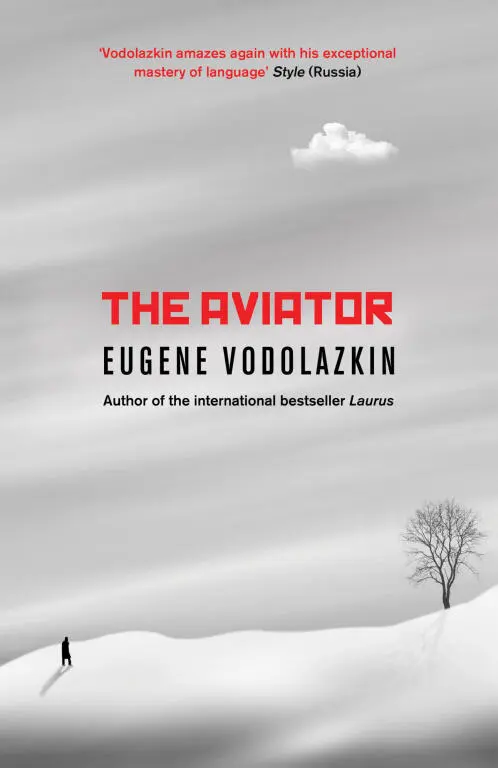
- Название:The Aviator
- Автор:
- Издательство:Oneworld Publications
- Жанр:
- Год:2018
- Город:London
- ISBN:978-1-78607-271-9
- Рейтинг книги:4 / 5. Голосов: 2
-
Избранное:Добавить в избранное
- Отзывы:
-
Ваша оценка:
The Aviator: краткое содержание, описание и аннотация
Предлагаем к чтению аннотацию, описание, краткое содержание или предисловие (зависит от того, что написал сам автор книги «The Aviator»). Если вы не нашли необходимую информацию о книге — напишите в комментариях, мы постараемся отыскать её.
Reminiscent of the great works of twentieth-century Russian literature, with nods to Dostoevsky’s
and Bulgakov’s
,
cements Vodolazkin’s position as the rising star of Russia’s literary scene.
The Aviator — читать онлайн бесплатно полную книгу (весь текст) целиком
Ниже представлен текст книги, разбитый по страницам. Система сохранения места последней прочитанной страницы, позволяет с удобством читать онлайн бесплатно книгу «The Aviator», без необходимости каждый раз заново искать на чём Вы остановились. Поставьте закладку, и сможете в любой момент перейти на страницу, на которой закончили чтение.
Интервал:
Закладка:
There was no challenge in his words, more likely sorrow. He was sitting motionless; only a bump twitched on his cheekbone. Amphibian. Sorrowful reptile. I walked right up to him.
‘I’ll kill you so nobody will ever find out.’
I spent that whole night in the Voronins’ room. Anastasia was sitting in the armchair and I was on the floor alongside her. She fell asleep toward morning and I carried her to bed. When I placed her on the bed, she opened her eyes and said:
‘Don’t kill him. Do you hear me, don’t kill him.’
She said that as if she were sleeping.
I kept silent because I did not know how, exactly, to respond: fine, I won’t? I’ll try not to kill? I thought: what will life be like after her father’s arrest? I looked at Anastasia; she was sleeping again. I’m going to sleep now, too. The pen fell from my fingers once and woke me up. I’ll continue tomorrow.
WEDNESDAY
Continuing. Oddly enough, after the professor’s arrest, life went on almost as before. My mother, Anastasia, and I ran into Zaretsky – in the kitchen, in the hallway, and by the toilet – and, surprisingly, we greeted him. My mother was the first to greet him (she was afraid Zaretsky would continue denouncing and hoped this would buy his silence), then I, and then Anastasia, too. My mother greeted him aloud but we only nodded. We were not thinking about future denunciations: put simply, it is difficult to pretend a person does not exist if you are living under the same roof. It is difficult to live in constant hatred, even if it is justified.
One time Zaretsky was walking drunk through the hallway and said to me:
‘I myself don’t know why I denounced the professor. I went there, so for some reason I denounced.’ After taking a few steps toward the toilet, he turned: ‘But I won’t denounce you, you can rest easy.’
Afterwards, I thought more than once about why he actually did denounce. An insult? But nobody insulted Zaretsky, people simply paid him no attention. Hm… Perhaps for him that was the worst insult?
From time to time, Anastasia and I would go to Gorokhovaya Street in hope of being granted a meeting with the professor, but we received no meeting. They also accepted no packages. No matter how Anastasia attempted to speak with the oprichniks there – she smiled at them, adding tinny notes into her voice, and ingratiating herself— nothing helped. Their backwards physiognomies remained impenetrable. I looked at them and imagined grabbing them by the hair and pounding them against the wall full force. I’m pounding with full force, I pound with enjoyment, and their dirty-brown blood is spewing on the government-owned chairs, floor, and ceiling. That’s how I imagined each of our trips there. I think they could not help but know that. We went the last time on March 26, and those people told us Professor Voronin had been shot, executed.
FRIDAY
Today Nurse Angela showed up instead of Nurse Valentina. She’s young but lacks Valentina’s charms. Her appearance is fairly vulgar, not to mention her name. Geiger said Valentina is ill; I did not like his tone very much. I don’t know why.
All day I attempted to type on the computer. I felt as if I were a printing pioneer.
SATURDAY
A few days ago, Geiger brought me a book by an American about freezing the dead for subsequent resurrection. He had already offered me something similar. It’s fascinating reading, especially as hospital reading goes. The author lists questions that the trailblazers of freezing will be forced to contend with: they are not at all easy. Will widows or widowers be allowed to enter into marriage after the deceased is frozen? What is someone who has been thawed and brought back to life to do when encountering spouses of former spouses? Is there a lawful right to freeze a relative or (I will add for myself) a flatmate? Could someone who was officially declared a corpse and then frozen have lawful rights and responsibilities? Could that person vote after being thawed? That final question genuinely moved me.
In the American’s opinion, however, the primary complication lies less in voting than in the freezing and thawing process. Upon cooling, liquid is released from cellular solutions and turns into crystals of ice. As we know, water expands during freezing and this process is capable of damaging the cell. Moreover, what does not turn to ice becomes an extraordinarily caustic saline solution that is destructive for the cell. For all that, if freezing is very fast – there are seemingly grounds for optimism here – the size of the crystals and the concentration of the saline solution end up being reduced.
Glycerin is used to ward off damage during freezing: it neutralizes the saline solution. This way, removing the glycerin from the body becomes the first task during thawing. All other actions are pointless if that is not resolved: glycerin instead of blood does the body no favors. True, there are other questions here, too: why is Geiger bringing me things of this sort and why am I reading it all?
‘So it works out,’ I ask him on one of those days, ‘that it isn’t so much a matter of freezing as of proper thawing?’
‘That’s right.’
‘If I understand correctly, nobody has ever been revived during thawing, despite all the success of science?’
‘They have,’ he answers.
‘Who might that be? I wonder. A baboon?’
Geiger looks at me sympathetically and even somehow warily:
‘You.’
THURSDAY
I’ve been thinking all these days about what I heard. At first I seemed to take it all calmly but then a second wave somehow caught me. They’d managed to thaw me: from there, it logically follows that I had been frozen. What can I say…
That thought veered off, meandering. It strove not to return to its initial point. I recalled logs that froze into the Neva. Bottles, washtubs, dead dogs, and pigeons: everything that agonizingly melted from the ice in spring. How did I look in icy captivity – like a pigeon? Perhaps like a sleeping princess? Did my bloodless face show through the ice? Were my eyes closed? Or was there no ice at all? Most likely there was not: I read that they use nitrogen for freezing.
Some days on the island, I myself wanted to freeze. To sit under a tree and drift off. I recalled Lermontov then – I’d like to forget and fall asleep – and I imagined very well just how that happens. When it is no longer cold, when one wants to do nothing, not even to live. It’s not frightening when you aren’t thinking about life and aren’t thinking about death. You hope: maybe it will all work out somehow, so something will happen that won’t allow you to definitively perish. But that didn’t happen. In the spring, under the pine trees, they found people you simply did not even want to describe. Though I remember I did already describe that; they did not withstand overwintering well. So did I freeze there or something? It doesn’t seem that way: it is known that good freezing requires glycerin. I look at myself in the mirror without false modesty and think that, in essence, I am pretty well preserved.
Geiger stopped by a few times and slapped me on the shoulder. He would slap and leave without saying a word. What, really, could someone say here?
‘And so,’ I ask, ‘how did you manage to thaw me? And the big thing: how did you remove the glycerin from my body?’
‘A specialist…’ There is respect in Geiger’s gaze. ‘And there was no glycerin.’
‘What do you mean?’ I’m surprised.
‘There just wasn’t any, that’s all. And therein lies the mystery.’
FRIDAY
The end of March. Zaretsky died at the end of March. He was found on the bank of the Zhdanovka River with a fractured skull, not far from the sausage factory where he worked. Detective Treshnikov from criminal investigations – a sturdily built forty-year-old with a walrus mustache – came to see us. Treshnikov was ascertaining who had a stake in Zaretsky’s death. He inquired as to whether Zaretsky had any enemies or any relatives that might inherit his room. Enemies or relatives (they do know how to formulate things in investigations)… we didn’t know about either. He asked where we had all been the night before, but we were all at home.
Читать дальшеИнтервал:
Закладка:
Похожие книги на «The Aviator»
Представляем Вашему вниманию похожие книги на «The Aviator» списком для выбора. Мы отобрали схожую по названию и смыслу литературу в надежде предоставить читателям больше вариантов отыскать новые, интересные, ещё непрочитанные произведения.




Обсуждение, отзывы о книге «The Aviator» и просто собственные мнения читателей. Оставьте ваши комментарии, напишите, что Вы думаете о произведении, его смысле или главных героях. Укажите что конкретно понравилось, а что нет, и почему Вы так считаете.