Eugene Vodolazkin - The Aviator
Здесь есть возможность читать онлайн «Eugene Vodolazkin - The Aviator» весь текст электронной книги совершенно бесплатно (целиком полную версию без сокращений). В некоторых случаях можно слушать аудио, скачать через торрент в формате fb2 и присутствует краткое содержание. Город: London, Год выпуска: 2018, ISBN: 2018, Издательство: Oneworld Publications, Жанр: Современная проза, на английском языке. Описание произведения, (предисловие) а так же отзывы посетителей доступны на портале библиотеки ЛибКат.
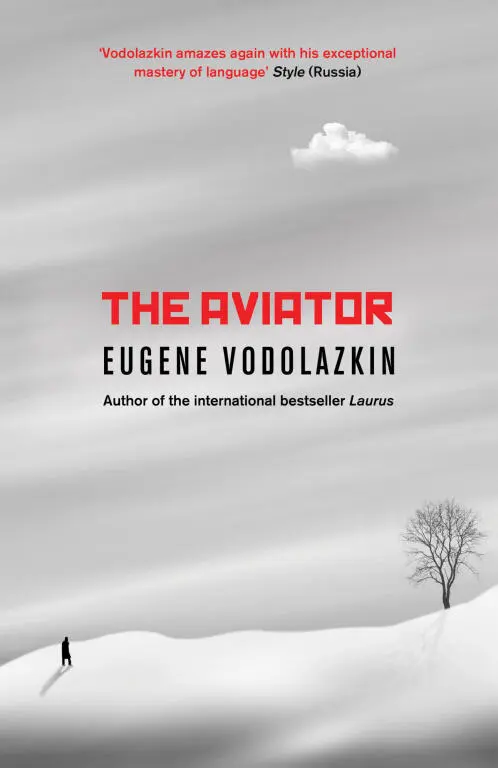
- Название:The Aviator
- Автор:
- Издательство:Oneworld Publications
- Жанр:
- Год:2018
- Город:London
- ISBN:978-1-78607-271-9
- Рейтинг книги:4 / 5. Голосов: 2
-
Избранное:Добавить в избранное
- Отзывы:
-
Ваша оценка:
The Aviator: краткое содержание, описание и аннотация
Предлагаем к чтению аннотацию, описание, краткое содержание или предисловие (зависит от того, что написал сам автор книги «The Aviator»). Если вы не нашли необходимую информацию о книге — напишите в комментариях, мы постараемся отыскать её.
Reminiscent of the great works of twentieth-century Russian literature, with nods to Dostoevsky’s
and Bulgakov’s
,
cements Vodolazkin’s position as the rising star of Russia’s literary scene.
The Aviator — читать онлайн бесплатно полную книгу (весь текст) целиком
Ниже представлен текст книги, разбитый по страницам. Система сохранения места последней прочитанной страницы, позволяет с удобством читать онлайн бесплатно книгу «The Aviator», без необходимости каждый раз заново искать на чём Вы остановились. Поставьте закладку, и сможете в любой момент перейти на страницу, на которой закончили чтение.
Интервал:
Закладка:
The cars ahead of us raised wind-blown snow and spattered us with clumps of mud that kept fogging the windshield. It now let in neither wind nor light. The ingenious Geiger sprayed water on it and cleaned it with windshield wipers. After having learned to lower the windows, I began pressing the button, but such a whirlwind burst into the car that I closed the window right away. Yes, that’s better, nodded Geiger. That’s better.
We parked by a railroad station that I did not recognize. Rather, I seemed to recognize one of the station’s buildings that has now become a store. So that’s how you are now, Siverskaya… When we got out of the car, Geiger asked me to wear a gauze mask. I shrugged and put it on. In the end, he’s the important person here, and I am accustomed to complying. But the Siverskaya air, which is like nothing else, made itself felt even through the gauze. We set off in the direction of the dam, along a street with wretched five-story buildings.
It became obvious in Siverskaya that winter was ending. There’s a particular smell of spring, after all, that comes about when there is still snow lying everywhere. Not a smell – perhaps it’s more a sort of softness in the air.
And where is Baron Frederiks’s dacha?’ My voice sounded muffled, even somehow accusatory, because of the mask.
‘It hasn’t remained intact.’
The snow was already crumbly; it didn’t squeak.
‘Why hasn’t it remained intact?’
There was Geiger’s vague gesture signalling no further ‘whys.’ We walked down toward the dam. Ruins standing by the water were chock-full of rubbish. We delighted in how frothy streams of water rushed out from somewhere underneath us. I had never been here in the winter, after all, and that made me feel a little better. The town’s winter condition could, if desired, explain the fact that Siverskaya bore little resemblance to itself. Everything could come back in the summer, though. Absolutely everything, including Frederik’s dacha.
And there it was, the road: it was along this road that we ascended back then, crossing the dam. Red cliffs. My father was alive then, and my grandmother, too. And my mother. I kept thinking about my mother and I didn’t want to ask Geiger how she was doing there. There. It was obvious, after all, that she died long ago but, well, I was afraid to hear it.
We began walking along Tserkovnaya Street, though the signs say Red. If they have in mind the Devonian clay, then that’s entirely appropriate. I soon glimpsed our house. The roof and color had changed and it had become boxy or something, but was instantly recognizable. Geiger lagged tactfully behind. I took hold of the gate and carefully examined the house. This was it. I turned to Geiger and he nodded. Even the light in the window was yellowish, as before.
An elderly person came out of the house and headed toward the gate. He slowed his stride when he saw me. He stopped.
‘We used to rent this dacha,’ I said. ‘A very long time ago.’
The man shook his head:
‘I inherited this house from my father. Neither he nor my grandfather ever rented it.’
‘Maybe your great-grandfather?’
After looking at my mask, he politely asked:
‘Are you here for treatment?’
‘In a certain sense, yes.’
He nodded. He came out to the street, pushed his hand through the slats of the gate, and closed the inner latch. He walked off toward the dam, unhurried.
The light inside the house did not go off when he left; someone must have stayed there. Perhaps my family. All I would have to do is go inside to see all my dear ones ( so you’ve come back, my chum ) and grasp that everything but their out-of-time sitting at the table was a dream and delusion, and I would burst into tears from a flood of happiness, just as then, the day of my solitary wanderings. But I did not go in.
SUNDAY
A little bird hops happily
Along disaster’s fences,
As it does, it can’t foresee
Any consequences.
This ancient stanza came back to me but it’s unclear what it has to do with anything.
Perhaps this is about me?
MONDAY
In the winter we rose at six o’clock and day broke toward noon. Morning seemed like the scariest part of the day to me. Even if by evening I felt like I was dying of pain, exhaustion, and the cold, at least in the evening there was hope of nighttime rest. In the morning, though, I would open my eyes with the thought that everything would start all over again today. Often I could not wake up. I would open my eyes and stand (they beat you with a stick for a one minute delay) but not wake up. I slept in formation as they led us to our workplace: it is possible to sleep while walking, too. We did not wash up, there was no time; sometimes we could wipe our faces with snow or damp moss when we were already at work. All we managed to do was eat a piece of bread and drink it down with water. They brought boiling water to the brigade but it turned almost cold when they poured it. Not that it mattered: there was nothing to brew in it anyway. And there was nothing to drink down with it. I dreamt of only two things on earth: eating my fill and a good night’s sleep.
TUESDAY
They came for Professor Voronin in the evening. They were sullen and focused, as befits those representing tremendous force. Who had not come on their own behalf. They were unhurried while searching the room. Fingers unaccustomed to turning pages examined book after book. After they tired of paging, they took the books by the binding and shook them energetically. Bookmarks and postcards fell out; a prerevolutionary ten-ruble note even flew out at one point, whirling. They looked at linens just as thoroughly. Standing in the hallway, I saw their fingers groping the sheets on which Anastasia slept.
Anastasia. She sank into the armchair when the GPU’s secret policemen presented their paperwork. The professor was still clarifying something with them but she was already sitting, motionless and silent. I had never seen her so pale. Voronin had a fright, too, from looking at her. He crouched in front of the chair, took her by the chin, and said that everything would turn out fine. They led him to the other end of the room. One of the GPU men brought Anastasia some water; there was a glimmer of something human in that.
Zaretsky did not hide that all this was happening because of his denunciation. Wary of them missing something in the search, he even led the visitors to the Voronins’ cabinet in the kitchen. They found a colander, a grater, and several empty jars. It was unclear to everybody – likely even to the searchers themselves – what they were searching for.
‘You are responsible for her now,’ Voronin whispered to me in the hallway.
We embraced. Then he embraced his daughter. The employee who had brought Anastasia the water forced apart her hands that had joined on her father’s neck. Both these actions were probably customary for him. Anastasia did not cry in her father’s presence; she was afraid he would not withstand that. She only began crying after he left. When she spoke, the words came out of her with sobs, one after another, like waves of vomiting. It was horrible for her that he left in the evening – rather than in the afternoon or at night, when the order of things seems settled – since evening is a shaky, transitional time.
I went to Zaretsky’s door and tugged at the doorknob. It turned out to be locked from the inside with a hook. I pulled it with both hands and the hook flew off. Zaretsky was sitting with his hands clasped on the table. The table was clean; there was not even any sausage on it.
‘I’ll kill you, you louse,’ I said quietly.
‘You’ll stand trial if you kill a proletarian,’ Zaretsky responded just as quietly.
Читать дальшеИнтервал:
Закладка:
Похожие книги на «The Aviator»
Представляем Вашему вниманию похожие книги на «The Aviator» списком для выбора. Мы отобрали схожую по названию и смыслу литературу в надежде предоставить читателям больше вариантов отыскать новые, интересные, ещё непрочитанные произведения.









Обсуждение, отзывы о книге «The Aviator» и просто собственные мнения читателей. Оставьте ваши комментарии, напишите, что Вы думаете о произведении, его смысле или главных героях. Укажите что конкретно понравилось, а что нет, и почему Вы так считаете.