Jeannette Walls - Half Broke Horses
Здесь есть возможность читать онлайн «Jeannette Walls - Half Broke Horses» весь текст электронной книги совершенно бесплатно (целиком полную версию без сокращений). В некоторых случаях можно слушать аудио, скачать через торрент в формате fb2 и присутствует краткое содержание. Жанр: Современная проза, на английском языке. Описание произведения, (предисловие) а так же отзывы посетителей доступны на портале библиотеки ЛибКат.
- Название:Half Broke Horses
- Автор:
- Жанр:
- Год:неизвестен
- ISBN:нет данных
- Рейтинг книги:5 / 5. Голосов: 1
-
Избранное:Добавить в избранное
- Отзывы:
-
Ваша оценка:
Half Broke Horses: краткое содержание, описание и аннотация
Предлагаем к чтению аннотацию, описание, краткое содержание или предисловие (зависит от того, что написал сам автор книги «Half Broke Horses»). Если вы не нашли необходимую информацию о книге — напишите в комментариях, мы постараемся отыскать её.
Jeannette Walls's The Glass Castle was "nothing short of spectacular" (Entertainment Weekly). Now she brings us the story of her grandmother – told in a voice so authentic and compelling that the book is destined to become an instant classic.
"Those old cows knew trouble was coming before we did." So begins the story of Lily Casey Smith, in Jeannette Walls's magnificent, true-life novel based on her no-nonsense, resourceful, hard working, and spectacularly compelling grandmother. By age six, Lily was helping her father break horses. At fifteen, she left home to teach in a frontier town – riding five hundred miles on her pony, all alone, to get to her job. She learned to drive a car ("I loved cars even more than I loved horses. They didn't need to be fed if they weren't working, and they didn't leave big piles of manure all over the place") and fly a plane, and, with her husband, ran a vast ranch in Arizona. She raised two children, one of whom is Jeannette's memorable mother, Rosemary Smith Walls, unforgettably portrayed in The Glass Castle.
Lily survived tornadoes, droughts, floods, the Great Depression, and the most heartbreaking personal tragedy. She bristled at prejudice of all kinds – against women, Native Americans, and anyone else who didn't fit the mold. Half Broke Horses is Laura Ingalls Wilder for adults, as riveting and dramatic as Isak Dinesen's Out of Africa or Beryl Markham's West with the Night. It will transfix readers everywhere.
Half Broke Horses — читать онлайн бесплатно полную книгу (весь текст) целиком
Ниже представлен текст книги, разбитый по страницам. Система сохранения места последней прочитанной страницы, позволяет с удобством читать онлайн бесплатно книгу «Half Broke Horses», без необходимости каждый раз заново искать на чём Вы остановились. Поставьте закладку, и сможете в любой момент перейти на страницу, на которой закончили чтение.
Интервал:
Закладка:
I SPENT THE NIGHTholding Helen in my arms, trying to reassure her that it was all going to work out. We’d write Mom and Dad, I told her. They’d understand. This sort of thing happened to young women all the time, and she could go live at the ranch until the baby was born. I’d start racing horses every weekend, and I’d save all my winnings for her and the baby, and when it was born, Buster and Dorothy could raise the child as theirs and Helen would have money to go start a new life in some fun place like New Orleans or Kansas City. “We have all sorts of options,” I said. “But this one makes the most sense.”
Helen, however, was inconsolable. She was convinced that Mom in particular would never forgive her for bringing shame on the family. Mom and Dad would disown her, she believed, the same way our servant girl Lupe’s parents had kicked her out when she got pregnant. No man would ever want her again, Helen said, she had no place to go. She wasn’t as strong as me, she said, and couldn’t make it on her own.
“Don’t you ever feel like giving up?” Helen asked. “I just feel like giving up.”
“That’s nonsense,” I said. “You’re much stronger than you think. There’s always a way out.” I talked again about the cottonwood tree. I also told her about the time I was sent home from the Sisters of Loretto because Dad wouldn’t pay my tuition, and how Mother Albertina had told me that when God closes a window, he opens a door, and it was up to us to find it.
Helen finally seemed to find some comfort in my words. “Maybe you’re right,” she said. “Maybe there’s a way.”
I was still awake and lying in bed with Helen when the first gray light of dawn began to appear in the window. Helen had finally fallen asleep, and I studied her face as it emerged from the shadows. That silly platinum hair had fallen forward, and I tucked it behind her ear. Her eyes were swollen from all the crying she’d been doing, but her features were still delicate, her skin still pale and smooth, and as the light filled the room, her face seemed to glow. She looked to me like an angel, a slightly bloated, pregnant angel, but an angel nonetheless.
All of a sudden I felt a lot better about things. It was Saturday. I got out of bed, put on my trousers, and brewed some strong coffee. When it was ready, I brought Helen a cup and told her it was time to rise and shine. A new day was beginning, and we had to get out in the world and make the most of it. What we’d do, I said, was borrow the Flivver from Jim and go for a picnic up to the Grand Canyon. Those mighty cliffs would give us some perspective on our puny little problems.
Helen smiled as she sat there drinking her coffee. I told her I’d go get the car while she got dressed, and we’d get an early start to make the most of the day. “Back in a jiffy,” I said at the door.
“Okay,” Helen said. “And Lily, I’m glad you asked me to come out here.”
It was a beautiful morning, the air so clear and crisp in the sharp light of the November sun that every twig and blade of grass stood out. The range had turned the color of hay. There was not a wisp of cloud to be seen anywhere, and mourning doves were cooing in the cedars. I walked past the old adobe houses and the newer frame houses, past the café and the gas station, past the farm families in town for market day, then all at once I felt like something was choking me.
I put my hand to my throat, and in that instant I was overtaken with a horrible feeling of dread. I turned and ran back as fast as I could, the stores and houses and puzzled farmers all flying by in one big blur, but when I flung open the door, I was too late.
My little sister was dangling from a rafter, a kicked-over chair beneath her. She’d hanged herself.
FATHER CAVANAUGH WOULDN’T LETme bury Helen in the Catholic cemetery. Suicide was a mortal sin, he said, the worst of all sins, because it was the only one for which it was impossible to repent and receive forgiveness; therefore, suicides were not allowed to be buried in hallowed ground.
So Jim, Rooster, and I drove out onto the range, far from town. We found a beautiful site at the top of a rise overlooking a shallow forested valley-so beautiful that I knew in God’s eyes it must be sacred-and we buried Helen there, in my red silk shirt.
V LAMBS
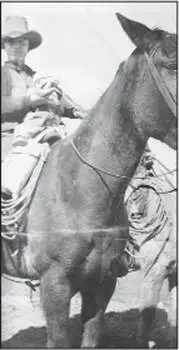
Big Jim holding Rosemary
WHEN PEOPLE KILL THEMSELVES,they think they’re ending the pain, but all they’re doing is passing it on to those they leave behind.
For months after Helen’s death, pain laid so dark and heavy on me, like a big slab of lead, that most days I wouldn’t have gotten out of bed if I hadn’t had kids to teach. The idea of riding horses-much less racing- playing cards, or driving the Flivver out into the country seemed so pointless as to be repulsive. Everything got on my nerves: kids yelling or even just laughing in the school yard, church bells ringing, birds chirping. What the hell was there to chirp about?
I thought of quitting my job, but I was under contract, and anyway, I couldn’t blame the kids for what the parents had done. But I was through with Red Lake, and when the school year was over, I was moving on. I wasn’t even sure I wanted to be a teacher anymore. I felt like I’d given everything I had to the kids of this town, and when I’d needed a little understanding, their families hadn’t cut me any slack. Maybe I should stop devoting myself to other people’s kids and instead have some kids of my own. I had never particularly wanted kids, but when Helen killed herself, she also killed the little baby inside her, and something about that made me want to bring another baby into the world.
As time passed, and without my even realizing it, this idea of having a baby of my own eased my grief. One day in the spring, I got up early, as usual, and sat on the front step of the teacherage, drinking my coffee as the sun rose over the San Francisco Mountains to the east. The shafts of light gliding across the plateau had that golden color that they get in the spring, and when they reached me, they warmed my face and arms.
I realized that in the months since Helen had died, I hadn’t been paying much attention to things like the sunrise, but that old sun had been coming up anyway. It didn’t really care how I felt, it was going to rise and set regardless of whether I noticed it, and if I was going to enjoy it, that was up to me.
And if I was going to have a baby, I needed to find a husband. I started looking at Jim Smith in a different light. He had plenty of good qualities, but the most important one was that I felt I could trust that man inside and out. Once I’d made up my mind about this, I didn’t see the need to beat around the bush or make any grand gestures. It was late afternoon in early May with school over for the day when I saddled up Patches and rode over to the garage. Jim was on his back underneath a car, and all I could see were his legs and boots sticking out. I told him I needed to talk to him, so he slowly pushed himself out and stood up, wiping the grease off his hands with a rag.
“Jim Smith, do you want to marry me?” I asked.
He stared at me a moment and then broke into a big grin. “Lily Casey, I wanted to marry you ever since I saw you take that fall off that mustang and then get right back on him. I just been waiting for a good time to ask.”
“Well, this is it,” I said. “Now, I only got two conditions.”
“Yes, ma’am.”
“The first is that we’ve got to be partners. Whatever we do, we’ll be in it together, each sharing the load.”
Читать дальшеИнтервал:
Закладка:
Похожие книги на «Half Broke Horses»
Представляем Вашему вниманию похожие книги на «Half Broke Horses» списком для выбора. Мы отобрали схожую по названию и смыслу литературу в надежде предоставить читателям больше вариантов отыскать новые, интересные, ещё непрочитанные произведения.






Обсуждение, отзывы о книге «Half Broke Horses» и просто собственные мнения читателей. Оставьте ваши комментарии, напишите, что Вы думаете о произведении, его смысле или главных героях. Укажите что конкретно понравилось, а что нет, и почему Вы так считаете.