Jeannette Walls - Half Broke Horses
Здесь есть возможность читать онлайн «Jeannette Walls - Half Broke Horses» весь текст электронной книги совершенно бесплатно (целиком полную версию без сокращений). В некоторых случаях можно слушать аудио, скачать через торрент в формате fb2 и присутствует краткое содержание. Жанр: Современная проза, на английском языке. Описание произведения, (предисловие) а так же отзывы посетителей доступны на портале библиотеки ЛибКат.
- Название:Half Broke Horses
- Автор:
- Жанр:
- Год:неизвестен
- ISBN:нет данных
- Рейтинг книги:5 / 5. Голосов: 1
-
Избранное:Добавить в избранное
- Отзывы:
-
Ваша оценка:
Half Broke Horses: краткое содержание, описание и аннотация
Предлагаем к чтению аннотацию, описание, краткое содержание или предисловие (зависит от того, что написал сам автор книги «Half Broke Horses»). Если вы не нашли необходимую информацию о книге — напишите в комментариях, мы постараемся отыскать её.
Jeannette Walls's The Glass Castle was "nothing short of spectacular" (Entertainment Weekly). Now she brings us the story of her grandmother – told in a voice so authentic and compelling that the book is destined to become an instant classic.
"Those old cows knew trouble was coming before we did." So begins the story of Lily Casey Smith, in Jeannette Walls's magnificent, true-life novel based on her no-nonsense, resourceful, hard working, and spectacularly compelling grandmother. By age six, Lily was helping her father break horses. At fifteen, she left home to teach in a frontier town – riding five hundred miles on her pony, all alone, to get to her job. She learned to drive a car ("I loved cars even more than I loved horses. They didn't need to be fed if they weren't working, and they didn't leave big piles of manure all over the place") and fly a plane, and, with her husband, ran a vast ranch in Arizona. She raised two children, one of whom is Jeannette's memorable mother, Rosemary Smith Walls, unforgettably portrayed in The Glass Castle.
Lily survived tornadoes, droughts, floods, the Great Depression, and the most heartbreaking personal tragedy. She bristled at prejudice of all kinds – against women, Native Americans, and anyone else who didn't fit the mold. Half Broke Horses is Laura Ingalls Wilder for adults, as riveting and dramatic as Isak Dinesen's Out of Africa or Beryl Markham's West with the Night. It will transfix readers everywhere.
Half Broke Horses — читать онлайн бесплатно полную книгу (весь текст) целиком
Ниже представлен текст книги, разбитый по страницам. Система сохранения места последней прочитанной страницы, позволяет с удобством читать онлайн бесплатно книгу «Half Broke Horses», без необходимости каждый раз заново искать на чём Вы остановились. Поставьте закладку, и сможете в любой момент перейти на страницу, на которой закончили чтение.
Интервал:
Закладка:
Ted had his arms up, trying to defend himself, but I got in some solid blows, and his face was bleeding by the time the other guy pulled me off. I then turned on him with my purse and whacked him good once before Ted grabbed me. “Calm down or I’ll drop you with a roundhouse punch,” he said, “and you know I can.”
“You go ahead, buster, you hit me and I’ll charge you with assault as well as robbery and bigamy.” But I stopped struggling.
The other fellow grabbed his hat. “I see you two have a few things to discuss,” he said, and slipped out the door.
Everything came exploding out of me then: why had he lied to me, why had he married me when he already had a wife and three children, why had he taken the money that we were supposedly saving for our future together, were there any other lies I hadn’t discovered, why hadn’t he just left me alone that day he first saw me beside the lake?
As Ted listened, his expression went from defiant to hangdog to downright mournful, and finally, his eyes welled up with tears. He’d taken the money because he’d run up some gambling debts and the dagos were after him, he said. He’d hoped to be able to pay it back before I even noticed. Margaret, he said, was the mother of his children, but he loved me. “Lily,” he said, “lying was the only way I could have you.”
The louse was acting as if he expected me to feel sorry for him.
“It’s my fault,” he said. Then he reached out and actually touched my hand, adding, “By loving you, I’ve destroyed you.”
The bum sounded like he was about to blubber up. I pulled my hand away.
“You have a mighty high opinion of yourself,” I told him. “The fact is, you don’t love me, and you haven’t destroyed me. You don’t have what it takes to do that.”
I shoved past him, slamming the door on my way out, then turned and swung my purse against the frosted glass pane, shattering it, and all the broken little pieces fell in a shower to the floor.
I TOOK ANOTHER WALKalong the lake. Sometimes I felt I could see into the future, but I sure as shoot hadn’t seen this coming. Things looked pretty bleak right then, but I’d survived a lot worse than a brief marriage to a crumb bum, and I’d survive this, too.
A wind was up, and as I watched it lash the water, I got to thinking how sometimes, as had happened with Minnie, something catastrophic can occur in a split second that changes a person’s life forever; other times one minor incident can lead to another and then another and another, eventually setting off just as big a change in a body’s life. If that car hadn’t hit me and that driver hadn’t insisted on taking me to the hospital and hadn’t found out I was married and hadn’t insisted on my calling Ted, I’d still be happily and obliviously going about my life. But now that life was dead.
I gazed out at the lake, and one thing became crystal-clear. It was over between me and Chicago. The city, for all its beautiful blue water and soaring skyscrapers, had been nothing but heartache. It was time for me to get back to the range.
That very day I went over to the Catholic church where I married that heel and told the priest what had happened. He said that if I could prove my husband had been previously married, I could apply to the bishop for an annulment. With the help of a clerk at city hall, I dug out a copy of Ted’s other marriage certificate, and the priest said he’d set the wheels in motion.
I thought Ted’s wife needed to know what had happened, and I wrote her a letter explaining it all. I decided, however, not to file criminal charges against Ted. It had not been illegal for that weasel to take the money, since it was a joint account; it was just stupid of me to trust him. And if he was sent off to prison as a bigamist, his wife and kids, who had it tough enough already with that Ted Conover in charge of their family, would be worse off than their dad. I also figured the peckerhead had taken up enough of my time and energy, and if he had to wait to get his just deserts from the good Lord himself, that was all right by me.
After mailing the letter, I took the ring Ted had given me in to a jeweler. I wasn’t going to keep it, but I certainly wasn’t going to do something melodramatic, like throw it in the lake. I figured it would fetch a couple hundred dollars, and I was thinking I’d use the money to take some college courses and maybe even splurge on a new dress at Marshall Field’s, but the jeweler looked at the diamond with his eyepiece and said, “It’s fake.”
So I threw it in the lake after all.
ONCE I STOPPED SMACKINGmyself in the head for being so gullible about that crumb bum, I focused on the future. I was twenty-seven years old, no spring chicken. Since I obviously couldn’t count on a man to take care of me, what I needed more than ever was a profession. I needed to get my college education and become a teacher. So I applied to the Arizona state teachers’ college in Flagstaff. As I waited to hear back-and waited for the annulment-I did nothing but work, scrimp, and save, taking two jobs during the week and another on weekends. The time flew by, and when both the dispensation and the acceptance letter arrived, I had enough money for a year of college.
The day came for me to say good-bye to Chicago. I packed everything I had into the same suitcase I had brought with me. I was leaving the city with about as much stuff as I had arrived with. But I had learned a lot-about myself and other people. Most of those lessons had been hard ones. For example, if people want to steal from you, they get you to trust them first. And what they take from you is not only your money but also your trust.
The train left from Union Station, a spanking-new building with marble floors and hundred-foot ceilings that framed wide skylights. The mayor thought the new station showcased Chicago as a city of the future, the very epitome of technological modernity. I had come to Chicago wanting a slice of that modernity, loving the city for it, but Chicago hadn’t loved me back.
The train pulled out of the station, and in a short time we were heading into the countryside. I walked to the back, and from the caboose I watched those massive skyscrapers growing smaller in the distance. Not a single soul in Chicago would miss me. Aside from getting my degree, I’d spent these past eight years in thankless, pointless drudgery, polishing silver that got tarnished again, washing the same dishes day after day, and ironing piles of shirts. Ironing was a particularly galling waste of time. You’d spend twenty minutes pressing one shirt front and back, spraying starch and getting the creases sharp, but once the man of the house put it on, it would wrinkle as soon as he bent an elbow; plus, you couldn’t even see whether the danged shirt was ironed or not under his suit coat.
Working in those little desert towns during the war years-teaching illiterate ragamuffins how to read-I had felt needed in a way that I never had in Chicago. That was how I wanted to feel again.
IV THE RED SILK SHIRT
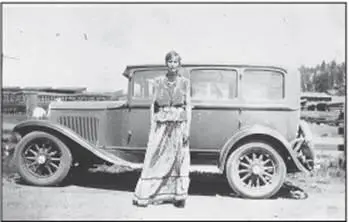
Helen Casey, Red Lake
YOU SAW PLENTY OFcars in Santa Fe now, and even out in the countryside, but when I got back to the KC, I was surprised by how little things had changed except that Buster and Dorothy had a couple of kids, the third generation of Caseys to be raised on the ranch. Dad had completely abdicated responsibility for the place but was still corresponding with old cowpokes about Billy the Kid’s exploits. Mom had grown more frail and complained that her teeth hurt. A couple of years earlier, Helen had moved to Los Angeles to chase her dream of making it in the movies. While she’d yet to get any roles, as she explained in letters home, she’d met a few producers and in the meantime was working as a sales clerk in a millinery.
Читать дальшеИнтервал:
Закладка:
Похожие книги на «Half Broke Horses»
Представляем Вашему вниманию похожие книги на «Half Broke Horses» списком для выбора. Мы отобрали схожую по названию и смыслу литературу в надежде предоставить читателям больше вариантов отыскать новые, интересные, ещё непрочитанные произведения.







Обсуждение, отзывы о книге «Half Broke Horses» и просто собственные мнения читателей. Оставьте ваши комментарии, напишите, что Вы думаете о произведении, его смысле или главных героях. Укажите что конкретно понравилось, а что нет, и почему Вы так считаете.