Milan Kundera - Farewell Waltz
Здесь есть возможность читать онлайн «Milan Kundera - Farewell Waltz» весь текст электронной книги совершенно бесплатно (целиком полную версию без сокращений). В некоторых случаях можно слушать аудио, скачать через торрент в формате fb2 и присутствует краткое содержание. Жанр: Современная проза, на английском языке. Описание произведения, (предисловие) а так же отзывы посетителей доступны на портале библиотеки ЛибКат.
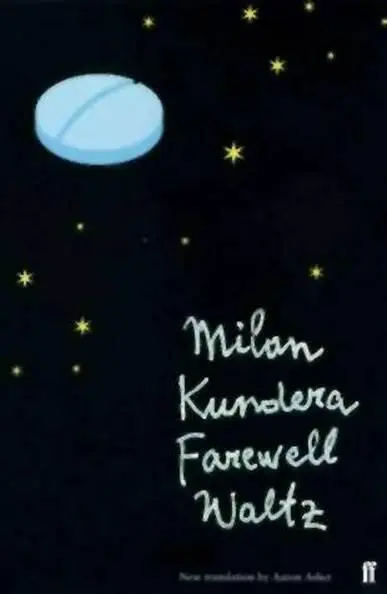
- Название:Farewell Waltz
- Автор:
- Жанр:
- Год:неизвестен
- ISBN:нет данных
- Рейтинг книги:5 / 5. Голосов: 1
-
Избранное:Добавить в избранное
- Отзывы:
-
Ваша оценка:
Farewell Waltz: краткое содержание, описание и аннотация
Предлагаем к чтению аннотацию, описание, краткое содержание или предисловие (зависит от того, что написал сам автор книги «Farewell Waltz»). Если вы не нашли необходимую информацию о книге — напишите в комментариях, мы постараемся отыскать её.
IN this dark farce of a novel, set in an old-fashioned Central Euroepean spa town, eight characters are swept up in an accelerating dance: a pretty nurse and her repairman boyfriend; an oddball gynecologist; a rich Amrican (at once saint and Don Juan); a popular trumpeter and his beautiful, obsessively jealous wife; an unillusioned former political prisoner about to leave his country and his young woman ward.Perhaps the most brilliantly plotted and sheerly entertaining of Milan Kundera’s novels, Farewell Waltz poses the most serious questions with a blasphemous lightness that makes us see that the modern world has deprived us even of the right to tragedy.Written in Bohemia in 1969-70, this book was first published (in 1976) in France under the title La valse aux adieux (Farewell Waltz), and later in thirty-four other countries. This beautiful new translation, made from the French text prepared by the novelist himself, fully reflects his own tone and intentions. As such it offers an opportunity for both the discovery and the rediscovery of one of the very best of a great writer’s works."Kundera remains faithful to this subtle, wily, devious talent for a fiction of 'erotic possibilities. ”New York Times Book Review"Farewell Waltz shocks. Black humor. Farcical ferocity. Admirably tender portraits of women." “Le Point (Paris)" After Farewell Waltz there cannot be any doubt. Kundera is a master of contemporary literature. This novel is both an example of virtuosity and a descent into the human soul."
Farewell Waltz — читать онлайн бесплатно полную книгу (весь текст) целиком
Ниже представлен текст книги, разбитый по страницам. Система сохранения места последней прочитанной страницы, позволяет с удобством читать онлайн бесплатно книгу «Farewell Waltz», без необходимости каждый раз заново искать на чём Вы остановились. Поставьте закладку, и сможете в любой момент перейти на страницу, на которой закончили чтение.
Интервал:
Закладка:
She knew nothing. She was filled to the brim with not knowing. She was nothing but not knowing. She didn't even know where she was going.
She was passing the Slavia, the worst restaurant in the spa town, a filthy cafe where the locals came to drink beer and spit on the floor. In the old days it had
probably been the best, and from those times there still remained a small garden with three red wooden tables and their chairs (paint peeling), a memento of bourgeois pleasure in open-air brass bands and dancing and parasols propped against the chairs. But what did she know about those times, this young woman who merely went through life on the narrow footbridge of the present, devoid of all historical memory? She was unable to see the shadow the pink parasol casts on us from a distant time, she only saw three young men in jeans, a beautiful woman, and a bottle of wine standing in the middle of a bare table.
One of the men called out to her. She turned and recognized the short cameraman in the torn sweater.
"Come have a drink with us!" he exclaimed.
She complied.
"Thanks to this charming young lady we were able to shoot a little porn film this morning," said the cameraman, by way of introducing Ruzena to the woman, who offered her hand and unintelligibly murmured her name.
Ruzena sat down beside the cameraman, who put a glass in front of her and filled it with wine.
Ruzena was grateful that something was happening. That she no longer had to wonder where she was going or what she should do. That she no longer had to decide whether or not to keep the child.
15
He had finally made up his mind. He paid the waiter and told Olga that he had to leave and that they would meet before the concert.
Olga asked him what it was he had to do, and Jakub had the unpleasant sensation of being interrogated. He answered that he had an appointment with Skreta.
"All right," she said, "but that won't take you very long. I'll go and change, and I'll be here at six. I'm inviting you to dinner."
Jakub accompanied Olga to Karl Marx House. When she had disappeared down the corridor, he turned to the doorkeeper: "Would you tell me, please, if Miss Ruzena is in?"
"No," said the doorkeeper. "The key's hanging on the board."
"I have something extremely urgent to tell her," said Jakub. "Do you know where I might find her?"
"I don't know."
"I saw her a while ago with the trumpeter who's giving a concert this evening."
"Yes, me too I hear tell she's going out with him," said the doorkeeper. "Right now he must be rehearsing in the Hall of the People."
When Dr. Skreta, enthroned on the bandstand behind his set of drums, caught sight of Jakub in the doorway, he nodded to him. Jakub smiled at him and examined the rows of seats in which about a dozen fans
were sitting. (Yes, Frantisek, Klima's shadow, was among them.) Then Jakub sat down, hoping that the nurse would finally appear.
He wondered where he might still go looking for her. At this moment she might be in any number of different places he had no idea of. Should he ask the trumpeter? But how would he pose the question? And what if something had already happened to Ruzena? Jakub had already concluded that if she died, her death would be totally inexplicable, that a murderer who killed without a motive could not be caught. Should he attract attention to himself? Did he have to leave a trail and lay himself open to suspicion?
He called himself to order. A human life was in danger, and he had no right to be thinking in such a cowardly way. He took advantage of a pause between two numbers and climbed up on the back of the bandstand. Skreta turned toward him, beaming, but Jakub put a finger to his lips and begged him in an undertone to ask the trumpeter the whereabouts of the nurse he had noticed him with an hour earlier in the brasserie.
"What do all of you see in her?" Skreta grumbled sullenly. "Where's Ruzena?" he then cried out to the trumpeter, who blushed and said he didn't know.
"Never mind!" said Jakub apologetically. "Go on playing!"
"How do you like our band?" asked Dr. Skreta.
"It's great," said Jakub, and he climbed down and returned to his seat. He knew that he was still behaving wrongly. If he really cared about Ruzena's life, he
would move heaven and earth to alert everyone to find her immediately. But he had set out to look for her only so as to have an alibi to present to his own conscience.
Again he recalled the moment when he had given her the tube containing the poison. Had it really happened so quickly that he had not had the time to be aware of it? Had it really happened without his knowledge?
Jakub knew that this was not true. His conscience had not been lulled. He again evoked the face under the blonde hair, and he realized it was not by accident (not by lulling his conscience) that he had given the nurse the tube containing the poison, but that it was an old desire of his which for years had watched for the opportunity, a desire so powerful that the opportunity finally obeyed it and came rushing toward it.
He shuddered and got up from his seat. He ran off to Karl Marx House, but Ruzena was still not home.
16
What an idyll, what a respite! What an interlude in the middle of the drama! What a voluptuous afternoon with three fauns!
The trumpeter's two persecutors, his two hardships, are seated opposite each other, both drinking wine from the same bottle and both equally happy to be
where they are, able if only for a while to do something other than think about him. What a touching alliance, what harmony!
Mrs. Klima looks at the three men. She had once been part of their circle, and she looks at them now as if at a negative of her present life. Submerged by cares, she is seated here facing pure carefreeness; bound to one man, she is seated here facing three fauns who embody virility in its infinite variety.
The fauns' remarks have an obvious goal: to spend the night with the two women, spend the night in a fivesome. It is an illusory goal, because they know that Mrs. Klima's husband is here, but the goal is so beautiful that they are pursuing it even though it is unreachable.
Mrs. Klima knows what they are getting at, and she abandons herself all the more easily to the pursuit of this goal that is merely a fantasy, merely a game, merely a dream temptation. She laughs at their ambiguous remarks, she trades encouraging jokes with the nameless woman who is her accomplice, and she hopes to prolong the dramas interlude as long as possible in order to delay still longer the moment when she will see her rival and look truth in the face.
Yet another bottle of wine, everyone is cheerful, everyone is a bit drunk, but less on wine than on the oddness of the atmosphere, on that desire to prolong the very rapidly passing moment.
Mrs. Klima feels the director's calf pressing her left leg under the table. She is well aware of it, but she does
not withdraw her leg. It is a contact that establishes a sensual connection between them, but it could also have happened quite by chance, could very well have gone unnoticed by her because of its triviality. It is thus a contact situated right on the border between innocence and shamelessness. Kamila does not want to cross this border, but she is happy to be able to stay on it (on this thin sliver of unexpected freedom), and she would be still happier if this magic line were to shift itself toward other verbal allusions, other touchings, other games. Protected by the innocent ambiguity of this shifting border, she wishes to let herself be carried far away, far away and still farther.
Whereas Kamila's beauty, radiant to the point of being nearly embarrassing, forces the director to conduct his offensive with cautious slowness, Ruzena's ordinary charm attracts the cameraman powerfully and directly. He has his arm around her and his hand on her breast.
Читать дальшеИнтервал:
Закладка:
Похожие книги на «Farewell Waltz»
Представляем Вашему вниманию похожие книги на «Farewell Waltz» списком для выбора. Мы отобрали схожую по названию и смыслу литературу в надежде предоставить читателям больше вариантов отыскать новые, интересные, ещё непрочитанные произведения.








Обсуждение, отзывы о книге «Farewell Waltz» и просто собственные мнения читателей. Оставьте ваши комментарии, напишите, что Вы думаете о произведении, его смысле или главных героях. Укажите что конкретно понравилось, а что нет, и почему Вы так считаете.