Milan Kundera - Farewell Waltz
Здесь есть возможность читать онлайн «Milan Kundera - Farewell Waltz» весь текст электронной книги совершенно бесплатно (целиком полную версию без сокращений). В некоторых случаях можно слушать аудио, скачать через торрент в формате fb2 и присутствует краткое содержание. Жанр: Современная проза, на английском языке. Описание произведения, (предисловие) а так же отзывы посетителей доступны на портале библиотеки ЛибКат.
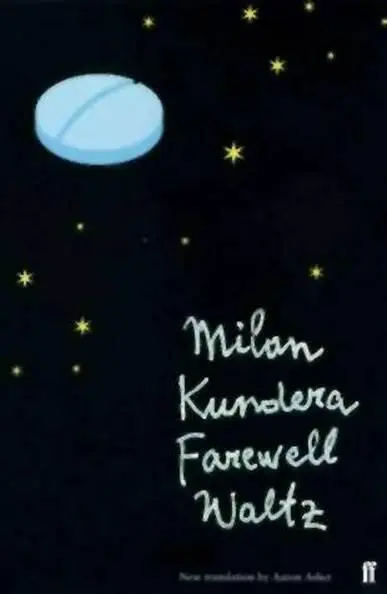
- Название:Farewell Waltz
- Автор:
- Жанр:
- Год:неизвестен
- ISBN:нет данных
- Рейтинг книги:5 / 5. Голосов: 1
-
Избранное:Добавить в избранное
- Отзывы:
-
Ваша оценка:
Farewell Waltz: краткое содержание, описание и аннотация
Предлагаем к чтению аннотацию, описание, краткое содержание или предисловие (зависит от того, что написал сам автор книги «Farewell Waltz»). Если вы не нашли необходимую информацию о книге — напишите в комментариях, мы постараемся отыскать её.
IN this dark farce of a novel, set in an old-fashioned Central Euroepean spa town, eight characters are swept up in an accelerating dance: a pretty nurse and her repairman boyfriend; an oddball gynecologist; a rich Amrican (at once saint and Don Juan); a popular trumpeter and his beautiful, obsessively jealous wife; an unillusioned former political prisoner about to leave his country and his young woman ward.Perhaps the most brilliantly plotted and sheerly entertaining of Milan Kundera’s novels, Farewell Waltz poses the most serious questions with a blasphemous lightness that makes us see that the modern world has deprived us even of the right to tragedy.Written in Bohemia in 1969-70, this book was first published (in 1976) in France under the title La valse aux adieux (Farewell Waltz), and later in thirty-four other countries. This beautiful new translation, made from the French text prepared by the novelist himself, fully reflects his own tone and intentions. As such it offers an opportunity for both the discovery and the rediscovery of one of the very best of a great writer’s works."Kundera remains faithful to this subtle, wily, devious talent for a fiction of 'erotic possibilities. ”New York Times Book Review"Farewell Waltz shocks. Black humor. Farcical ferocity. Admirably tender portraits of women." “Le Point (Paris)" After Farewell Waltz there cannot be any doubt. Kundera is a master of contemporary literature. This novel is both an example of virtuosity and a descent into the human soul."
Farewell Waltz — читать онлайн бесплатно полную книгу (весь текст) целиком
Ниже представлен текст книги, разбитый по страницам. Система сохранения места последней прочитанной страницы, позволяет с удобством читать онлайн бесплатно книгу «Farewell Waltz», без необходимости каждый раз заново искать на чём Вы остановились. Поставьте закладку, и сможете в любой момент перейти на страницу, на которой закончили чтение.
Интервал:
Закладка:
He felt no sadness, but neither was he in any hurry. According to his arrangements with his friends abroad, he should already have crossed the border by now, but he felt he was again prey to that indecisive lethargy so well known and so much derided in his circle because he succumbed to it exactly when circumstances demanded energetic and resolute behavior. He knew
that he was going to maintain to the last moment that he was leaving today, but he was also aware that since the morning he had done all he could to delay the moment of departure from this charming spa town where for years he had been coming to see his friend, sometimes after long intervals but always with pleasure.
He parked the car (yes, the trumpeter's white sedan and Frantisek's motorcycle were already there) and went into the brasserie, where Olga would be joining him in half an hour. He saw a table he liked, next to the bay window in back looking out at the park's flaming trees, but unfortunately it was already occupied by a man in his thirties. Jakub sat down nearby. He could not see the trees from there; he was fascinated instead by the man, who was visibly nervous, never taking his eyes off the door as he tapped his foot.
7
She finally arrived. Klima sprang up from his chair, went forward to meet her, and led her to the window table. He smiled at her as if trying by that smile to show that their agreement was still valid, that they were calm and in alliance, and that they had confidence in each other. He searched the young woman's expression for a
positive response to his smile, but he didn't find it. That alarmed him. He didn't dare talk about what preoccupied him, and he engaged the young woman in a meaningless conversation that ought to have created a carefree atmosphere. Nonetheless his words echoed off the young woman's silence as though off a stone wall.
Then she interrupted him: "I've changed my mind. It would be a crime. You might be capable of something like that, but not me."
The trumpeter felt everything in him collapse. He fixed an expressionless look on Ruzena and no longer knew what to say. There was nothing in him but hopeless fatigue. And Ruzena repeated: "It would be a crime."
He looked at her, and she seemed unreal to him. This woman, whose face he was unable to recall when he was away from her, now presented herself to him as his life sentence. (Like all of us, Klima considered reality to be only what entered his life from inside, gradually and organically, whereas what came from outside, suddenly and randomly, he perceived as an invasion of unreality. Alas, nothing is more real than that unreality.)
Then the waiter who had recognized the trumpeter two days before appeared at their table. He brought them a tray with two brandies, and said jovially: "You see, I can read your wishes in your eyes." And to Ruzena he made the same remark as the last time: "Watch out! All the girls want to scratch your eyes out!" And he laughed very loudly.
This time Klima was too absorbed in his fear to pay attention to the waiter s words. He drank a mouthful of brandy and leaned toward Ruzena: "What's going on? I thought we agreed. It was all settled between us. Why did you suddenly change your mind? Just like me, you think we need a few years to devote ourselves entirely to each other. Ruzena! We're doing it only because of our love and to have a child together when both of us really want one."
8
Jakub instantly recognized the nurse who had wanted to turn Bob over to the old men. He looked at her, fascinated, very curious to know what she and the man with her were talking about. He could not distinguish a single word, but he saw clearly that the conversation was extremely fraught.
From the man's expression it soon became obvious that he had just heard distressing news. He needed a while to find his tongue. His gestures showed that he was trying to persuade the young woman, that he was imploring her. But the young woman remained obstinately silent.
Jakub could not keep from thinking that a life was at stake. The blonde young woman still seemed to him
like someone ready to restrain the victim during an execution, and he didn't for a moment doubt that the man was on the side of life and that she was on the side of death. The man wanted to save someone's life, he was asking for help, but the blonde was refusing it and because of her someone was going to die.
And then he noticed that the man had stopped insisting, that he was smiling and was not hesitating to caress the young woman's cheek. Had they reached an agreement? Not at all. Under the yellow hair the face looked obstinately into the distance, avoiding the man's look.
Jakub was powerless to tear his eyes away from the young woman, whom he was unable since the day before to imagine other than as a hangman's assistant. She had a pretty and vacant face. Pretty enough to attract a man and vacant enough to make all his pleas vanish in it. That face was proud and, Jakub knew, proud not of its prettiness but of its vacuity.
He thought that he saw in that face thousands of other faces he knew well. He thought that his entire life had been an unbroken dialogue with that face. Whenever he had tried to explain something to it, that face had turned away, offended, responding to his arguments by talking about something else; whenever he had smiled at it, that face had reproached him for his superficiality; whenever he had implored it to do something, that face had accused him of exhibiting his superiority-that face which understood nothing and decided everything, a face as vacant as a desert and proud of its desertedness.
It occurred to him that today he was looking at that face for the last time, that tomorrow he was leaving its realm.
9
Ruzena too had noticed Jakub and recognized him. She felt his eyes fixed on her, and it made her nervous. She found herself surrounded by two men in tacit collusion, surrounded by two gazes pointed at her like two gun barrels.
Klima kept going over his arguments, and she didn't know how to reply. She preferred to repeat quickly to herself that when it was a matter of the life of a child-to-be, reason had nothing to say and only feelings had the right to speak. In silence she turned her face out of range of the double gaze and looked fixedly out the window. Then, thanks to a certain degree of concentration, she felt beginning in her the offended consciousness of a misunderstood lover and mother, and this consciousness was rising in her soul like dumpling dough. And because she was unable to express this feeling in words, she let it be conveyed by fixing her eyes on a single spot in the park.
But precisely where her dazed eyes were fixed she suddenly saw a familiar figure and was panic-stricken.
She no longer heard what Klima was saying. Now there was a third gaze pointing its gun barrel at her, and it was the most dangerous. For Ruzena had been unable to tell with certainty who was responsible for her pregnancy. The one she had thought of first was the man now watching her on the sly, poorly hidden by a tree. But that was only obvious at the beginning, for as time passed she more and more favored choosing the trumpeter as begetter, until the day when she finally decided that it was most certainly he. Let us be utterly clear: she was not trying to attribute her pregnancy to him through trickery. In making her decision, she chose not trickery but truth. She decided it was truly so.
Besides, pregnancy is such a sacred thing that it seemed to her impossible that a man she so looked down on could be the cause of it. It was not logical reasoning but a kind of suprarational illumination that had convinced her she could only have become pregnant by a man she liked, respected, and admired. And when she heard over the telephone that the one she had chosen as the father of her child was shocked, frightened, and refusing to accept his paternal mission, everything was settled conclusively, for from that moment on, not only did she no longer doubt her truth, but she was ready to fight for it.
Читать дальшеИнтервал:
Закладка:
Похожие книги на «Farewell Waltz»
Представляем Вашему вниманию похожие книги на «Farewell Waltz» списком для выбора. Мы отобрали схожую по названию и смыслу литературу в надежде предоставить читателям больше вариантов отыскать новые, интересные, ещё непрочитанные произведения.








Обсуждение, отзывы о книге «Farewell Waltz» и просто собственные мнения читателей. Оставьте ваши комментарии, напишите, что Вы думаете о произведении, его смысле или главных героях. Укажите что конкретно понравилось, а что нет, и почему Вы так считаете.