Selma Dabbagh - Out of It
Здесь есть возможность читать онлайн «Selma Dabbagh - Out of It» весь текст электронной книги совершенно бесплатно (целиком полную версию без сокращений). В некоторых случаях можно слушать аудио, скачать через торрент в формате fb2 и присутствует краткое содержание. Город: London, Год выпуска: 2011, ISBN: 2011, Издательство: Bloomsbury Publishing, Жанр: Современная проза, на английском языке. Описание произведения, (предисловие) а так же отзывы посетителей доступны на портале библиотеки ЛибКат.
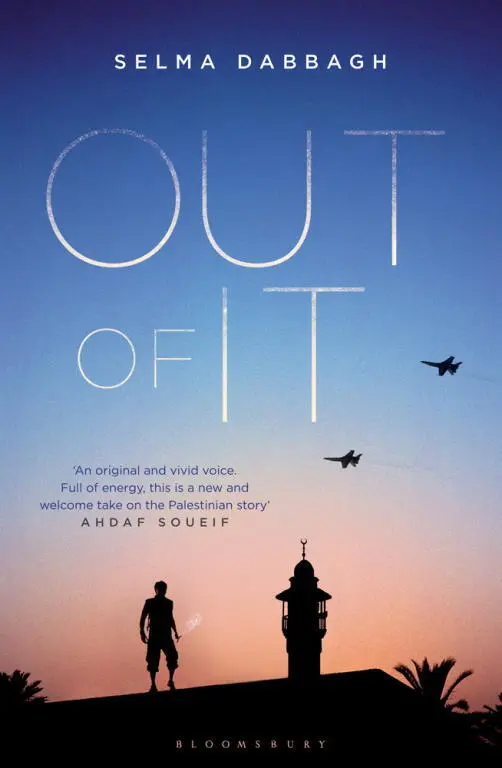
- Название:Out of It
- Автор:
- Издательство:Bloomsbury Publishing
- Жанр:
- Год:2011
- Город:London
- ISBN:978-1-4088-2430-6
- Рейтинг книги:5 / 5. Голосов: 1
-
Избранное:Добавить в избранное
- Отзывы:
-
Ваша оценка:
Out of It: краткое содержание, описание и аннотация
Предлагаем к чтению аннотацию, описание, краткое содержание или предисловие (зависит от того, что написал сам автор книги «Out of It»). Если вы не нашли необходимую информацию о книге — напишите в комментариях, мы постараемся отыскать её.
Meanwhile Sabri, the oldest brother of this disparate Palestinian family works on a history of Palestine from his wheelchair as their mother pickles vegetables and feuds with their neighbours.
Written with extraordinary humanity and humour, and moving between Gaza London and the Gulf, Out of It is a tale that redefines Palestine and its people. It follows the lives of Rashid and Iman as they try to forge paths for themselves in the midst of occupation, religious fundamentalism and the divisions between Palestinian factions. It tells of family secrets, unlikely love stories and unburied tragedies as it captures the frustrations and energies of the modern Arab world.
Out of It — читать онлайн бесплатно полную книгу (весь текст) целиком
Ниже представлен текст книги, разбитый по страницам. Система сохранения места последней прочитанной страницы, позволяет с удобством читать онлайн бесплатно книгу «Out of It», без необходимости каждый раз заново искать на чём Вы остановились. Поставьте закладку, и сможете в любой момент перейти на страницу, на которой закончили чтение.
Интервал:
Закладка:
It was him. Ayyoubi. In the picture on the front page. His back turned. The green jacket. He was everywhere. Even there, in the mall.
‘ Smile !’ Suzi commanded with the sharpness borne of the knowledge that she had been far prettier than Iman would ever be. Iman, the paper tight in her hand, slowly turned to Suzi.
‘You want to get me to dress up and smile at men? Is that what you and Baba want?’
‘We just want the best for you,’ Suzi snapped back, ‘and if you take my advice you will start to work on developing yourself as a woman rather than… whatever it is that you are trying to do. You want to be a politician of some kind? Or an activist ? Is that it?’ Suzi disregarded Iman’s stare. With this type, Suzi decided, it was far better to just be rude. ‘ Yallah ! Allons-y!’ Suzi brushed the breadcrumbs off her herringbone skirt. Come now. Allez!’ Iman folded the newspaper section up again and again until it was small enough to be pushed into her back pocket, ‘Maybe a little bag, too? You seem to need a little something like that,’ Suzi suggested, re-armouring herself with her shopping before she took Iman’s arm and led her back into the shops.
Chapter 27
Iman had come to accept that he was everywhere and now he was there in her room, in her father’s flat, in this oasis of boredom. In her hand she held a piece of evidence that that world of meaning and horror still existed. He was in the newspaper she had stuffed into her jeans pocket. Of all the objects that she had brought back with her to the room from the mall, it was only the newspaper that was meant for her. She took it out of her pocket, unfolded it and stood next to the window so she could see the picture clearly. It was definitely him: the green jacket, the slight stoop. It was not clear what story the photograph was linked to, whether it was to illustrate internal strife or the well-being of the peace process. Whatever it was, it showed that he was there and she was here. And that there was a link.
How fickle was love. Or at least how fickle was Iman’s experience of it. These men she hardly knew, had not really even touched, had barely spoken to, who expanded to take over her brain, the core of her purpose, who had filled out into idealised figures that she was free to adore for a period, until for some spurious reason they would disperse as quickly as they had entered, without leaving a trace. Raed she had barely thought of since that day, since his death. She had not just forgotten him because he was dead. There had just been so many other things that had happened since then, but now, and she was shy to admit it even to herself, the man Ziyyad was taking over space in her mind.
Outside, a stream of traffic made its way down from the ports: trucks carrying shipping containers blocked the road as far as the eye could see, grinding and beeping forwards under a low net of electricity cables. On a diagonal to the road stumpy pylons stretched far into the desert, lined up like crucifixes after a slave uprising.
She knew now that he had been right. Right about Manar and Seif El Din. Right to stop her and to send her away. She had been manipulated and she had been stupid. Her lower lip was sore from being pulled at and now it bled. She looked again at the picture of him. All she could make out was some green jacket and a blurry hint of his profile. But still, there was something in it.
She could trust him. The secret of her stupidity was safe with him.
The skin around her mouth still burnt from the threading. She had been dressed by Suzi and had agreed to being made up in a department store in one of the malls. Grains of mascara were stuck in the edges of her eyes. She wanted to scratch at herself, to get herself out of all this frippery.
You should concentrate on developing yourself as a woman.
What did Suzi mean? The hell with Suzi and her father telling her to get fixed and settle down as though she was a dog needing to be neutered.
But there were the phrases of the Jahali poetry that sometimes ran around her head, body lapping, hair pulling. What did it feel like? Why was she the age she was, where she was, with no experience of these things at all, although she felt inside her that she had lived all of them in another life? She was not surprised that her lacking showed; she felt it everywhere. It almost hurt.
She would have to get a job to get out of there. For all the shopping in the world piled up in her cupboard, without her father she still had just ten dollars and fifteen shekels.
As a woman. What did that mean? What had Suzi picked up on? Suzi knew, she was sure of it, of her inexperience and ineptitude in that way, in the sexual way; women like Suzi could sniff these things out.
She could not sell the shopping for a flight out of there. She could not sell anything. No job. No money. No visa. Stuck.
She looked at the newspaper photograph again: Ziyyad Ayyoubi. He had treated her like one of his deputies. He had spoken to her, not as a girl, but as someone of significance in all of this, even though he had seen the stupidity and the madness of that day. He had seen her deranged with grief and caked with mud but yet he had treated her as though she had the balls of a man. Iman folded the sheet of newspaper and fed off the exhilaration of it.
The air conditioning, which had stopped earlier, started up again and the bags of shopping rustled in its first gust.
The place was deadening. Iman kicked out at the wide-bottomed office chair left in the deskless room, thrashed out at the ghost of a fat-bottomed executive who sat there. It swung around and knocked into the towers of cardboard boxes behind it. They started falling and Iman kicked again. She wanted the whole lot to collapse. They fell incompetently: some backwards, others forwards, one tower staggered on its base until it finally toppled. At the top of the pile was one shoebox, heavier than the others, and this tumbled to Iman’s feet, spilling photographs on to the floor.
There were photographs of them as a family in Cyprus and Geneva, several of her father standing next to his Lancia in Monte Carlo, others of her and Rashid at school in Switzerland. There were some enlarged ones of Sabri and Lana by their wedding cake that she passed over quickly, two of Naji as a baby, and then in a brown envelope scribbled with rough calculations were photographs of her mother. These were professional photographs on thick card with clipped decorative edges and in them her mother was wearing fatigues and standing in the desert with a Kalashnikov. Iman switched on the desk light and checked the pictures. She looked from one to the other until she was absolutely sure of what she was looking at. The badge on her mother’s sleeve was that of the leftist group, the Front, and her mother’s nose had since been completely altered by plastic surgery.
PART IV
LONDON CROWDS
Six months later
Chapter 28
London was quiet to Iman. The traffic, planes and people worked along allocated channels. They moved along the grooves cut out for them. It was not a world shaken down and cut through night after night. The noise was conformist and the talk and expressions appeared to operate on one level only. People behaved in ways that seemed unconnected to others. Their actions had repercussions only for themselves. There was an enviable ability to relinquish involvement in the bigger picture, to believe that it was all under control, that somebody with your interests in mind was looking out for you.
But close up the whole place was talking. London was babbling. The air was crossed through with questions and fragments of sentences, the tails of the kites of conversations that flew elsewhere:
Читать дальшеИнтервал:
Закладка:
Похожие книги на «Out of It»
Представляем Вашему вниманию похожие книги на «Out of It» списком для выбора. Мы отобрали схожую по названию и смыслу литературу в надежде предоставить читателям больше вариантов отыскать новые, интересные, ещё непрочитанные произведения.










Обсуждение, отзывы о книге «Out of It» и просто собственные мнения читателей. Оставьте ваши комментарии, напишите, что Вы думаете о произведении, его смысле или главных героях. Укажите что конкретно понравилось, а что нет, и почему Вы так считаете.