Maggie Helwig - Girls Fall Down
Здесь есть возможность читать онлайн «Maggie Helwig - Girls Fall Down» весь текст электронной книги совершенно бесплатно (целиком полную версию без сокращений). В некоторых случаях можно слушать аудио, скачать через торрент в формате fb2 и присутствует краткое содержание. Город: Toronto, Год выпуска: 2008, ISBN: 2008, Издательство: Coach House Books, Жанр: Современная проза, Триллер, на английском языке. Описание произведения, (предисловие) а так же отзывы посетителей доступны на портале библиотеки ЛибКат.
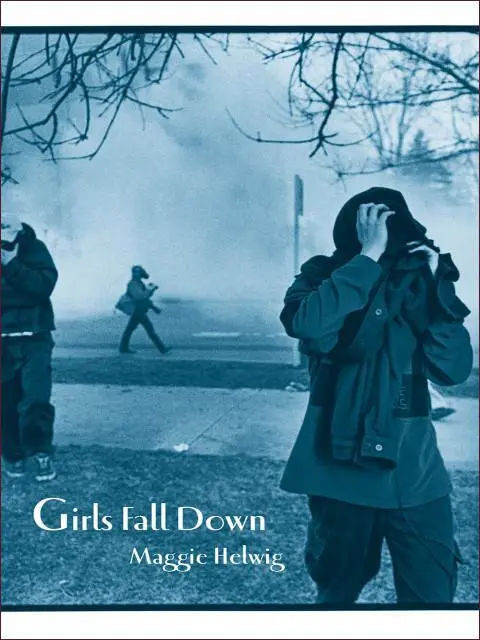
- Название:Girls Fall Down
- Автор:
- Издательство:Coach House Books
- Жанр:
- Год:2008
- Город:Toronto
- ISBN:978-1-55245-196-0
- Рейтинг книги:3 / 5. Голосов: 1
-
Избранное:Добавить в избранное
- Отзывы:
-
Ваша оценка:
Girls Fall Down: краткое содержание, описание и аннотация
Предлагаем к чтению аннотацию, описание, краткое содержание или предисловие (зависит от того, что написал сам автор книги «Girls Fall Down»). Если вы не нашли необходимую информацию о книге — напишите в комментариях, мы постараемся отыскать её.
Alex was witness to this first episode. He’s a photographer: of injuries and deaths, for his job at the hospital, and of life, in his evening explorations of every nook and cranny of the city. Alex is a diabetic, now facing the very real possibility of losing his sight, and he’s determined to create a permanent vision of his city through his camera lens. As he rushes to take advantage of his dying sight, he encounters an old girlfriend – the one who shattered his heart in the eighties, while she was fighting for abortion rights and social justice and he was battling his body’s chemical demons. But now Susie-Paul is fighting her own crisis: her schizophrenic brother has been missing for months, and the streets of Toronto are more hostile than ever.
Maggie Helwig, author of the critically lauded
, has fashioned a novel not of bold actions but of small gestures, showing how easy and gentle is the slide into paranoia, and how enormous and terrifying is the slide into love. This is a remarkable novel: romantically and politically charged, utterly convincing in its portrait of our individual and societal instability, and steadfast in its faith in redemption.
Girls Fall Down — читать онлайн бесплатно полную книгу (весь текст) целиком
Ниже представлен текст книги, разбитый по страницам. Система сохранения места последней прочитанной страницы, позволяет с удобством читать онлайн бесплатно книгу «Girls Fall Down», без необходимости каждый раз заново искать на чём Вы остановились. Поставьте закладку, и сможете в любой момент перейти на страницу, на которой закончили чтение.
Интервал:
Закладка:
‘Or are you supposed to go to work today?’
‘I’m not sure. I think I took today off. I can’t really remember.’
And he should have gone home, he meant to go home. There was no reason to think she wanted him there. He left her his beeper number, but he didn’t expect her ever to use it.
It wasn’t much of a way to leave, but he wasn’t sure that mattered.
He went down into the dim lobby, and even here there were traces of the night, shadowy worried figures drifting back and forth in the darkness, lost relatives maybe, wandering patients, doctors who had been working for thirty-six hours. Outside, he saw another ambulance pulling around to the emergency bay.
There was a cab parked near the entrance, a warm orange light on the silent street, and he sank gratefully into the soft fake leather of the back seat. He did mean to go home. It was just that he could see the sky starting to fade from black to a dull lead blue, the suggestion of bare tree branches emerging, and he thought of something that needed to be done.
The driver looked at Alex skeptically as he stood on the shoulder at Bayview and Pottery Road, counting out the fare. Nearly morning now, the streetlights glowing pale and redundant under the wet clouds. ‘What you planning to do here, man?’ he asked. ‘Nothing here at all. You sure you got the right address?’
‘It’s okay,’ said Alex. ‘Really. I know what I’m doing.’
A police car came speeding around the curve in the opposite lane, siren wailing. ‘I take you where you want to go, you know,’ shouted the cab driver over the noise. ‘You tell me where you need to go, I be happy to take you.’
‘This is where I want to go. Honestly.’
‘You got something to do, I wait for you and drive you on.’
‘I’ll be okay. Thanks, but I’m fine.’
‘I’m a good driver.’
‘I’m sure you are. I just, this is where I need to be, that’s all.’
‘Things pretty crazy on the subway, you know. Better not rely on that.’
‘I’ll keep it mind. Thanks.’
‘Your business, man. But you know, this very strange behaviour, I must tell you.’
He waited until the cab pulled away – slowly, and with obvious reluctance – before he began to climb the hill, fearing that otherwise the driver might come after him, furious with an insistent mixture of concern and the desire not to lose a fare.
Something, a raccoon or a skunk, had been in Derek’s tent already. The sleeping bag was torn, half the stuffing pulled out; the opened tins of Ensure had been scattered. He pushed through the mess, leaving his gloves on, kicking aside a small pile of dirt-stiffened clothes. There were some bottles of water, some Ensure tins that were still sealed, but nothing worth saving. By the side of the bed he found a few ragged books, university textbooks. Physics, chemistry. An edition of Chaucer. He opened one and looked at the copyright page. Yes. About twenty years old. They were the talismans of Derek’s life before madness, maybe the last things he had owned in the daylight world. Alex searched among the contents of the tent for a plastic bag – there had to be a plastic bag, there was always a plastic bag, all human activity seemed to generate plastic bags – and put the textbooks in it.
Maybe there was a health card somewhere. It seemed vastly improbable, but there could be something, maybe medical records, something with Derek’s health number on it. He came out of the tent and looked into the first milk crate.
It was lined with more plastic bags, then a pile of crumbling bricks. From the old brickworks, he supposed. For a minute he thought there was nothing there but bricks; then he realized that there were two layers, and in between them a thick sheaf of papers, lined three-hole pages torn from notebooks.
Dear Mr. Kofi Annan, I am writing to inform you. FUCK FUCK FUCK SHIT CRAP FUCK. the laws against the evil thing 1) avoiding the touching 2) periodic table equated with hyposodium = GHB tranks. But he had the knife but it didn’t go like that snick snick.
once upon a time there was a little girl
Derek would want these, he thought, and put them as neatly as he could into the plastic bag, beside the textbooks.
The other milk crate was filled with more books, water-bloated and smelling of decay. These seemed to be a selection of whatever Derek had been able to scavenge – a Gideon Bible, a novel by Leon Uris, two copies of Jonathan Livingston Seagull . He didn’t think many of them were going to be worth saving, but he began to sort through them, checking to see if there was anything beyond the standard leavings of rummage sales. As he took them out and piled them up beside him, he noticed that there was something else at the bottom of the crate. He shifted another stack of books and saw a photo, an old snapshot, sealed in a clear plastic folder.
It wasn’t a posed shot exactly, but a bit of a coerced family group, some aunt or uncle behind the camera marshalling the four of them together momentarily in front of a Christmas tree, two adults and two children, maybe thirteen or fourteen years old, sitting on the carpet. It was the worst picture of Susie-Paul he could imagine (was she Susie-Paul then? He had never known where that odd nickname came from, though he’d always assumed she had come up with it herself – it wasn’t her parents, he was sure of that. But Derek called her Susie-Paul, so it must go back some way. It occurred to him for the first time that it might have been Derek who gave her the name). Her eyes were half-closed from the flash, her skin blotchy and her face sullen; her brown hair was pulled back tight in an unflattering ponytail. She could not have communicated more clearly that she wanted to be somewhere, almost anywhere, other than this. The spectacled boy beside her was smiling, embarrassed; he looked scholarly and gentle, held a book in his lap. They were very like each other, the same hair, the same features, both wearing jeans and plaid wool shirts, Derek’s in blue, Susie’s red. Derek’s shirt was tucked in neatly; Susie’s was far too large for her, the sleeves hanging down over her hands. Derek had scribbled over his parents’ faces with a ballpoint pen, so Alex couldn’t make out much about them, except that they were old to be the parents of teenagers.
It told him nothing, really. That she had been an unlovely girl who didn’t like having her picture taken. There was nothing here that could explain it to him, what had happened to these children to make them so alone in the world together, to leave them so terribly bound to each other. Nothing that predicted Derek’s long ordeal, or Susie on the hillside, his heart in her hands.
He touched the girl’s face through the plastic, and put the folder carefully into his camera bag.
He sat under the bridge for a while, watching the edges of objects grow slowly definite as the light crept down the hill. There was some shelter from the wind here; at moments it seemed almost warm. But every safe thing is taken from us in the end, and maybe he was not so different from Derek sometimes, their lives a long training in how things went away. He came out from under the bridge into the open plain of snow at the top of the hill, and walked over to the edge of the slope.
It was a white cold morning now, the sky a scrambled mixture of dark cloud banks and sun. And someone had parked a bike at the foot of the hill and begun to climb. This seemed like such an insane development that he could not immediately think how to react, and by the time he had decided that he should go down towards this person, she was already nearly at the top, and he could see that it was Evelyn, in a black toque and duffel coat.
‘Alex, how are you?’ she said, as she pulled herself up and stood. ‘You look tired.’
Читать дальшеИнтервал:
Закладка:
Похожие книги на «Girls Fall Down»
Представляем Вашему вниманию похожие книги на «Girls Fall Down» списком для выбора. Мы отобрали схожую по названию и смыслу литературу в надежде предоставить читателям больше вариантов отыскать новые, интересные, ещё непрочитанные произведения.










Обсуждение, отзывы о книге «Girls Fall Down» и просто собственные мнения читателей. Оставьте ваши комментарии, напишите, что Вы думаете о произведении, его смысле или главных героях. Укажите что конкретно понравилось, а что нет, и почему Вы так считаете.