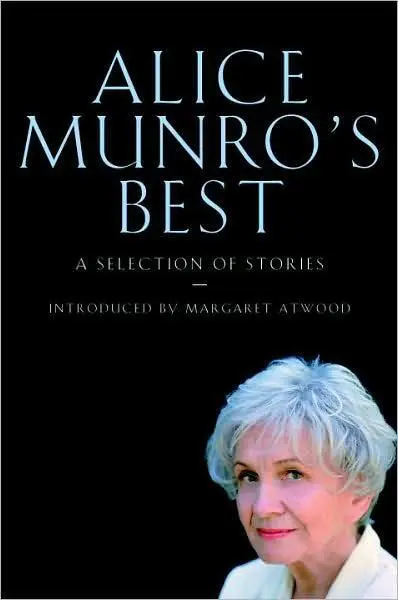
Alice Munro - Alice Munro's Best
Здесь есть возможность читать онлайн «Alice Munro - Alice Munro's Best» весь текст электронной книги совершенно бесплатно (целиком полную версию без сокращений). В некоторых случаях можно слушать аудио, скачать через торрент в формате fb2 и присутствует краткое содержание. Город: Toronto, Год выпуска: 2008, ISBN: 2008, Издательство: McClelland & Stewart, Жанр: Современная проза, на английском языке. Описание произведения, (предисловие) а так же отзывы посетителей доступны на портале библиотеки ЛибКат.
- Название:Alice Munro's Best
- Автор:
- Издательство:McClelland & Stewart
- Жанр:
- Год:2008
- Город:Toronto
- ISBN:9780771065200
- Рейтинг книги:3 / 5. Голосов: 1
-
Избранное:Добавить в избранное
- Отзывы:
-
Ваша оценка:
Alice Munro's Best: краткое содержание, описание и аннотация
Предлагаем к чтению аннотацию, описание, краткое содержание или предисловие (зависит от того, что написал сам автор книги «Alice Munro's Best»). Если вы не нашли необходимую информацию о книге — напишите в комментариях, мы постараемся отыскать её.
This splendid gift edition is sure to delight Alice Munro’s growing body of admirers, what Atwood calls her “devoted international readership.” Long-time fans of her stories will enjoy meeting old favourites, where their new setting in this book may reveal new sides to what once seemed a familiar story; devoted followers may even dispute the exclusion of a specially-beloved story. Readers lucky enough to have found her recently will be delighted, as one masterpiece succeeds another.
The 17 stories are carefully arranged in the order in which she wrote them, which allows us to follow the development of her range. “A Wilderness Station,” for example, breaks “short story rules” by taking us right back to the 1830s then jumping forward more than 100 years. “The Albanian Virgin” destroys the idea that her stories are set in B.C. or in Ontario’s “Alice Munro Country.” And “The Bear Came Over the Mountain,” the story behind the film
, takes us far from the world of young girls learning about sex into unflinching old age.
This is a book to read slowly, savouring each story. It deserves a place in every Canadian book-lover’s library.
Alice Munro's Best — читать онлайн бесплатно полную книгу (весь текст) целиком
Ниже представлен текст книги, разбитый по страницам. Система сохранения места последней прочитанной страницы, позволяет с удобством читать онлайн бесплатно книгу «Alice Munro's Best», без необходимости каждый раз заново искать на чём Вы остановились. Поставьте закладку, и сможете в любой момент перейти на страницу, на которой закончили чтение.
Интервал:
Закладка:
The beef stew was excellent, as Johanna’s cooking always was, but Mr. McCauley found he could not swallow it. He disregarded the instruction about the lid and left the pot sitting open on the stove and did not even turn off the burner until the water in the bottom pot boiled away and he was alerted by a smell of smoking metal.
This was the smell of treachery.
He told himself to be thankful at least that Sabitha was taken care of and he did not have that to worry about. His niece — his wife’s cousin, actually, Roxanne — had written to tell him that from what she had seen of Sabitha on her summer visit to Lake Simcoe the girl was going to take some handling.
“Frankly I don’t think you and that woman you’ve hired are going to be up to it when the boys come swarming around.”
She did not go so far as to ask him whether he wanted another Marcelle on his hands, but that was what she meant. She said she would get Sabitha into a good school where she could be taught manners at least.
He turned on the television for a distraction, but it was no use.
It was the furniture that galled him. It was Ken Boudreau.
The fact was that three days before — on the very day that Johanna had bought her ticket, as the station agent had now told him — Mr. McCauley had received a letter from Ken Boudreau asking him to (a) advance some money against the furniture belonging to him (Ken Boudreau) and his dead wife, Marcelle, which was stored in Mr. McCauley’s barn, or (b) if he could not see his way to doing that, to sell the furniture for as much as he could get and send the money as quickly as he could to Saskatchewan. There was no mention of the loans that had already been made by father-in-law to son-in-law, all against the value of this furniture and amounting to more than it could ever be sold for. Could Ken Boudreau have forgotten all about that? Or did he simply hope — and this was more probable — that his father-in-law would have forgotten?
He was now, it seemed, the owner of a hotel. But his letter was full of diatribes against the fellow who had formerly owned it and who had misled him as to various particulars.
“If I can just get over this hurdle,” he said, “then I am convinced I can still make a go of it.” But what was the hurdle? A need for immediate money, but he did not say whether it was owing to the former owner, or to the bank, or to a private mortgage holder, or what. It was the same old story — a desperate, wheedling tone mixed in with some arrogance, some sense of its being what was owed him, because of the wounds inflicted on him, the shame suffered, on account of Marcelle.
With many misgivings but remembering that Ken Boudreau was after all his son-in-law and had fought in the war and been through God-knows-what trouble in his marriage, Mr. McCauley had sat down and written a letter saying that he did not have any idea how to go about getting the best price for the furniture and it would be very difficult for him to find out and that he was enclosing a check, which he would count as an outright personal loan. He wished his son-in-law to acknowledge it as such and to remember the number of similar loans made in the past — already, he believed, exceeding any value of the furniture. He was enclosing a list of dates and amounts. Apart from fifty dollars paid nearly two years ago (with a promise of regular payments to follow), he had received nothing. His son-in-law must surely understand that as a result of these unpaid and interest-free loans Mr.McCauley’s income had declined, since he would otherwise have invested the money.
He had thought of adding, “I am not such a fool as you seem to think,” but decided not to, since that would reveal his irritation and perhaps his weakness.
And now look. The man had jumped the gun and enlisted Johanna in his scheme — he would always be able to get around women — and got hold of the furniture as well as the check. She had paid for the shipping herself, the station agent had said. The flashy-looking modern maple stuff had been overvalued in the deals already made and they would not get much for it, especially when you counted what the railway had charged. If they had been cleverer they would simply have taken something from the house, one of the old cabinets or parlor settees too uncomfortable to sit on, made and bought in the last century. That, of course, would have been plain stealing. But what they had done was not far off.
He went to bed with his mind made up to prosecute.
He woke in the house alone, with no smell of coffee or breakfast coming from the kitchen — instead, there was a whiff of the burned pot still in the air. An autumn chill had settled in all the high-ceilinged, forlorn rooms. It had been warm last evening and on preceding evenings — the furnace had not been turned on yet, and when Mr. McCauley did turn it on the warm air was accompanied by a blast of cellar damp, of mold and earth and decay. He washed and dressed slowly, with forgetful pauses, and spread some peanut butter on a piece of bread for his breakfast. He belonged to a generation in which there were men who were said not to be able even to boil water, and he was one of them. He looked out the front windows and saw the trees on the other side of the racetrack swallowed up in the morning fog, which seemed to be advancing, not retreating as it should at this hour, across the track itself. He seemed to see in the fog the looming buildings of the old Exhibition Grounds — homely, spacious buildings, like enormous barns. They had stood for years and years unused — all through the war — and he forgot what happened to them in the end. Were they torn down, or did they fall down? He abhorred the races that took place now, the crowds and the loudspeaker and the illegal drinking and the ruinous uproar of the summer Sundays. When he thought of that he thought of his poor girl Marcelle, sitting on the verandah steps and calling out to grown schoolmates who had got out of their parked cars and were hurrying to see the races. The fuss she made, the joy she expressed at being back in town, the hugging and holding people up, talking a mile a minute, rattling on about childhood days and how she’d missed everybody. She had said that the only thing not perfect about life was missing her husband, Ken, left out west because of his work.
She went out there in her silk pajamas, with straggly, uncombed, dyed-blond hair. Her arms and legs were thin, but her face was somewhat bloated, and what she claimed was her tan seemed a sickly brown color not from the sun. Maybe jaundice.
The child had stayed inside and watched television — Sunday cartoons that she was surely too old for.
He couldn’t tell what was wrong, or be sure that anything was. Marcelle went away to London to have some female thing done and died in the hospital. When he phoned her husband to tell him, Ken Boudreau said, “What did she take?”
If Marcelle’s mother had been alive still, would things have been any different? The fact was that her mother, when she was alive, had been as bewildered as he was. She had sat in the kitchen crying while their teenage daughter, locked into her room, had climbed out the window and slid down the verandah roof to be welcomed by carloads of boys.
The house was full of a feeling of callous desertion, of deceit. He and his wife had surely been kind parents, driven to the wall by Marcelle. When she had eloped with an airman, they had hoped that she would be all right, at last. They had been generous to the two of them as to the most proper young couple. But it all fell apart. To Johanna Parry he had likewise been generous, and look how she too had gone against him.
He walked to town and went into the hotel for his breakfast. The waitress said, “You’re bright and early this morning.”
Читать дальшеИнтервал:
Закладка:
Похожие книги на «Alice Munro's Best»
Представляем Вашему вниманию похожие книги на «Alice Munro's Best» списком для выбора. Мы отобрали схожую по названию и смыслу литературу в надежде предоставить читателям больше вариантов отыскать новые, интересные, ещё непрочитанные произведения.



Обсуждение, отзывы о книге «Alice Munro's Best» и просто собственные мнения читателей. Оставьте ваши комментарии, напишите, что Вы думаете о произведении, его смысле или главных героях. Укажите что конкретно понравилось, а что нет, и почему Вы так считаете.