V. Naipaul - Magic Seeds
Здесь есть возможность читать онлайн «V. Naipaul - Magic Seeds» весь текст электронной книги совершенно бесплатно (целиком полную версию без сокращений). В некоторых случаях можно слушать аудио, скачать через торрент в формате fb2 и присутствует краткое содержание. Год выпуска: 2005, ISBN: 2005, Издательство: Vintage, Жанр: Современная проза, на английском языке. Описание произведения, (предисловие) а так же отзывы посетителей доступны на портале библиотеки ЛибКат.
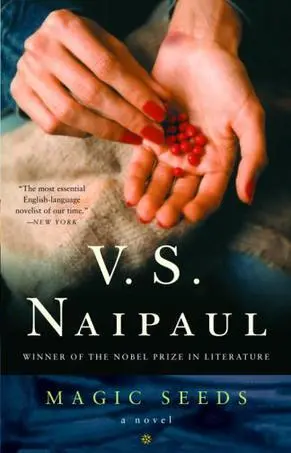
- Название:Magic Seeds
- Автор:
- Издательство:Vintage
- Жанр:
- Год:2005
- ISBN:978-0375707278
- Рейтинг книги:3 / 5. Голосов: 1
-
Избранное:Добавить в избранное
- Отзывы:
-
Ваша оценка:
Magic Seeds: краткое содержание, описание и аннотация
Предлагаем к чтению аннотацию, описание, краткое содержание или предисловие (зависит от того, что написал сам автор книги «Magic Seeds»). Если вы не нашли необходимую информацию о книге — напишите в комментариях, мы постараемся отыскать её.
Having left a wife and a livelihood in Africa, Willie is persuaded to return to his native India to join an underground movement on behalf of its oppressed lower castes. Instead he finds himself in the company of dilettantes and psychopaths, relentlessly hunted by police and spurned by the people he means to liberate. But this is only one stop in a quest for authenticity that takes in all the fanaticism and folly of the postmodern era. Moving with dreamlike swiftness from guerrilla encampment to prison cell, from the squalor of rural India to the glut and moral desolation of 1980s London, Magic Seeds is a novel of oracular power, dazzling in its economy and unblinking in its observations.
Magic Seeds — читать онлайн бесплатно полную книгу (весь текст) целиком
Ниже представлен текст книги, разбитый по страницам. Система сохранения места последней прочитанной страницы, позволяет с удобством читать онлайн бесплатно книгу «Magic Seeds», без необходимости каждый раз заново искать на чём Вы остановились. Поставьте закладку, и сможете в любой момент перейти на страницу, на которой закончили чтение.
Интервал:
Закладка:
The squad leader said, “Is there a policeman or a police box at the intersection?”
Einstein said, “I wouldn’t have wanted to do it if there was a police box. When we have passed, this person will walk calmly to the other side of the road, taking off his gloves, and will get into a car or a taxi, which will then leave the scene. So perhaps we will need a second car. If anyone at all notices they will think it’s another Indian street joker. Four men, two cars, three pistols.”
Keso said, “I feel you are determined to do this, whatever we say.”
Einstein said, “I think it will be a challenging thing to do. And it will be unexpected, since we have nothing against this particular minister. I like the unexpectedness. I think it will set an example to our people. Too many of us, when we plan a military action, can think only in the most banal way. So the other side are always waiting for us, and we fill the jails.”
Afterwards Einstein and Willie talked.
Einstein said, “I hear you had a rough time during that push into the interior. Extending the liberation area. The strategy was poor, and some people paid the price. We spread ourselves too thinly to do anything.”
“I know, I know.”
“The leaders are letting us down. Too much high living. Too many conferences in exotic places. Too much jostling to go abroad to do publicity and raise funds. By the way. You remember that weaver-caste fellow who betrayed us to the police a couple of years ago?”
Willie said, “The Bhoj Narayan business?”
“He wouldn’t be giving any evidence against anybody. I don’t think they would be booking Bhoj Narayan under Section 302.”
Willie said, “What a relief.”
“I wanted you to know. I know how close you two were.”
“Are you going to do that action?”
“I mustn’t talk any more about it. You can talk these things away, you know. It’s like mathematics when you’re young. It comes to you without your knowledge, when you are most silent.”
Willie thought of the little weaver colony as he had last seen it: the red sky, the clean front yards where yarn was spun into thread, the three-wheeler scooter-taxi in front of the house where Raja lived with his elder brother. He remembered the cooking fire, festive-looking in the fading light of day, in the half-open kitchen of the leaf-cigarette makers a hundred yards away: people twice as well off, or half as poor, as the weavers; that early fire seeming to mark the difference between them. He remembered the elder brother’s wife in her cotton peasant skirt falling to the floor of the little house before Bhoj Narayan, holding his knees and pleading for her brother-in-law’s life beside the home-made loom.
He thought, “Who here would know that I cared for those men? Perhaps both brothers are better off dead. Perhaps it’s as Ramachandra said. For people like Raja and his brother the damage is already too great. This generation is lost, and perhaps the next as well. Perhaps both brothers have been spared an untold amount of useless striving and needless pain.”
EVERY TWO WEEKS now there were district meetings. Squad leaders or their representatives came from liberated areas in different parts of the forest in a kind of mimicry of old-fashioned social life. The news they brought, unofficially, was of police arrests and the liquidation of squads, but the fiction of successful revolution and the ever-expanding liberated areas was still maintained, at least in the formal discussions, so that these discussions became more and more abstract. They might debate, for instance, with great seriousness, whether landlordism or imperialism was the greater contradiction. One man might become vehement about imperialism — which in the setting really felt very far away — and afterwards someone might say to Willie, “He would say that, of course. His father is a landlord, and when he is talking about imperialism what he is really saying is, ‘ Whatever you people do, stay away from my father and family.’ ” Or they might debate — they did it every two weeks, and everyone knew what would be said on either side — whether the peasantry or the industrial proletariat was going to bring about the revolution. In spite of all the killings, the movement was becoming more and more a matter of these abstract words.
In the middle of this came news of Einstein’s action. He had done it all as he had said, and it had failed. Einstein had said that the high wall of the minister’s official house was good for the action because it would hide Einstein and his friends in the kidnap car. But his research was not as thorough as he had boasted at the sector meeting. What the wall also did was hide the full security arrangements of the house from Einstein. He had thought that there was only one armed guard and he was at the gate. What he discovered, on the day of the action, and seconds away from the intended kidnap, was that there were two further armed guards inside. He decided to call the whole thing off, and almost as soon as he had entered the yard he pushed his way back past the guard at the gate and got into the car. The lights were against them, but the man they had deputed to stop the cross-traffic did his job beautifully, walking slowly to the middle of the road, pulling on big white gloves and stopping the traffic. Some people had thought that this was the weakest part of the plan. As it turned out, this was the only part that worked. And, as Einstein had said, it was hardly noticed.
When he reappeared among them, he said, “Perhaps it’s for the best. Perhaps the police would have come down really hard on us.”
Willie said, “You were pretty cool, to cancel at the last moment. I probably would have pressed on. The more I saw myself getting into a mess, the more I would have pressed on.”
Einstein said, “All plans should have that little room for flexibility.”
A senior man of the council of the movement came to the next section meeting. He was in his sixties, far older than Willie had expected. So perhaps the boastful madman who had talked about being in all the movements for thirty years was right in some things. He was also something of a dandy, the senior man of the council, tall and slender and with beautifully barbered, glossy grey hair. This again was something Willie hadn’t expected.
Einstein, to turn the talk away from his own abandoned plan, said to the man of the council, “We really should stop talking about the liberated areas. We tell people in the universities that the forest is a liberated area, and we tell people in the forest that the universities are a liberated area. Unlikely things happen: these people sometimes meet. We are fooling nobody, and we are putting off the people we want to recruit.”
The man of the council fell into a great rage. His face became twisted and he said, “Who are these people who will want to question me? Have they read the books I have read? Can they read those books? Can they begin to understand Marx and Lenin? I am not Kandapalli. These people will do as I say. They will stand when I tell them to stand, and sit when I tell them to sit. Have I made this long journey here to listen to this kind of rubbish? I might have been arrested at any time. I have come here to talk about new tactics, and I get this tosh.”
His rage — the rage of a man who had for too long been used to having his own way — clouded the rest of the meeting, and no one raised any further serious points.
Later Einstein said to Willie, “That man makes me feel like a fool. He makes us all fools. I cannot imagine that we have been doing what we have been doing for his sake.”
Willie said (a little of his ancient London college wit unexpectedly coming back to him, overriding his caution), “Perhaps the big books he has been reading have been about the great rulers of the century.”
Читать дальшеИнтервал:
Закладка:
Похожие книги на «Magic Seeds»
Представляем Вашему вниманию похожие книги на «Magic Seeds» списком для выбора. Мы отобрали схожую по названию и смыслу литературу в надежде предоставить читателям больше вариантов отыскать новые, интересные, ещё непрочитанные произведения.





Обсуждение, отзывы о книге «Magic Seeds» и просто собственные мнения читателей. Оставьте ваши комментарии, напишите, что Вы думаете о произведении, его смысле или главных героях. Укажите что конкретно понравилось, а что нет, и почему Вы так считаете.