Kate Pullinger - Landing Gear
Здесь есть возможность читать онлайн «Kate Pullinger - Landing Gear» весь текст электронной книги совершенно бесплатно (целиком полную версию без сокращений). В некоторых случаях можно слушать аудио, скачать через торрент в формате fb2 и присутствует краткое содержание. Город: Toronto, Год выпуска: 2014, ISBN: 2014, Издательство: Doubleday Canada, Жанр: Современная проза, на английском языке. Описание произведения, (предисловие) а так же отзывы посетителей доступны на портале библиотеки ЛибКат.
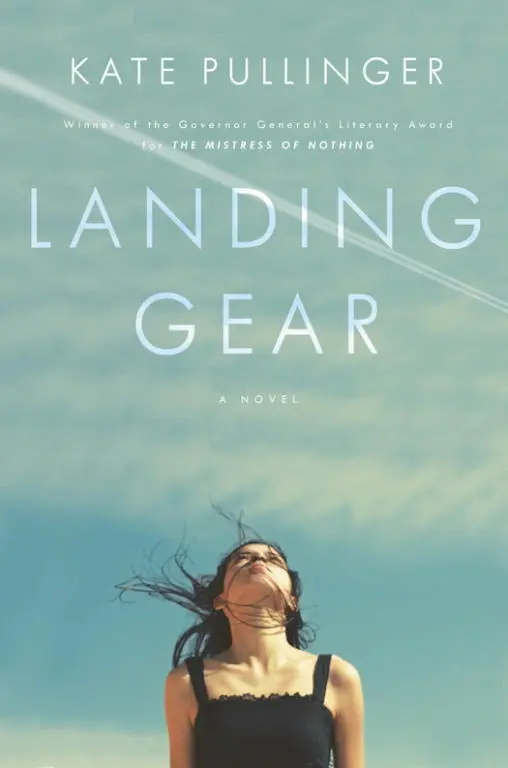
- Название:Landing Gear
- Автор:
- Издательство:Doubleday Canada
- Жанр:
- Год:2014
- Город:Toronto
- ISBN:978-0-385-68121-6
- Рейтинг книги:5 / 5. Голосов: 1
-
Избранное:Добавить в избранное
- Отзывы:
-
Ваша оценка:
Landing Gear: краткое содержание, описание и аннотация
Предлагаем к чтению аннотацию, описание, краткое содержание или предисловие (зависит от того, что написал сам автор книги «Landing Gear»). Если вы не нашли необходимую информацию о книге — напишите в комментариях, мы постараемся отыскать её.
A man falls from the sky and against all odds lands himself a new life. Spring 2010. Harriet works in local radio in London, England. When a volcano explodes in Iceland and airspace shuts down over Europe stranding most of her colleagues abroad, she seizes the opportunity to change her working life. At the same time, Yacub, a migrant worker from Pakistan, is stranded in a labour camp in Dubai, an Emily, a young TV researcher, loses her father to a sudden heart attack. Michael, stuck in New York, travels to Toronto to stay with an old flame. And Jack, a teenager liberated from normal life by the absence of airplanes, takes an unexpected risk and finds himself in trouble.
Two years later, Yacub, attempting to stow away, falls out of the landing gear of an airplane onto Harriet’s car in a London supermarket parking lot—and survives—while Emily accidentally captures it all on film. Yacub’s sudden arrival in the lives of Harriet, Jack, Michael, and Emily catapults these characters into a series of life-changing events, ultimately revealing the tenuous, often unexpected ties that bind us together.
Inspired by real-life accounts of airplane stowaways,
is about the complex texture of modern life, and how we fight the loneliness of the nuclear family to hold on to one another.
Landing Gear — читать онлайн бесплатно полную книгу (весь текст) целиком
Ниже представлен текст книги, разбитый по страницам. Система сохранения места последней прочитанной страницы, позволяет с удобством читать онлайн бесплатно книгу «Landing Gear», без необходимости каждый раз заново искать на чём Вы остановились. Поставьте закладку, и сможете в любой момент перейти на страницу, на которой закончили чтение.
Интервал:
Закладка:
They walked through the crowd and down to the river and all the while he began to feel lighter and lighter. He couldn’t stop thinking about Yacub, he couldn’t stop imagining what it must have felt like when Yacub was released from the landing gear of the plane and falling. Flying.
When they got down to the riverbank Ruby wanted to sit on a bench and look out over the water. The Thames curved sharply here, and there was a chunk of parkland directly opposite. On the far side—not that far, as the river was fairly narrow at this point—a set of steps led up from the tidal river into the trees. Jack couldn’t see the steps, it was too dark, but they were there in his mind’s eye. He couldn’t see whether the tide was in or out, whether the river was low or high, and he felt the need to know.
“Wait for me here,” he said to Ruby, but she didn’t answer. She was sitting on the bench and looked like she’d fallen asleep. He scrambled over the railing and down the riverbank, along the uneven ground, slipping on rocks and gravel, through the stinging nettles, brambles and blackberries. The tide was high, and the river churned past where he stood, and he could hear the water right in front of him, he could smell the wet of it. The party receded. Jack had always loved the Thames, his whole life he loved the river, it was part of why he loved Dukes with its enormous trees and its long grass and its big sky.
So he walked forward, and felt his trainers fill with water. He felt heavier and heavier, more and more weighed down by the water, pulled down into the water, as though by the force of gravity, just like Yacub must have felt as the ground rushed toward him that day.
25
Yacub wandered along the riverside footpath, dodging the revellers, thinking to himself that perhaps the Islamic Republic of Pakistan had got it right and making alcohol illegal was a good idea, though he had stopped feeling sick and now felt—well, he felt happy. He lifted his face to the breeze and smelled the river. The night air was soft and damp in England, and it was as though it washed his face for him, kept him clear and clean, far away from the dust of Dubai, the filth of Karachi. The mud on his hands had dried and he’d succeeded in brushing much of it away. He straightened the collar of his new jacket, adjusted his new trousers. These clothes alone were enough to make him happy. Something inside him had shaken loose, been set free.
He came to a bench to one side of the footpath, overlooking the river, with a girl curled up on one end, her hood drawn over her head as though she was asleep. Yacub felt tired—he was looking forward to the day when he no longer felt tired all the time—as he sat down beside her. The moon had come out and he had a good view of the river. Someone—a man, Yacub thought—was moving through the water, wading in as though he was planning on walking to the other side. The water reached his thighs; he slipped a bit, and was suddenly in up to his waist. Yacub sat straighter. It didn’t look right. It didn’t look right at all. It—it was Jack.
As though she’d heard his thoughts, the girl on the bench woke up with a start and lurched forward.
“Jack!” Ruby screamed. “Jack! What the fuck are you doing?”
26
Harriet didn’t think it was possible to feel any older than she felt that night. The teenagers parted for her as though she was unclean. Despite the dark, despite being drunk or stoned or impaired in some way, they could tell she was someone’s mum. Harriet made her way across the field. A few times she saw kids she thought she recognized, friends of Jack’s, but they moved away from her rapidly, and she knew better than to try to speak to them. She heard an ambulance siren getting louder, drawing near, and she could hear shouting coming from down by the river. She began to run and had to push people out of her way, forcing her body through the crowd, which grew denser the closer she got to the riverbank. She broke through to a clearing and saw the paramedic closing the ambulance doors. A girl was standing behind the ambulance, lit up by red taillights and the blue lights that flashed on the roof of the vehicle. The ambulance gave a short siren burst and began to drive away.
She touched Ruby’s arm. The girl looked at her and collapsed in tears. “It’s Jack, Mrs. Smith. He got into the river.”
“What?”
“I don’t know why he went into the water, like he thought he’d go for a swim or something. His cousin went after him and pulled him out—I don’t know how—he—”
“His cousin?”
“Yeah, the cousin from Pakistan—”
“Is Jack all right?”
“I don’t know, he wasn’t speaking. His sister pumped his chest and made him breathe—”
“His sister?”
“With the red hair. She told the paramedic she was his sister. I didn’t know Jack had a sister. He was completely drenched and coughing up water and he—”
“Which hospital, Ruby?”
“West Middlesex.”
“Go home now, Ruby. Go home.”
And Harriet ran up the lane toward the main road, shouting into her phone for a taxi.
27
I open my eyes and then close them again. Too bright.
“Put the camera away,” I told her,
“you’re not allowed to film in hospitals.”
I didn’t say her name, not yet.
I open my eyes again. My mum. Who is she talking to?
“Why are you here? You said you’re his sister?”
She thinks I’m her mother! Of course—
that was inevitable. How stupid of me.
Crazeeharree.
Sister? I have a sister? I can’t keep my eyes open. It’s too bright.
28
“I understand if you don’t want to discuss it in front of him,” Emily said, indicating the very long boy on the hospital bed. They were separated from the rest of Accident and Emergency by curtains.
“I followed you online,” Harriet said. “I’m not proud of it. But I needed to see you, to see how you were doing. I’ve worried about you all these years.”
“You followed me online and you’re still going to deny it?” Emily said.
“Deny what?” said Harriet. “You’re not his sister.”
Harriet watched Emily crumple. Her clothes were wet; her mascara had leaked down her face. She put the camera on the plastic chair by the curtain, pulled a soggy tissue out of her pocket, wiped her nose and began to cry.
“You look like her,” Harriet said. “You look just like her.”
Emily looked up. “Like who?”
“Like your mother.”
29
Jack surfaced once again and fought to open his eyes. His mother and that girl with the red hair were still standing beside his bed. They had their arms around each other. They were hugging. Shit, they’re crying. Just when it looked as though everything was going to be all right. Fuck, he thought. I must be dead. I’ve gone and died.
PART THREE

NUCLEAR FAMILIES
AUTUMN 2014
1
Before Yacub arrived, Emily made sure the room was spotless. She cleaned the window for the first time in a long time, sitting on the sill and leaning back carefully to spray and wipe the glass outside as well. She removed evidence of her own life, so as not to distract him. Sofa, empty side table. Camera on the tripod, clip-on microphone ready. The big lamp on its stand. Earlier, she had gone to the supermarket to pick up tea, milk and biscuits to offer him, to make him feel welcome. As she paid for her purchases, she listened to the many tills beeping, and remembered the day Yacub landed in the car park. A lot had happened since then. And now she had a whole week off work to film the interviews. Emily couldn’t bring herself to add up the number of years it had taken for her to reach this point; her friends had long since given up asking about “Me, Myself and I.” But she was nearly there now. Nearly.
Читать дальшеИнтервал:
Закладка:
Похожие книги на «Landing Gear»
Представляем Вашему вниманию похожие книги на «Landing Gear» списком для выбора. Мы отобрали схожую по названию и смыслу литературу в надежде предоставить читателям больше вариантов отыскать новые, интересные, ещё непрочитанные произведения.






Обсуждение, отзывы о книге «Landing Gear» и просто собственные мнения читателей. Оставьте ваши комментарии, напишите, что Вы думаете о произведении, его смысле или главных героях. Укажите что конкретно понравилось, а что нет, и почему Вы так считаете.