Stanley Elkin - A Bad Man
Здесь есть возможность читать онлайн «Stanley Elkin - A Bad Man» весь текст электронной книги совершенно бесплатно (целиком полную версию без сокращений). В некоторых случаях можно слушать аудио, скачать через торрент в формате fb2 и присутствует краткое содержание. Год выпуска: 2010, Издательство: Open Road Integrated Media LLC, Жанр: Современная проза, на английском языке. Описание произведения, (предисловие) а так же отзывы посетителей доступны на портале библиотеки ЛибКат.
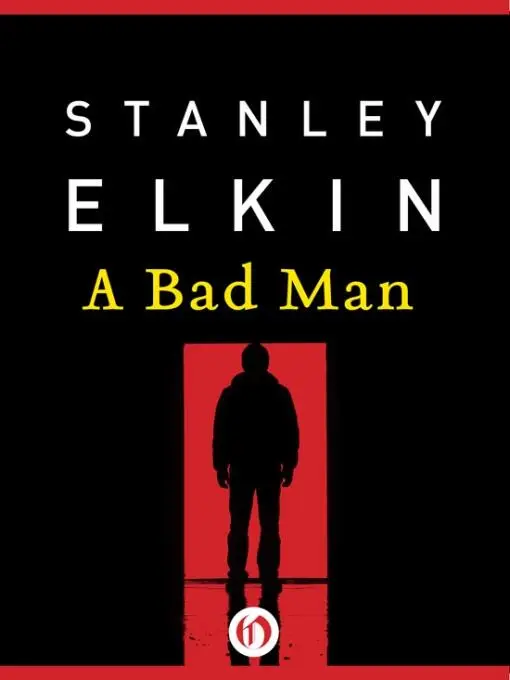
- Название:A Bad Man
- Автор:
- Издательство:Open Road Integrated Media LLC
- Жанр:
- Год:2010
- ISBN:нет данных
- Рейтинг книги:5 / 5. Голосов: 1
-
Избранное:Добавить в избранное
- Отзывы:
-
Ваша оценка:
A Bad Man: краткое содержание, описание и аннотация
Предлагаем к чтению аннотацию, описание, краткое содержание или предисловие (зависит от того, что написал сам автор книги «A Bad Man»). Если вы не нашли необходимую информацию о книге — напишите в комментариях, мы постараемся отыскать её.
A Bad Man — читать онлайн бесплатно полную книгу (весь текст) целиком
Ниже представлен текст книги, разбитый по страницам. Система сохранения места последней прочитанной страницы, позволяет с удобством читать онлайн бесплатно книгу «A Bad Man», без необходимости каждый раз заново искать на чём Вы остановились. Поставьте закладку, и сможете в любой момент перейти на страницу, на которой закончили чтение.
Интервал:
Закладка:
Always an invitation had meant to him something more than it was: a secret message, a signal, a declaration of love. And though he was not a public man he had gone to all parties open to the regard of others, to their attention. It was all that he would ever do for anyone — show them his moods, demonstrate himself. I should have been a late-model automobile, he thought. But these people, these cops and armored-car executives and czars of baseball and auditors of books, wanted only to be protected from him, and to have the right of protecting others from him. His blue fool suit was as heavy as armor. Ah, he thought, I’m such an amateur. He despised his clumsiness, his bad balance. He knew himself for a stumbler in the dark, a stubber of toes, a snagger of pockets. The insurance companies wouldn’t touch him.
Once — it was the year his father died — he had sent himself to Boy Scout summer camp. Joining on a whim at the last moment — he had seen a poster of some boys around a campfire, Negroes, Asians, white kids, all of them strangely Caucasoid — he’d had to go as a Tenderfoot, years older than any other boy of that rank, and as a pauper, with none of the equipment that the others had. He hadn’t understood why he’d come. He couldn’t tie the knots or make a fire or pitch a tent. He didn’t know the pressure points and was clumsy in the canoe and didn’t recognize the plants. He couldn’t find the North Star. He suffered much from the taunts of the other boys and from the commands of boys much younger than himself; yet for the two weeks he was there he had been convinced of his happiness. He remembered one clear, cool evening of a three-day portage when they had slept in the open. He had no sleeping bag and lay in his town clothes, his only protection the few rubber rain slickers the others had lent him and would take back as soon as it rained. He recalled looking at the sky, knowing none of nature’s names but smelling its woods and feeling its earth, sensing himself there in it, who knew no cloud formations nor the shapes of leaves. He was too excited to sleep, and he began to talk to a thirteen-year-old boy who lay near him, telling him about himself, speaking as someone younger might have spoken to someone older but rarely as someone older ever spoke to someone younger. And the kid listened. Then it rained and that kid was the first to ask for his slicker back. Best pal I ever had, Feldman thought.
It’s the liquor, he told himself. It makes you sentimental. Hell, he thought, something has to.
A woman came into the room and sat down in a straight chair a few feet from the couch where Feldman was sitting. She slumped backwards, her behind sliding down inside her clothing, so that her body appeared to be lowered from her dress, exposing thigh, straps, the top of a stocking like a vase of flesh. Her position might have been something the Red Cross recommended as a specific against a certain kind of respiratory attack. Feldman waited for her to speak, then realized that she was tipsy and hadn’t yet noticed him. He watched her underwear, soon imagining shapes in it, lumps and shadows and stains. It made him nervous to stare, and he wondered if he should cough or scrape his feet. He looked at her face. He knew nothing about people’s eyes, couldn’t tell character from facial planes. People were young or old, dark or fair, fat or thin. This woman seemed to be in her thirties, a brunette, an inch or so taller than he was, though perhaps it was only the way her legs were extended in front of her that made her seem tall. (He thought of her posture as Lincolnesque.) He found it pleasant to be there with her, their accidental intimacy and her apparent ignorance of his presence enormously sexy. She looked up once and still didn’t seem to notice him, and he settled into a comfortable contemplation of her. He let his hands rest in his lap.
“I read about you ,” she said suddenly, and Feldman jumped. “I read about you ,” she repeated, her voice shriller than Feldman would have guessed. He allowed himself a stiff, frightened nod in her direction, only then realizing the danger of his position. There were many things that he, their prisoner, could do to earn their anger, and knowing this, he had had any disadvantaged man’s low-souled regard for his own prerogative. His contempt for his captors had been modest, abased, and he had moved only reluctantly around their rules, all the while unconsciously — doing superstitiously the personality’s special pleading — trusting in miracle to save him in some final pinch. Now he was furious with himself. He had been about to commit the great sin: to have been at ease with one of their women. And that , he understood at last, was what the party was all about.
Of course, he thought, seeing everything. Guest of honor, life of the party. His first thought, his first , had been to wonder if there would be women. He thought of the omniscient Fisher. How that man worked him! He had wanted a maudlin Feldman, a Feldman sorry for himself — Boy, oh boy, Feldman thought, he’s yours, you’ve got him — and had scared him into self-pity with the shilled routines he had been suckered into overhearing. Then they had softened his fear, using forgotten comfort as an aphrodisiac, turning him into a yearner for tenderness and solace, off balance as a man on tiptoe. Even now, as he looked at the girl, he found it difficult to resist, and he longed to touch her, to pull at one of her straps as at a ripcord. He considered rape, though even as it crossed his mind, he knew she would know judo, know karate, know Burmese foot fighting, and he contemplated his sensuous, bone-shattering comeuppance, the intimate complicated smells of the hammer lock and bear hug. But all that she could do to him would be nothing; it was what the others — he thought of them as of her older brothers — would do. He could see a creosote-and-spit-on-the-floor doom, some blunt-instrumented humiliation, steamy clouds of race hatred, rage, righteous anger, an edge-of-the-bread-knife ruin. He understood how they felt. In a way, he was even on their side.
“My name is Mona,” the woman said.
“Mona. Well, well. How do you do? Mona, is it? Nice weather, Miss Mona. Well, well.”
“Why are you so nervous, a tough guy like you?”
“Me? Tough? Say, that’s rich. Yes sir. Kind of chilly, don’t you think? Feels like rain.”
“You just said it was nice.”
“Nice for some, not nice for others. Me, I like it. I do, I like it. Suits me.”
“Hey, where are you going?”
“Got to be running along, got to be skedaddling. It’s been a real pleasure, Miss Mona. Yes .”
“Ooh, I love you tough guys. You killers kill me.”
“Pshaw, Miss Mona, I’m no killer.”
“Well, you wheelers and dealers then, you big-time operators, you behind-the-scenes guys who can get someone killed by picking up a phone.”
“Heck, miss, I wouldn’t know what number to dial.”
“Sure, sure. I know. Tell me something, will you? Will you tell me something?”
“I’ll try,” Feldman said. “I’ll give it a try.” I’ll kick it around, he thought. I’ll see what I can come up with.
“Well, a thing that’s always fascinated me is why when you people are arrested and step out of those cars at the courthouse you always hold your hats over your face. It can’t be you’re afraid of the publicity. Everyone already knows what you look like. Why do you do it?”
“Our hats, is it?” Feldman said.
“Yes. Why?”
“Yes, well, we like the smell, that’s why we do that.”
Mona looked at him. Now she blows the whistle, Feldman thought. Now she taps the glass with the little hammer. Mona to Warden, Mona to Warden, come in, Warden. “That’s cute,” Mona said. She came over to his couch and sat next to him. She put out a finger and touched his arm. Don’t touch me with that, he thought. “I liked the part,” she said, “in the basement, where you did all those terrible things for people.”
Читать дальшеИнтервал:
Закладка:
Похожие книги на «A Bad Man»
Представляем Вашему вниманию похожие книги на «A Bad Man» списком для выбора. Мы отобрали схожую по названию и смыслу литературу в надежде предоставить читателям больше вариантов отыскать новые, интересные, ещё непрочитанные произведения.









Обсуждение, отзывы о книге «A Bad Man» и просто собственные мнения читателей. Оставьте ваши комментарии, напишите, что Вы думаете о произведении, его смысле или главных героях. Укажите что конкретно понравилось, а что нет, и почему Вы так считаете.