Stanley Elkin - A Bad Man
Здесь есть возможность читать онлайн «Stanley Elkin - A Bad Man» весь текст электронной книги совершенно бесплатно (целиком полную версию без сокращений). В некоторых случаях можно слушать аудио, скачать через торрент в формате fb2 и присутствует краткое содержание. Год выпуска: 2010, Издательство: Open Road Integrated Media LLC, Жанр: Современная проза, на английском языке. Описание произведения, (предисловие) а так же отзывы посетителей доступны на портале библиотеки ЛибКат.
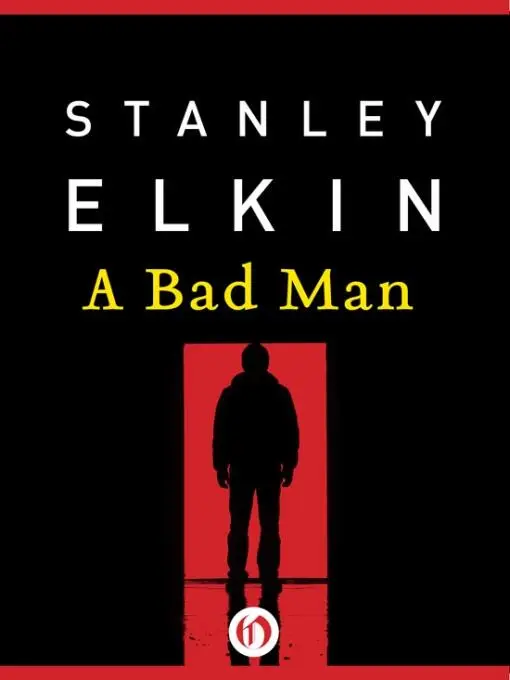
- Название:A Bad Man
- Автор:
- Издательство:Open Road Integrated Media LLC
- Жанр:
- Год:2010
- ISBN:нет данных
- Рейтинг книги:5 / 5. Голосов: 1
-
Избранное:Добавить в избранное
- Отзывы:
-
Ваша оценка:
A Bad Man: краткое содержание, описание и аннотация
Предлагаем к чтению аннотацию, описание, краткое содержание или предисловие (зависит от того, что написал сам автор книги «A Bad Man»). Если вы не нашли необходимую информацию о книге — напишите в комментариях, мы постараемся отыскать её.
A Bad Man — читать онлайн бесплатно полную книгу (весь текст) целиком
Ниже представлен текст книги, разбитый по страницам. Система сохранения места последней прочитанной страницы, позволяет с удобством читать онлайн бесплатно книгу «A Bad Man», без необходимости каждый раз заново искать на чём Вы остановились. Поставьте закладку, и сможете в любой момент перейти на страницу, на которой закончили чтение.
Интервал:
Закладка:
They went to the drawing room, where, as the warden had said, the others had gathered. They must have collected suddenly, but as he and the warden entered they were already lounging in a stiff, suspect sereneness. Feldman recognized none of them, but their ease was familiar to him. He was reminded of his own casual duplicities, the petite infighting of maneuvered-for advantage and self-control. They were people one step ahead of other people, he thought, like schoolchildren whose teacher has come back to find them all studying. Or spies who have rifled drawers, suitcases, the seams of pillows. As he preceded the warden, who had turned deferential, he had a sense of the queer, sedate violence of entering a strange room. He thought with wonder of all the times he had arrived early for appointments, guiltily examining the instruments in doctors’ offices, a lawyer’s framed degrees, family photographs, of all the times, left alone in hotel rooms while others shaved and apologized through closed doors for their lateness, he had picked candy from boxes open on the table.
Though he no longer cared, there were women. Men in dinner jackets stood with ladies in cocktail dresses. “Excuse me,” the warden said, abandoning him, “I have to see to some guests.” Feldman stayed nervously where he was, smiling back tentatively into the remote stares of the others.
A tall graying man came up to him. “Tell me,” he said, “which is worse for you, the day or the night?”
“ That old chestnut,” another said, slowly wheeling from the margin of a small group to which he had attached himself. “Paul’s still espousing those malfeasant ideas. As Chargé de Disease, I couldn’t permit his theories to become operational in any institution in which I had an infirmary.”
“I believe, Chargé de Disease,” the tall man said with much dignity, “that I was addressing the thief here.”
“I’m not a thief, sir,” Feldman said shyly.
“There’s only one crime,” the man said. “It’s theft.”
“A dietary approach to punishment,” the second man said. “Paul, it’s medieval.”
“Please, Chargé, let him answer.” He turned grimly back to Feldman.
“The day is worse,” Feldman said.
“Morning or afternoon?”
“Afternoon.”
“Early or late afternoon?”
“Early afternoon.”
“You see?” the tall man said. “He means that dead center of a waking life fifteen minutes past lunch, three hundred forty-five minutes before dinner. My techniques would extend that desperation. Stretch the fabric of his hopelessness — all crimes are wishes, Chargé—over an entire day, and you’ve returned his aggressions to his dream life, where they belong. Let him writhe in bed. Cut out this fellow’s lunch, remove the water coolers, make the water in the sinks as nonpotable as on European trains. Forbid him cigarettes. Abolish his coffee breaks and canteen privileges, poleax the penny gum machines as if they were gaming tables, Chargé, and you’ve denatured him. Nullify his oral gratifications, and you’ve stripped his hope, I tell you, and made his imagination as incapable of crime as of epic poetry.”
“Well perhaps—”
“Not perhaps, Chargé—certainly, absolutely. It’s historical, Chargé. When was the golden age of obedience in this country?”
“His tor ical, Paul? His tor ical? Pooh pooh, tut tut.”
“When was the golden age of obedience in this country?” Paul insisted.
“Well—”
“It was the sweatshop age, Chargé. It was the piecework age. It was the twelve- and fourteen-hour-day age. The simultaneity of those hard times with the flourishing of the city park system, when parks were safe, was no coincidence. Where were your Coca Cola machines then, Chargé? Where were your refreshment stands? Sweat and hopelessness, Chargé, is our only hope.”
“Well, I agree with you in principle, of course, Paul, but do you really think you can keep hope down? ‘Hope springs eternal.’”
“Hope does not spring eternal forever , Chargé,” the tall scholarly man said.
Feldman excused himself and went up to a servant who carried a tray of drinks. He had already had three in the library, but they had not been enough. He removed a glass from the tray and nodded his thanks. The servant looked at him blankly. A plainclothesman, Feldman thought. He finished it quickly, and the servant handed him another. Flatfoot, Feldman thought. I’d better not get drunk here. Keep me sober, he prayed. He reminded himself merely to sip the next drink, but in a few minutes the servant was beside him again, extending the tray. “No, no, I’m fine,” Feldman said. The servant did not move, and Feldman drank the rest of the liquor in his glass and took another from the tray. Watch your step, he thought. Watch my step, he prayed.
He remembered an empty, comfortable-looking couch he had seen on first entering the room, and now he looked for it again. There were no empty couches. He was very puzzled. That’s funny, he thought, they must have taken it out. There was a couch just where he remembered the empty couch to have been, but five people were sitting on it.
It was essential that he make himself inconspicuous, so he went up to the couch and squeezed in. Because it was already crowded, he had to place the edge of one thigh in a woman’s lap. He had not had this close a contact with a woman in months, and soon he had a hard-on. In those close quarters his erection was pretty apparent, but he reasoned that because of her age — she was about seventy — the woman might not mind.
“Recidivism’s not important, Julia. What counts is that we catch these guys,” the man on Feldman’s left said. “The very fact that we have statistics on recidivism demonstrates the efficacy of our policework.”
“I don’t contest that,” Julia said. It was the old lady. She had a gentle voice. Feldman fought off a vagrant impulse to blow in her ear. “It isn’t that at all. It’s the older parolees. Men who’ve done twenty and thirty years. It annoys me that they don’t behave.”
“You think age quiets those old thieves down?” the man asked. “Infirmity? How thick is plate glass? How heavy is a watch? A diamond bracelet?”
“The inspector’s right,” said a man at the other end, half of whose body Feldman’s presence had forced far over the arm of the couch. He supported himself with his right arm extended on the floor, so that he looked like a downed boxer waiting to rise. Feldman hoped someone would step on his watch. “And I’ll tell you something else. Science in its development of transistorized equipment has made our problem tougher. A thief’s armload today is worth more than a thief’s armload was yesterday, and a thief’s armload tomorrow will be worth even more. I foresee a time when the thief’s armload will be approximate in value to the thief’s truckload of yesteryear. That’s what science has done with its vaunted miniaturization!”
With the strain on his arm the man had spoken louder than he had perhaps intended, and Paul heard him. “And not only that,” Paul said, “but improper diet — the snack-food industry is a three-billion-dollar-a-year business today — has made his thief’s arms longer.” He saw Feldman. “Which it worse for you, the day or the night?”
“The night,” Feldman said. He got up quickly and moved away from them. Across the room he blew a kiss covertly to Julia.
Behind him the warden was standing with two men. “Keep them under,” one was saying.
“But there’s no need to keep them under,” the second man said. “You’ve changed the goal,” he objected. “Hasn’t he, Warden? Hasn’t he changed the goal?”
Читать дальшеИнтервал:
Закладка:
Похожие книги на «A Bad Man»
Представляем Вашему вниманию похожие книги на «A Bad Man» списком для выбора. Мы отобрали схожую по названию и смыслу литературу в надежде предоставить читателям больше вариантов отыскать новые, интересные, ещё непрочитанные произведения.









Обсуждение, отзывы о книге «A Bad Man» и просто собственные мнения читателей. Оставьте ваши комментарии, напишите, что Вы думаете о произведении, его смысле или главных героях. Укажите что конкретно понравилось, а что нет, и почему Вы так считаете.