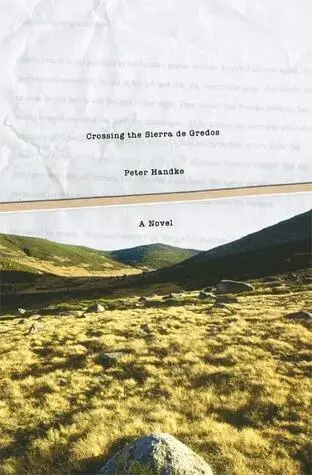
Peter Handke - Crossing the Sierra De Gredos
Здесь есть возможность читать онлайн «Peter Handke - Crossing the Sierra De Gredos» весь текст электронной книги совершенно бесплатно (целиком полную версию без сокращений). В некоторых случаях можно слушать аудио, скачать через торрент в формате fb2 и присутствует краткое содержание. Год выпуска: 2002, Издательство: Farrar, Straus and Giroux, Жанр: Современная проза, на английском языке. Описание произведения, (предисловие) а так же отзывы посетителей доступны на портале библиотеки ЛибКат.
- Название:Crossing the Sierra De Gredos
- Автор:
- Издательство:Farrar, Straus and Giroux
- Жанр:
- Год:2002
- ISBN:нет данных
- Рейтинг книги:4 / 5. Голосов: 1
-
Избранное:Добавить в избранное
- Отзывы:
-
Ваша оценка:
Crossing the Sierra De Gredos: краткое содержание, описание и аннотация
Предлагаем к чтению аннотацию, описание, краткое содержание или предисловие (зависит от того, что написал сам автор книги «Crossing the Sierra De Gredos»). Если вы не нашли необходимую информацию о книге — напишите в комментариях, мы постараемся отыскать её.
In this visionary novel, Peter Handke offers descriptions of objects, relationships, and events that teach readers a renewed way of seeing; he creates a wealth of images to replace those lost to convention and conformity.
is also a very human book of yearning and the ancient quest for
love, peopled with memorable characters (from multiple historical periods) and imbued with Handke's inimitable ability to portray universal, inner-worldly adventures that blend past, future, present, and dreamtime.
Crossing the Sierra De Gredos — читать онлайн бесплатно полную книгу (весь текст) целиком
Ниже представлен текст книги, разбитый по страницам. Система сохранения места последней прочитанной страницы, позволяет с удобством читать онлайн бесплатно книгу «Crossing the Sierra De Gredos», без необходимости каждый раз заново искать на чём Вы остановились. Поставьте закладку, и сможете в любой момент перейти на страницу, на которой закончили чтение.
Интервал:
Закладка:
“Sometimes I have the same sensation,” the author is said to have replied, “when I see portraits of people from earlier centuries, paintings, copper engravings, woodcuts: initially the faces usually look not only remote in time, but also entirely foreign, alien, incomprehensible, belonging to a human type diametrically opposite to me, as a man of today, but as I gaze at them, they often come alive for me as wonderfully approachable, colorful, lively beings, such as are now revealed to me in my daily surroundings only at sacred, or rather blessed, times. Goodness gracious!”—Her reply: “That evening only one person was entirely rooted in the present, in nothing but today. But I do not want you to have him appear in our story until later.”—The author: “A photographer?”—She: “Yes, a photographer, among other things. But how do you know?”
The earlier writer of the magazine story, constantly turning toward her earlier heroine, began to speak and revealed herself as follows: “Once I was a friend of other people’s stories. Fui una vez amiga de historias ajenas . At least I played that role, or wanted to play it, or had to play it. Now I know nothing of others anymore, and have no desire to know anything, and above all do not pretend to know anything about this person or that or about you. No sé nada . I know nothing.
“And I am no longer a friend of knowing about others’ lives. No soy amiga de saber vidas ajenas . How alien, cold and abruptly alien, clearly alien for all time, every person, in truth, appeared to me from the outset, men as well as women, also children, closer relatives as well as much more distant ones, aunts and uncles, nephews and nieces, once to three times removed. Especially the aunts and uncles, the nephews and nieces. How incomprehensible people appeared to me, and how little I understood how anyone could describe another person, tease out traits, characteristics, and idiosyncrasies, and knit them into an ostensibly recognizable figure. What I perceived instead was a cloth doll. Even when someone did this only in the presence of one other person, even when I recognized the person being described, or thought I recognized him, it seemed to me that the whole thing was a swindle, and that even a — what is the term? — lifelike description of a person was simply not right, was indecent, presumptuous.
“Just as there is a prohibition on images that is rooted in our consciousness, or in instinct, above all in respect to the human face, it seemed to me that there was also a sort of prohibition on description, again where the human face was concerned.
“And all the more so when the describing no longer occurred only in the presence of one other person but in society! And all the more so when it became public! And all the more so when it was done in writing, in an article or even a book! And why did it have to be me to whom all the individual strangers became even more alien, if possible, in descriptions, or ceased to exist altogether! — the pseudo-descriptions and imitations, especially those considered most successful, had the most devastating effect — why did it have to be me who came upon or stumbled into a profession or business whose stock in trade was public description, captured in black-and-white, of individuals, of ‘people’!
“If it had at least been a question of capturing a nation, or of people in the aggregate. Human masses and crowds were alien to me, too, but alien in a different way, at least sometimes, not as indescribably foreign as all the nine hundred ninety-nine individuals whom I pried loose and nailed to the page, from the color of their eyes, to their gums, to their shoe size, to their way of walking, shaking hands, brushing the hair back from their forehead, their voices, the shape of their ears, the shape of their chins, their shoulders, their furniture, their pets, their gardens, their vehicles, their preferences, their recurring dreams, their perfume, their failed suicide attempts, their hidden guilt, their forbidden love, their secret ambition in life.
“And even when all the details were correct, and as a rule they were, I knew that my descriptions, my descriptions of people and persons, were nothing but a deception and a distortion. How did I know that? I just knew it. I knew it if for no other reason than that every detail had to be striking. There was no demand for a detail that was not striking. I knew it? My disgust knew it, my disgust at describing your lips, your skin, your nostrils, your way of driving a car, your way of crossing your legs, or not, as the case might be, of opening the door for others, of keeping your eyes closed for a long time, of remaining constantly attentive, of reading people’s lips and eyes, of suddenly clenching your fists, of striking your head with your fist. My disgust at describing, and then at you and at me.
“But now that I no longer need to find anything striking about my subjects, now that I do not need to publish such things, these people have become a tad less alien to me, and above all alien in a different way. Now that I no longer pretend to be a friend of others’ lives, to understand them, to write and put in circulation true stories about them, I have begun to discover a new world. Now that I do not need to know anything about you — now that I no longer have to focus on someone as the subject or object of a story that must be written, I know that I can be more open with you, with him—” (turning toward the stonemason) “before him—” (turning toward Carlos Primero, alias Charles V) “before all of you—” (opening her eyes and taking in all the others at the table at a glance) “more open in general.” (With each gaze now, and now, and now, a blushing deeper than ever before, as if on the verge of a great anger or some other powerful emotion.)
“Only now, with my fundamental ignorance, my ignorance as my foundation — heaven knows, facile paradoxes and plays on words still crop up from my story period! — instead of writing about you, I could write you up , write you off , write around you.
“And I was never as frank as tonight in Pedrada, here in the innermost Sierra. I sense, I know, that today I could discover you, you and you, and all of you, instead of revealing this or that about you, guessing, and putting it into a false context. During the bus ride, with the first rotation of the wheels, everything I had known about you earlier was already canceled — no previous life, no roles, no position, and in its place the desire to discover you, to tell your story again in discovery mode, the very opposite of the scoop that was once my first commandment.
“Except that now I no longer write, not out of disgust at writing, at writing implements, at paper, at the computer. My not-writing-anymore comes from a sort of lightheartedness; giving up writing has left me more light of heart and friendly. And now that I keep my hands off anything remotely connected with script and texts, I see that I am, in fact, yes, fact! a friend of others’ lives. The more alien your life, your lives, the more open I am to them.
“And how strange our story seems to me, precisely here; ¡Soy amiga de vidas ajenas! ¡Soy amiga de historias ajenisimas! Mi emperador , let us see a few moments of your unknown story. And you, you are not really the banking empress I once had to interview across three continents, are you? Or you are no longer that? Ah, goodness gracious, I still have all these questions. But at least they are only spoken and are not intended for publication.”
Now the response of the woman to whom these remarks were primarily directed: “And you ask different questions now. For I recall how in the old days you talked almost constantly, always in the same soft, childlike voice. But simultaneously, gazing into my eyes with your own large eyes, you were ready to pounce. You were intent on trapping, catching, pinning down — not necessarily me as a person but a predetermined, predictable, printable — what was the word I used at the time? — scenario, extending beyond me to a situation, a state of affairs, a current issue. You also talked constantly about your own stories, worries, dreams, adventures, including your adventures in love, perhaps not entirely made up on the spur of the moment — for the purpose of worming corresponding confessions out of strangers.
Читать дальшеИнтервал:
Закладка:
Похожие книги на «Crossing the Sierra De Gredos»
Представляем Вашему вниманию похожие книги на «Crossing the Sierra De Gredos» списком для выбора. Мы отобрали схожую по названию и смыслу литературу в надежде предоставить читателям больше вариантов отыскать новые, интересные, ещё непрочитанные произведения.





Обсуждение, отзывы о книге «Crossing the Sierra De Gredos» и просто собственные мнения читателей. Оставьте ваши комментарии, напишите, что Вы думаете о произведении, его смысле или главных героях. Укажите что конкретно понравилось, а что нет, и почему Вы так считаете.