Minae Mizumura - A True Novel
Здесь есть возможность читать онлайн «Minae Mizumura - A True Novel» весь текст электронной книги совершенно бесплатно (целиком полную версию без сокращений). В некоторых случаях можно слушать аудио, скачать через торрент в формате fb2 и присутствует краткое содержание. Год выпуска: 2013, Издательство: Other Press, Жанр: Современная проза, на английском языке. Описание произведения, (предисловие) а так же отзывы посетителей доступны на портале библиотеки ЛибКат.
- Название:A True Novel
- Автор:
- Издательство:Other Press
- Жанр:
- Год:2013
- ISBN:нет данных
- Рейтинг книги:4 / 5. Голосов: 1
-
Избранное:Добавить в избранное
- Отзывы:
-
Ваша оценка:
A True Novel: краткое содержание, описание и аннотация
Предлагаем к чтению аннотацию, описание, краткое содержание или предисловие (зависит от того, что написал сам автор книги «A True Novel»). Если вы не нашли необходимую информацию о книге — напишите в комментариях, мы постараемся отыскать её.
A True Novel
The winner of Japan’s prestigious Yomiuri Literature Prize, Mizumura has written a beautiful novel, with love at its core, that reveals, above all, the power of storytelling.
A True Novel — читать онлайн бесплатно полную книгу (весь текст) целиком
Ниже представлен текст книги, разбитый по страницам. Система сохранения места последней прочитанной страницы, позволяет с удобством читать онлайн бесплатно книгу «A True Novel», без необходимости каждый раз заново искать на чём Вы остановились. Поставьте закладку, и сможете в любой момент перейти на страницу, на которой закончили чтение.
Интервал:
Закладка:
It became routine for Taro to be summoned to Karuizawa to do the work of a handyman. In no time he was spending the night two or three times a summer, sleeping on a futon spread on the Saegusa kitchen floor. The grounds were spacious and the house old, in need of all sorts of attention beyond the responsibility of a gardener, electrician, or plumber. Taro was well aware that if he made a bad impression on any one of the three Saegusa sisters, his access to the Utagawa home in Chitose Funabashi could be affected, and so he always swallowed his feelings and got the job done. The money they paid him no doubt helped him to bear it. He must have found it reassuring too that spending time in Karuizawa let him learn more about this other world of Yoko’s from which normally he was excluded. And although the Saegusa sisters were taskmasters, as they grew used to seeing him summer after summer they became fond of him in their way. If they baked a nice meat pie, someone would say, “Oh, that boy Taro is coming tomorrow, we must give him some!” Old fountain pens or men’s wristwatches that had been replaced by new ones were set aside for him—“That boy Taro could use this, don’t you think?” To make it easier for him to come to Karuizawa, they even bought him a bicycle.
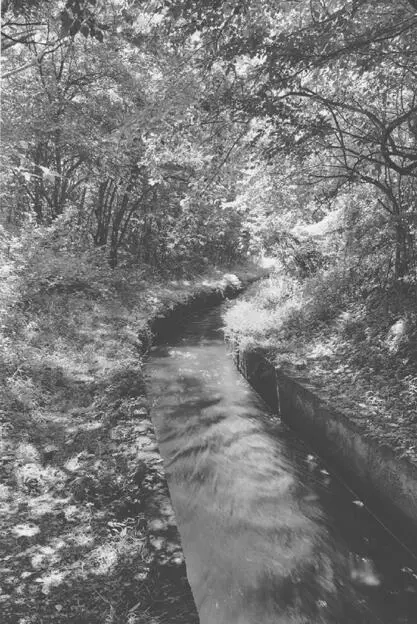
CANAL IN OIWAKE
I don’t know how aware Natsue may have been that Taro was in and out of the Chitose Funabashi house on a daily basis, but she made the exaggerated claim that “his family has been in the Utagawas’ service for generations.” It pleased her that the family she had married into was able to provide her own family with someone so useful to them.
In the Shigemitsu household, Yayoi seemed to feel it wasn’t right to use a boy the same age as Masayuki as a handyman, and so, although the Demon made occasional demands of him, she herself never did. Ever since the sweater incident she kept her distance, as though she had done something wrong, and if she happened to pass him she would greet him with the sudden shyness of a girl. Taro in turn would respond with a bashfulness that is not unusual in adolescent boys but that was rare with him.
Time’s pace was so slow and ambling that it scarcely seemed to move, but one thing did change quickly, and that was Taro’s physique. He was rather late in developing, but from around his second year in middle school he shot up, and his voice deepened. Yoko entered puberty around the same time, but girls’ physical changes are not as dramatic as boys’ to begin with, and although her asthma had retreated, she was still delicate in health and childish in appearance. Taro, by contrast, though he had once been as sweet-looking as a girl, became decidedly masculine. Sometimes I would sit and marvel at his cheekbones and jaw. When he worked up a sweat, his armpits gave off a strong sweet-sour smell like that of some animal at night. I think he knew that once he became a full-grown man he could not go on being with Yoko the way he had all these years, so he did what he could to minimize this transformation, talking to her in a high voice and acting childish around her. Mrs. Utagawa had grown so used to seeing him every day, and he was so much like a grandson to her, that she may not have noticed the changes particularly. But others did.
Harue teased him outright. “Well, look at you! You’ve turned into quite a charmer, haven’t you!”
She was right too. As he matured, the appeal of his rather unconventional looks gradually attracted attention. Now that I think of it, Yoko might have been the one most immune to his charms. Taro hung so eagerly on all she did, from morning to night, and Yoko took their rather peculiar relationship so much for granted, that she never seemed to realize how others might see him.
Harue even made the same uncalled-for comment to her sister Natsue: “You know something? That boy Taro is turning into a real charmer.”
“Is he?”
“Yes, indeed. If he gets any more grown-up, you’d better not let him hang around Yoko too much.”
That conversation took place in Karuizawa, and it must have stuck in Natsue’s mind. Some six months later, one balmy Sunday morning, she and I were in the kitchen of the Chitose Funabashi house, making breakfast with the windows open, in an atmosphere fragrant with the smell of coffee. From out back we could plainly hear O-Tsune yelling angrily: “The way you pigs stuff yourselves, you eat up every yen we earn!”
Natsue and I exchanged wide-eyed looks. Then, as if remembering what Harue had said that time, she turned with a frown to Yoko, who was setting the table with her sister, and asked, “Does Taro still come over every day?”
“Not every day,” Yoko lied, her face bent toward the table as she laid out the knives and forks.
“It’s one thing to help him with his schoolwork, but you mustn’t spend all your time with a boy like that.”
Yoko was silent. By then she couldn’t possibly have helped Taro with his schoolwork, but there was no point in her saying so.
“He will only have a bad influence on you.”
When Yoko didn’t answer this but just kept on with her work, head down, Natsue raised her eyebrows. Takero, who had been drinking his morning coffee and reading the paper, spoke up. “Look, there’s no need to worry about Taro. He may have grown up with those people back there, but he’s no lout. I’ve seen him at Oiwake. The boy knows how to behave.”
“You may think so, but Yoko will be starting high school next year, and I don’t think it’s right for her to be spending so much time with him.”
“Maybe so, but once she’s in high school, things will change anyway.”
Yoko had just turned fourteen, but she was so small and childish for her age that she looked barely twelve, standing there beside her more mature sister. Looking at her, her mother evidently thought pressing the matter any further would be pointless and let it drop. Probably she ought to have had the girl spend her afternoons at the Saegusas’ after school, but because of old Mrs. Utagawa, she wanted to avoid that.
A FEW MONTHS after that exchange, in the summer of 1963, after a long lull, time was jolted forward. It started in Oiwake when Taro noticed that the whites of old Mrs. Utagawa’s eyes had turned yellow. When she went to Karuizawa Hospital to be examined, the diagnosis was senile jaundice, a sign that she didn’t have long to live. Frail though she seemed, the old lady had a strong constitution, and had never been infected by her husband’s syphilis. I always assumed she would live on for years, and the news left me dazed. It was decided that she should stay in Oiwake, since she would only suffer in the heat if she returned to Tokyo. Yoko came over from Karuizawa, and she and Taro looked after her together. Yoko’s father spent more time there than usual that summer, and her mother came visiting several times, driven by Fuyue, who had just passed her driving test.
I too went over as often as I could to check on her condition.
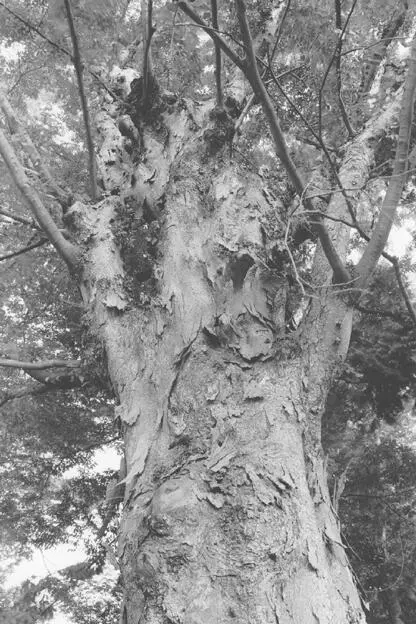
AGED TREE
Taro and Yoko gave up trekking around the countryside so that she wouldn’t be alone. But even though they learned how to cope, and could cook things she enjoyed, not having any adults in charge must have been tough for them on their own. When she saw me arrive, Yoko would jump up and down, clapping the tips of her fingers, and Taro looked relieved too. With the four of us together again, much the way it had been from the time Taro first began having after-school snacks with us, we felt like a family.
Читать дальшеИнтервал:
Закладка:
Похожие книги на «A True Novel»
Представляем Вашему вниманию похожие книги на «A True Novel» списком для выбора. Мы отобрали схожую по названию и смыслу литературу в надежде предоставить читателям больше вариантов отыскать новые, интересные, ещё непрочитанные произведения.












Обсуждение, отзывы о книге «A True Novel» и просто собственные мнения читателей. Оставьте ваши комментарии, напишите, что Вы думаете о произведении, его смысле или главных героях. Укажите что конкретно понравилось, а что нет, и почему Вы так считаете.