Nadine Gordimer - Life Times - Stories 1952-2007
Здесь есть возможность читать онлайн «Nadine Gordimer - Life Times - Stories 1952-2007» весь текст электронной книги совершенно бесплатно (целиком полную версию без сокращений). В некоторых случаях можно слушать аудио, скачать через торрент в формате fb2 и присутствует краткое содержание. Год выпуска: 2010, Издательство: Farrar, Straus and Giroux, Жанр: Современная проза, на английском языке. Описание произведения, (предисловие) а так же отзывы посетителей доступны на портале библиотеки ЛибКат.
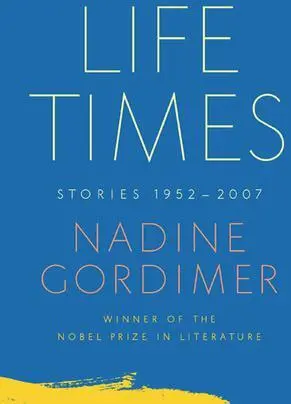
- Название:Life Times: Stories 1952-2007
- Автор:
- Издательство:Farrar, Straus and Giroux
- Жанр:
- Год:2010
- ISBN:нет данных
- Рейтинг книги:5 / 5. Голосов: 1
-
Избранное:Добавить в избранное
- Отзывы:
-
Ваша оценка:
Life Times: Stories 1952-2007: краткое содержание, описание и аннотация
Предлагаем к чтению аннотацию, описание, краткое содержание или предисловие (зависит от того, что написал сам автор книги «Life Times: Stories 1952-2007»). Если вы не нашли необходимую информацию о книге — напишите в комментариях, мы постараемся отыскать её.
This collection of Nadine Gordimer’s short fiction demonstrates her rich use of language and her unsparing vision of politics, sexuality, and race. Whether writing about lovers, parents and children, or married couples, Gordimer maps out the terrain of human relationships with razor-sharp psychological insight and a stunning lack of sentimentality. The selection, which spans the course of Gordimer’s career to date, presents the range of her storytelling abilities and her brilliant insight into human nature. From such epics as “Friday’s Footprint” and “Something Out There” to her shorter, more experimental stories, Gordimer’s work is unfailingly nuanced and complex. Time and again, it forces us to examine how our stated intentions come into conflict with our unspoken desires.
This definitive volume, which includes four new stories from the Nobel laureate, is a testament to the power, force, and ongoing relevance of Gordimer’s vision.
Life Times: Stories 1952-2007 — читать онлайн бесплатно полную книгу (весь текст) целиком
Ниже представлен текст книги, разбитый по страницам. Система сохранения места последней прочитанной страницы, позволяет с удобством читать онлайн бесплатно книгу «Life Times: Stories 1952-2007», без необходимости каждый раз заново искать на чём Вы остановились. Поставьте закладку, и сможете в любой момент перейти на страницу, на которой закончили чтение.
Интервал:
Закладка:
Dreaming of the Dead
Did you come back last night?
I try to dream you into materialisation but you don’t appear. I keep expecting you. Because dream has no place, time. The Empyrean — always liked that as my free-floating definition of Somenowhere — balloon without tether to earth. There is no past no present no future. All is occupied at once. Everyone there is without boundaries of probability.
I don’t know why it was a Chinese restaurant — ah, no, the choice is going to come clear later when a particular one of the guests arrives! Guests? Whose invitation is it. Who hosts. Such causation doesn’t apply; left behind. Look up and there’s Edward, the coin-clear profile of Edward Said that is aware how masculinely beautiful it still exists in photographs, he’s turning this way and that to find where the table is that expects him. It’s his decision it’s this one. He’s always known what was meant for him, the placing of himself, by himself, through the path of any obstacles, Christian-Muslim, Palestinian-Cairene, American. He’s his own usher, shining a torch of distinctive intellectual light and sensibility to guide him. It’s not the place to remember this, here, but if you’re the one still living in the flesh wired up by synapses and neurons you recall his wife Mariam told that on his last journey to the hospital he disputed the route taken by the driver.
Edward. He stands a moment, before the embrace of greeting. His familiar way of marking the event of a meeting brought about by the coordination of friends’ commitments and lucky happenstance. It’s reassuring he’s wearing one of the coloured shirts and the flourished design of his tie is confirmed by the ear of a silk handkerchief showing above the breast pocket of the usual elegant jacket. Edward never needed to prove his mental superiority by professorial dowdiness and dandruff. We don’t bother with how-are-yous, there’s no point in that sort of banality, here. He says why don’t we have a drink while we’re waiting — he seems to know for whom although I don’t (except, for you) any more than I knew he would come to this place hung with fringed paper lanterns. He beckons a waiter who doesn’t pretend in customary assertion of dignity against servility that he hasn’t noticed. Edward never had to command, I’d often noted that, there is something in those eyes fathomless black with ancient Middle Eastern ancestry, that has no need of demanding words. With the glance back to me, he orders what we’ve always drunk to being well-met. He apologises with humour ‘I don’t know how I managed to be late, it’s quite an art’ though he isn’t late because he never was expected, and there can be no explanation I could understand of what could have kept him.
We plunge right away into our customary eager exchange of interpretations of political events, international power-mongering, national religious and secular conflicts, the obsessional scaffolding of human existence on earth, then ready to turn to personal preoccupations, for which, instinctively selected in each friendship, there is a different level of confidences. Before we get to ours, someone else arrives at our table; even I, who have known that face in its changes over many years and in relation to many scenes and circumstances, from treason trials in the country where I am still one of the living, to all-night parties in London, don’t recognise his entry. Once standing at this table, the face creased in his British laugh of greeting: it’s Anthony Sampson. Who? Because instead of the baggy pants unworthy of tweed jacket, he’s wearing an African robe. Not just a dashiki shirt he might have picked up on his times in Africa, and donned for comfortable summer informality of whatever this gathering is, but a robe to the ankles — by the way, it can’t be hot in the Chinese restaurant; there’s no climate in dream. When he was editor of a black-staffed newspaper in South Africa and belonged, was an intimate of shebeen ghettos, never mind his pink British skin, this preceded the era when African garb became fashionable as a mark of the wearer’s non-racism. Sampson had no interest in being fashionable within any convention. He showed no consciousness, now, of his flowing robe. So neither did I; nor did Edward though I suppose they had met in the Elsewhere. Edward rose while Anthony and I hugged, kissed on either cheek, he greeted Edward with recollected — it seemed — admiration and chose a chair, having to arrange the robe out of the way of his shoes, like a skirt.
We took up, three of us now, the interrupted talk of political conflict and scandals, policies and ideologies, corrupt governments, tyrant fundamentalists, homegrown in the Middle East and Eastern Europe, and those created by the hubris of the West. A waiter subserviently intruded with distributed menus but we all ignored him as if it were understood we were waiting for someone. I was waiting for you. Even in that Chinese restaurant though it was never your favourite cuisine.
Whom were we waiting for?
I wonder now, awakened in bed by a heavy cat settling on my feet, but I didn’t then, no one asked me so I didn’t have to give my answer: you. Edward opened a menu big and leather-bound as a book of world maps. Perhaps this meant he and Anthony knew no one was coming. No one else was available among the dead in their circle. Maybe the too newly dead cannot enter dreams. But no; Anthony was recent, and here he was, if strangely got up in the category of the childhood belief that when you die you grow wings, become angels in the Empyrean.
Suddenly she was there, sitting at the head of the table as if she had been with us all along or because there was no time we hadn’t remarked when it was she’d joined us. Susan. Susan Sontag. How to have missed the doorway entrance of that presence always larger-than-life (stupid metaphor to have chosen in the circumstances, but this is a morning-after account) not only in sense of her height and size: a mythical goddess, Athena-Medea statue with that magnificent head of black hair asserting this doubling authority, at once inspiring, menacing, unveiling a sculptor’s bold marble features, gouged by commanding eyes.
It seemed there had been greetings. Exclamations of pleasure, embraces and less intimate but just as sincere pressures of hands left animation, everyone talking at once across one another. Susan’s deep beautiful voice interrupted itself in an aside to call a waiter by name — well of course, so this is the Chinese restaurant in New York’s SoHo she used to take me to! The waiters know her, she’s the habituée who judges what’s particularly good to order, in fact she countermands with an affectionate gesture of a fine hand the hesitant choices of the others and questions, insists, laughs reprovingly at some of the waiter’s suggestions; he surely is aware of what the cooks can’t get away with, with her. She does let us decide on what to drink. Susan was never a drinker and this one among her favourite eating places probably doesn’t have a cellar of the standard that holds the special French and Italian cultivars for which she makes an exception.
As if, non-smoker, she carries a box of matches, there strikes from her a flame flaring the Israeli-Palestinian situation. The light’s turned on Edward, naturally, although this is not a group in which each sees personal identity and its supposed unquestioning loyalty cast by birth, faith, country, race, as the decisive and immutable sum of self. Edward is a Palestinian, he’s also in his ethics of human being, a Jew, we know that from his writings, his exposure of the orientalism within us, the invention of the Other that’s survived the end of the old-style colonialism into globalisation. If Susan’s a Jew, she too has identity beyond that label, hers has been one with Vietnamese, Sarajevans, many others, to make up the sum of self.
Читать дальшеИнтервал:
Закладка:
Похожие книги на «Life Times: Stories 1952-2007»
Представляем Вашему вниманию похожие книги на «Life Times: Stories 1952-2007» списком для выбора. Мы отобрали схожую по названию и смыслу литературу в надежде предоставить читателям больше вариантов отыскать новые, интересные, ещё непрочитанные произведения.






Обсуждение, отзывы о книге «Life Times: Stories 1952-2007» и просто собственные мнения читателей. Оставьте ваши комментарии, напишите, что Вы думаете о произведении, его смысле или главных героях. Укажите что конкретно понравилось, а что нет, и почему Вы так считаете.