Walker Percy - The Moviegoer
Здесь есть возможность читать онлайн «Walker Percy - The Moviegoer» весь текст электронной книги совершенно бесплатно (целиком полную версию без сокращений). В некоторых случаях можно слушать аудио, скачать через торрент в формате fb2 и присутствует краткое содержание. Год выпуска: 2011, Издательство: Open Road Media, Жанр: Современная проза, на английском языке. Описание произведения, (предисловие) а так же отзывы посетителей доступны на портале библиотеки ЛибКат.
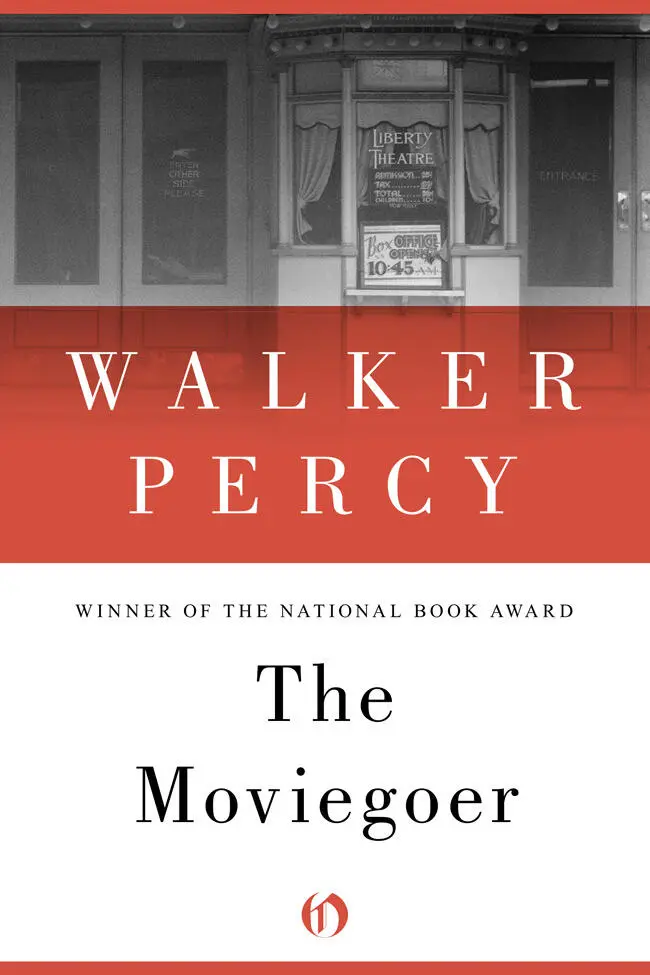
- Название:The Moviegoer
- Автор:
- Издательство:Open Road Media
- Жанр:
- Год:2011
- ISBN:нет данных
- Рейтинг книги:5 / 5. Голосов: 1
-
Избранное:Добавить в избранное
- Отзывы:
-
Ваша оценка:
The Moviegoer: краткое содержание, описание и аннотация
Предлагаем к чтению аннотацию, описание, краткое содержание или предисловие (зависит от того, что написал сам автор книги «The Moviegoer»). Если вы не нашли необходимую информацию о книге — напишите в комментариях, мы постараемся отыскать её.
The Moviegoer — читать онлайн бесплатно полную книгу (весь текст) целиком
Ниже представлен текст книги, разбитый по страницам. Система сохранения места последней прочитанной страницы, позволяет с удобством читать онлайн бесплатно книгу «The Moviegoer», без необходимости каждый раз заново искать на чём Вы остановились. Поставьте закладку, и сможете в любой момент перейти на страницу, на которой закончили чтение.
Интервал:
Закладка:
Thérèse is telling about her plans to write her Congressman about the Rivers and Harbors bill. Thérèse and Mathilde are something like Joan and Jane in the Civics reader.
“Isn’t that Tessie a case?” my mother cries as she disappears into the kitchen, signifying that Tessie is smart but also that there is something funny about her precocity.
“Where’s Roy? We didn’t see a car. We almost didn’t walk over.”
“Playing poker!” they all cry. This seems funny and everybody laughs. Lonnie’s hand curls. If our arrival had caused any confusion, we are carried quickly past by the strong current of family life.
“Do you have any more crabs, Mother?”
“Any more crabs! Ask Lonnie if we weren’t just wondering what to do with the rest. You haven’t had your supper?”
“No’m.”
Mother folds up the thick layer of newspaper under the crab carcasses, making a neat bundle with her strong white hands. The whole mess comes away leaving the table dry and clean. Thérèse spreads fresh paper and Mathilde fetches two cold bottles of beer and two empty bottles for hammering the claws and presently we have a tray apiece, two small armies of scarlet crabs marching in neat rows. Sharon looks queer but she pitches in anyhow and soon everybody is making fun of her. Mathilde shows her how to pry off the belly plate and break the corner at the great claw so that the snowy flesh pops out in a fascicle. Sharon affects to be amazed and immediately the twins must show her how to suck the claws.
Outside is the special close blackness of night over water. Bugs dive into the tight new screen and bounce off with a guitar thrum. The children stand in close, feeling the mystery of the swamp and the secrecy of our cone of light. Clairain presses his stomach against the arm of my chair. Lonnie tries to tune his transistor radio; he holds it in the crook of his wrist, his hands bent back upon it. Once his lip falls open in the most ferocious leer. This upsets Sharon. It seems to her that a crisis is at hand, that Lonnie has at last reached the limit of his endurance. When no one pays any attention to him, she grows fidgety — why doesn’t somebody help him? — then, after an eternity, Mathilde leans over carelessly and tunes in a station loud and clear. Lonnie turns his head, weaving, to see her, but not quite far enough.
Lonnie is dressed up, I notice. It turns out that Aunt Ethel, Roy’s sister, was supposed to take him and the girls to a movie. It was not a real date, Mother reminds him, but Lonnie looks disappointed.
“What is the movie?” I ask him.
“Fort Dobbs.” His speech is crooning but not hard to understand.
“Where is it?”
“At the Moonlite.”
“Let’s go.”
Lonnie’s head teeters and falls back like a dead man’s.
“I mean it. I want to see it.”
He believes me.
I corner my mother in the kitchen.
“What’s the matter with Lonnie?”
“Why nothing.”
“He looks terrible.”
“That child won’t drink his milk!” sings out my mother.
“Has he had pneumonia again?”
“He had the five day virus. And it was bad bad bad bad bad. Did you ever hear of anyone with virus receiving extreme unction?”
“Why didn’t you call me?”
“He wasn’t in danger of death. The extreme unction was his idea. He said it would strengthen him physically as well as spiritually. Have you ever heard of that?”
“Yes. But is he all right now?”
She shrugs. My mother speaks of such matters in a light allusive way, with the overtones neither of belief nor disbelief but rather of a general receptivity to lore.
“Dr Murtag said he’d never seen anything like it. Lonnie got out of bed in half an hour.”
Sometimes when she mentions God, it strikes me that my mother uses him as but one of the devices that come to hand in an outrageous man’s world, to be put to work like all the rest in the one enterprise she has any use for: the canny management of the shocks of life. It is a bargain struck at the very beginning in which she settled for a general belittlement of everything, the good and the bad. She is as wary of good fortune as she is immured against the bad, and sometimes I seem to catch sight of it in her eyes, this radical mistrust: an old knowledgeable gleam, as old and sly as Eve herself. Losing Duval, her favorite, confirmed her in her election of the ordinary. No more heart’s desire for her, thank you. After Duval’s death she has wanted everything colloquial and easy, even God.
“But now do you know what he wants to do? Fast and abstain during Lent.” Her eyes narrow. Here is the outrage. “He weighs eighty pounds and he has one foot in the grave and he wants to fast.” She tells it as a malignant joke on Lonnie and God. For a second she is old Eve herself.
Fort Dobbs is good. The Moonlite Drive-In is itself very fine. It does not seem too successful and has the look of the lonesome pine country behind the Coast. Gnats swim in the projection light and the screen shimmers in the sweet heavy air. But in the movie we are in the desert. There under the black sky rides Clint Walker alone. He is a solitary sort and a wanderer. Lonnie is very happy. Thérèse and Mathilde, who rode the tops of the seats, move to a bench under the projector and eat snowballs. Lonnie likes to sit on the hood and lean back against the windshield and look around at me when a part comes he knows we both like. Sharon is happy too. She thinks I am a nice fellow to take Lonnie to the movies like this. She thinks I am being unselfish. By heaven she is just like the girls in the movies who won’t put out until you prove to them what a nice unselfish fellow you are, a lover of children and dogs. She holds my hand on her knee and gives it a squeeze from time to time.
Clint Walker rides over the badlands, up a butte, and stops. He dismounts, squats, sucks a piece of mesquite and studies the terrain. A few decrepit buildings huddle down there in the canyon. We know nothing of him, where he comes from or where he goes.
A good night: Lonnie happy (he looks around at me with the liveliest sense of the secret between us; the secret is that Sharon is not and never will be onto the little touches we see in the movie and, in the seeing, know that the other sees — as when Clint Walker tells the saddle tramp in the softiest easiest old Virginian voice: “Mister, I don’t believe I’d do that if I was you”—Lonnie is beside himself, doesn’t know whether to watch Clint Walker or me), this ghost of a theater, a warm Southern night, the Western Desert and this fine big sweet piece, Sharon.
A good rotation. A rotation I define as the experiencing of the new beyond the expectation of the experiencing of the new. For example, taking one’s first trip to Taxco would not be a rotation, or no more than a very ordinary rotation; but getting lost on the way and discovering a hidden valley would be.
The only other rotation I can recall which was possibly superior was a movie I saw before the war called Dark Waters. I saw it in Lafitte down on Bayou Barataria. In the movie Thomas Mitchell and Merle Oberon live in a decaying mansion in a Louisiana swamp. One night they drive into the village — to see a movie! A repetition within a rotation. I was nearly beside myself with rotatory emotion. But Fort Dobbs is as good as can be. My heart sings like Octavian and there is great happiness between me and Lonnie and this noble girl and they both know it and have the sense to say nothing.
THREE O’CLOCK and suddenly awake amid the smell of dreams and of the years come back and peopled and blown away again like smoke. A young man am I, twenty nine, but I am as full of dreams as an ancient. At night the years come back and perch around my bed like ghosts.
Читать дальшеИнтервал:
Закладка:
Похожие книги на «The Moviegoer»
Представляем Вашему вниманию похожие книги на «The Moviegoer» списком для выбора. Мы отобрали схожую по названию и смыслу литературу в надежде предоставить читателям больше вариантов отыскать новые, интересные, ещё непрочитанные произведения.










Обсуждение, отзывы о книге «The Moviegoer» и просто собственные мнения читателей. Оставьте ваши комментарии, напишите, что Вы думаете о произведении, его смысле или главных героях. Укажите что конкретно понравилось, а что нет, и почему Вы так считаете.