Walker Percy - The Moviegoer
Здесь есть возможность читать онлайн «Walker Percy - The Moviegoer» весь текст электронной книги совершенно бесплатно (целиком полную версию без сокращений). В некоторых случаях можно слушать аудио, скачать через торрент в формате fb2 и присутствует краткое содержание. Год выпуска: 2011, Издательство: Open Road Media, Жанр: Современная проза, на английском языке. Описание произведения, (предисловие) а так же отзывы посетителей доступны на портале библиотеки ЛибКат.
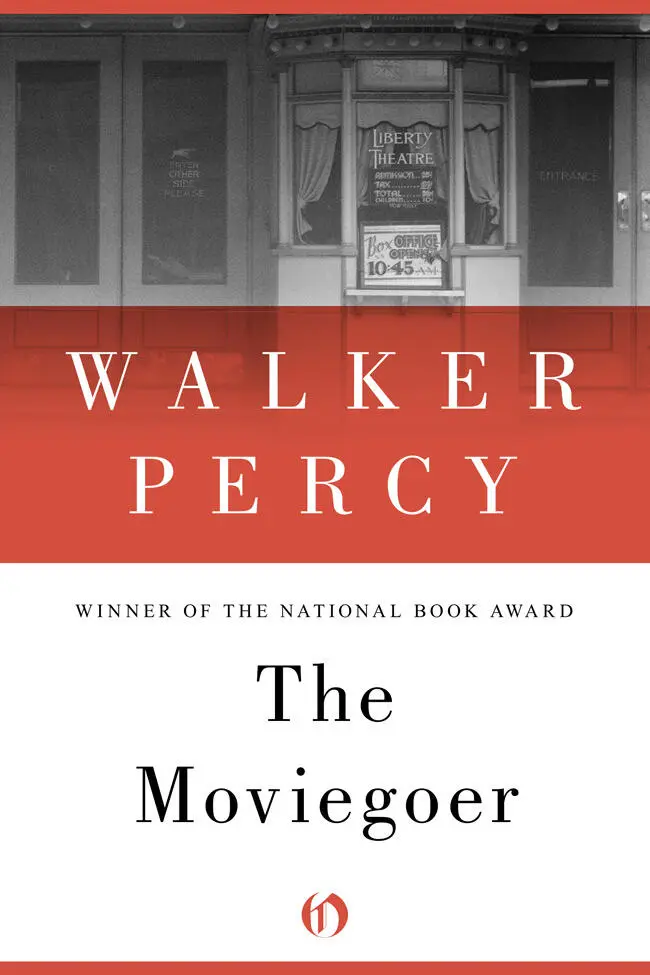
- Название:The Moviegoer
- Автор:
- Издательство:Open Road Media
- Жанр:
- Год:2011
- ISBN:нет данных
- Рейтинг книги:5 / 5. Голосов: 1
-
Избранное:Добавить в избранное
- Отзывы:
-
Ваша оценка:
The Moviegoer: краткое содержание, описание и аннотация
Предлагаем к чтению аннотацию, описание, краткое содержание или предисловие (зависит от того, что написал сам автор книги «The Moviegoer»). Если вы не нашли необходимую информацию о книге — напишите в комментариях, мы постараемся отыскать её.
The Moviegoer — читать онлайн бесплатно полную книгу (весь текст) целиком
Ниже представлен текст книги, разбитый по страницам. Система сохранения места последней прочитанной страницы, позволяет с удобством читать онлайн бесплатно книгу «The Moviegoer», без необходимости каждый раз заново искать на чём Вы остановились. Поставьте закладку, и сможете в любой момент перейти на страницу, на которой закончили чтение.
Интервал:
Закладка:
It turns out that Mr Sartalamaccia is a contractor and owns the housing development next door. He has done well and he wants my duck club for an addition. I ask about the houses.
“You want to see one?”
We follow him along a hog trail to a raw field full of pretty little flat-topped houses. He must show us one abuilding. I take pleasure in watching him run a thumb over the sawn edges of the sheathing. Sharon does not mind. She stands foursquare, eyes rolled back a little, showing white. She is sleepy-eyed and frumpy; she looks like snapshots of Ava Gardner when she was a high school girl in North Carolina.
“You know what’s in this slab?” The concrete is smooth as silk.
“No.”
“Chance number six copper pipe. Nobody will ever know it’s there but it will be there a long time.” I see that with him it is not purely and simply honesty; it is his own pleasure at thinking of good pipe in a good slab.
Back at the hummock, Mr Sartalamaccia takes me aside and holds his hat away to the east. “You see that ditcher and doozer?”
“Yes.”
“You know what that’s going to be?”
“No.”
“That’s the tidewater canal to the Gulf. You know how much our land is going to be worth?”
“How much?”
“Fifty dollars a foot.” Mr Sartalmaccia draws me close. Again he tells it as the veriest piece of news. Deal or no deal, this is a piece of news that bears telling.
Later Sharon tells me I was smart to trick him into revealing the true value of my duck club. But she is mistaken. It came about from the moment I met him that thenceforward it pleased him to speak of the past, of his strange odyssey in 1932 when he gazed at Old Faithful in Yellowstone Park and worked on the causeway to Key West and did not go hungry — it pleased him to speak with me of the past and to connive with me against the future. He speaks from his loneliness and together we marvel at the news of the canal and enjoy the consolation of making money. For money is a great joy.
Mr Sartalamaccia has become possessed by a secret hilarity. He gives me a poke in the ribs. “I’ll tell you what we can do, Mr Bolling. You keep your land! I’ll develop it for you. You make the offsite improvements. I’ll build the houses. We’ll make us some money.” He shrinks away in some kind of burlesque.
“How much do you think we can make?”
“Well I don’t know. But I can tell you this.” Mr Sartalamaccia is hopping in a sort of goat dance and Sharon stands dreaming in the green darkness of the glade. “I’ll give you fifteen thousand for it right now!”
Our name is Increase.
Sharon and I spin along the River Road. The river is high and the booms and stacks of ships ride up and down the levee like great earth engines.
In the Shell station and in a drift of honeysuckle sprouting through the oil cans and standing above Sharon with a Coke balanced on her golden knee, I think of flattening my hummock with bulldozers and it comes back to me how the old Gable used to work at such jobs: he knew how to seem to work and how to seem to forget about women: stand asweat with his hands in his back pockets.
It is a great joy to be with Sharon and to make money at it and to seem to pay no attention to her. As for Sharon: she finds nothing amiss in sitting in the little bucket seat with her knees doubled up in the sunshine, dress tucked under. An amber droplet of Coca-Cola meanders along her thigh, touches a blond hair, distributes itself around the tiny fossa.
“Aaauugh,” I groan aloud.
“What’s the matter?”
“It is a stitch in the side.” It is a sword in the heart.
Sharon holds a hand against the sun to see me. “Mr Bolling?”
“Yes.”
“Do you remember the price Mr Sartalamaccia first mentioned?”
“Eight thousand dollars.”
“He was really gon mess you up.”
“No he wasn’t. But if it hadn’t been for you, I’d have taken the eight thousand.”
“Me?”
“You got me to come down here.”
She assents doubtfully, casting back in her mind with one eye screwed up.
“Do you know how much you saved me, or rather made for me? At least seven thousand dollars and probably a great deal more. I’m obliged to give you ten percent.”
“You’re not giving me any money, son.”
I have to laugh. “Why not?”
“Ain’t nobody giving me any money.” (Now she catches herself and speaks broadly on purpose.) “I got plenty money.”
“How much money do you have?”
“Ne’mind.”
By flexing her leg at a certain angle, she can stand the Coke on a facet of her knee. What a structure it is, tendon and bone, facet and swell, and gold all over.
I go home as the old Gable, asweat and with no thought for her and sick to death with desire. She is pleased because, for one thing, she can keep quiet. I notice that it makes her uneasy to keep up a conversation.
She says only one more thing, tilting her head, eyes alight. “What about the court house?”
“It’s too late. You didn’t have to come. I’m sorry.”
“Listen!” she cries, as far away as Eufala itself. “I had a wonderful time!”
ONCE A WEEK, on Fridays, all Cutrer salesmen return to the main office for a lunch conference with the staff. The week’s business is reviewed, sales reports made, talks given on market conditions and coming issues presented by the underwriter. But today there is not much talk of business. Carnival is in full swing. Parades and balls go on night and day. A dozen krewes have already had their hour, and Proteus, Rex and Comus are yet to come. Partners and salesmen alike are red-eyed and abstracted. There is gossip about the identity of the king and queen of Iberia tonight (most of the staff of Cutrer, Klostermann and Lejier are members either of the Krewe of Neptune or the Krewe of Iberia). It is generally conceded that the king of Iberia will be James (Shorty) Jones, president of Middle Gulf Utilities, and the queen Winky Ouillibert, the daughter of Plauche Ouillibert of Southern Mutual. The choice is a popular one — I can testify that both men are able, likable and unassuming fellows.
Some Fridays, Uncle Jules likes to see me in his office after lunch. When he does, he so signifies by leaving his door open to the corridor so that I will see him at his desk and naturally stop by to say hello. Today he seems particularly glad to see me. Uncle Jules has a nice way of making you feel at home. Although he has a big office with an antique desk and a huge portrait of Aunt Emily, and although he is a busy man, he makes you feel as if you and he had come upon this place in your wanderings; he is no more at home than you. He sits everywhere but in his own chair and does business everywhere but at his own desk. Now he takes me into a corner and stands feeling the bones of my shoulder like a surgeon. “Ravaud came in to see me this morning.” Uncle Jules falls silent and throws his head straight back. I know enough to wait. “He said, Jules, I’ve got a little bad news for you — you know the convention of the open-ends, the one you never miss? I said, sure, I know about it.” Now Uncle Jules puts his head down to my chest as if he were listening to my heart. I wait. “Do you know when it is? Why yes, along about the middle of March, I told him. Along about Tuesday, says Ravaud. Carnival day.” Uncle Jules presses my shoulder to keep me quiet. “Is that right, Ravaud? Oh, that reminds me. Here are your tickets. Have a good trip.” Uncle Jules is bent way over and I can’t tell whether he is laughing, but his thumb presses deep into the socket of my shoulder.
“That’s pretty good.”
“But then he said something that stuck in my mind. He said, I don’t mind going if you want me to, Jules, but you got the man right in your own family. Why that scoun’l beast Jack Bolling knows more about selling open-ends than anybody on Carondelet Street. So. You don’t really care about Carnival, do you?” He does not really believe I do not. As for himself, he could not conceive being anywhere on earth Mardi Gras morning but the Boston Club.
Читать дальшеИнтервал:
Закладка:
Похожие книги на «The Moviegoer»
Представляем Вашему вниманию похожие книги на «The Moviegoer» списком для выбора. Мы отобрали схожую по названию и смыслу литературу в надежде предоставить читателям больше вариантов отыскать новые, интересные, ещё непрочитанные произведения.









Обсуждение, отзывы о книге «The Moviegoer» и просто собственные мнения читателей. Оставьте ваши комментарии, напишите, что Вы думаете о произведении, его смысле или главных героях. Укажите что конкретно понравилось, а что нет, и почему Вы так считаете.