Ranko Marinkovic - Cyclops
Здесь есть возможность читать онлайн «Ranko Marinkovic - Cyclops» весь текст электронной книги совершенно бесплатно (целиком полную версию без сокращений). В некоторых случаях можно слушать аудио, скачать через торрент в формате fb2 и присутствует краткое содержание. Год выпуска: 2010, Издательство: Yale University Press, Жанр: Современная проза, на английском языке. Описание произведения, (предисловие) а так же отзывы посетителей доступны на портале библиотеки ЛибКат.
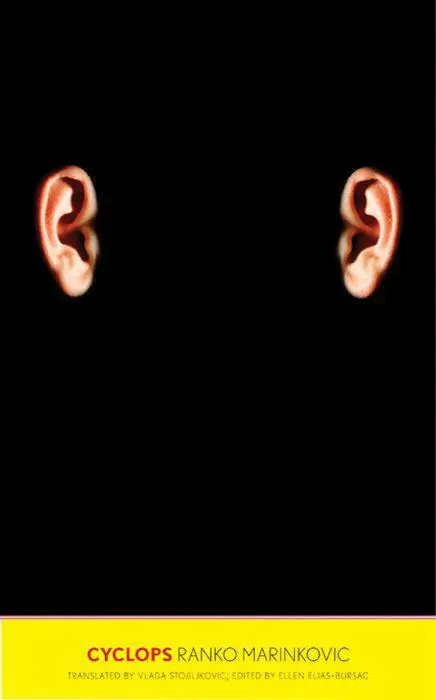
- Название:Cyclops
- Автор:
- Издательство:Yale University Press
- Жанр:
- Год:2010
- ISBN:нет данных
- Рейтинг книги:3 / 5. Голосов: 1
-
Избранное:Добавить в избранное
- Отзывы:
-
Ваша оценка:
Cyclops: краткое содержание, описание и аннотация
Предлагаем к чтению аннотацию, описание, краткое содержание или предисловие (зависит от того, что написал сам автор книги «Cyclops»). Если вы не нашли необходимую информацию о книге — напишите в комментариях, мы постараемся отыскать её.
, Croatian writer Ranko Marinkovic recounts the adventures of young theater critic Melkior Tresic, an archetypal antihero who decides to starve himself to avoid fighting in the front lines of World War II. As he wanders the streets of Zagreb in a near-hallucinatory state of paranoia and malnourishment, Melkior encounters a colorful circus of characters — fortune-tellers, shamans, actors, prostitutes, bohemians, and café intellectuals — all living in a fragile dream of a society about to be changed forever.
A seminal work of postwar Eastern European literature,
reveals a little-known perspective on World War II from within the former Yugoslavia, one that has never before been available to an English-speaking audience. Vlada Stojiljkovic's able translation, improved by Ellen Elias-Bursac's insightful editing, preserves the striking brilliance of this riotously funny and densely allusive text. Along Melkior’s journey
satirizes both the delusions of the righteous military officials who feed the national bloodlust as well as the wayward intellectuals who believe themselves to be above the unpleasant realities of international conflict. Through Stojiljkovic's clear-eyed translation, Melkior’s peregrinations reveal how history happens and how the individual consciousness is swept up in the tide of political events, and this is accomplished in a mode that will resonate with readers of Charles Simic, Aleksandr Hemon, and Kundera.
Cyclops — читать онлайн бесплатно полную книгу (весь текст) целиком
Ниже представлен текст книги, разбитый по страницам. Система сохранения места последней прочитанной страницы, позволяет с удобством читать онлайн бесплатно книгу «Cyclops», без необходимости каждый раз заново искать на чём Вы остановились. Поставьте закладку, и сможете в любой момент перейти на страницу, на которой закончили чтение.
Интервал:
Закладка:
~ ~ ~
A discarded cigarette is burning down in the street. A butt flicked out of a high window. A sizeable butt, nearly half the cigarette; as there is only a gentle breeze it might survive for quite a time, fifteen or twenty minutes, under favorable circumstances. Perhaps even longer, as long as an insect would survive crossing the street. A cockroach. No, a cigarette butt is a fallen firefly … A woman of sin expelled from a bed where love has come and gone. It flew in a burning arc like a meteor, out the window — into the street. It is now sending up smoke from the ember. Burning, alive …
“I could step off the pavement, go out into the middle of the road and kill it, stomp on it.”
A murderous thought requiring decision and deliberate action: that of stomping underfoot. Of murder. “For it is stupid for a butt to be alive in the middle of the road while upstairs there is only exhaustion and boredom in bed. The end.”
“You don’t love me anymore, I know. You would dearly love to flick me now out the window like a cigarette butt, for someone to crush on the street. You’re done smoking me …”
“I’ll be smoking again …”
“Yes. Smoking another cigarette. I’m finished. I’m a butt.”
“You’re a briar …”
“That’s right, call me a liar!”
“I said briar. A briar pipe.”
“Why a pipe? Does that have to do with your desire?”
“A pipe is something you don’t throw away. The longer you use it the finer it gets.”
“Like a violin. The longer you play it …”
“Yes, exactly like a violin.”
“And you will play?”
“Like a virtuoso!”
“Don’t play like a virtuoso. Just plain play.”
“Plain is how you play the bass. The violin should be played virtuoso. You are a violin. Look at yourself in the mirror over there, full figure, naked — aren’t you a violin?”
“Yes I am. Shall we play?”
“No, we’ll sleep. I’m a recruit. Hair shorn to the skin. Army cap lying low on my ears. Belt above the half-belt, you horrid little man!”
You’ve got to get up, you’ve got to get up … screamed the bugle.
“You woke it with your shall we play! You’re … Where are you?”
“Not looking for Greta Garbo, are you, pretty boy?” leered the drill sergeant from his bunk. “They’re tarts, all those night birds — flitting away at the crack of dawn. Take it from Nettle, old garrison rat.”
The barracks room laughed a dry, flattering laugh in the groggy grayness of the cold, senseless dawn.
… you’ve got to get up this morning, you … toots the bugle outside to the gray sky. Screeching into Melkior’s silly, sleepy ear: Rise and shine! Gotta groom the horses for King and Country! This is no hotel, you spoiled brat. Get your ass out of bed and off to the stables with you!
A penetrating jet of stable stench shot up his nostrils. But the equine ammonia cleared the torpid mind and stirred fresh, unsoldierly thoughts.
Is the King really so keen on horses? Each horse is my senior by a year or two. This ought to be very old age for equine gerontology. Hence the care. (Above each stall there is a board with the occupant’s name and year of birth.) So nice and caring. I’m glad to see the horses are well looked after.
“Tennn-shun!” yelled the sergeant, who for some reason called himself Nettle. All the skin-shorn heads under army caps quaked on the spot: through them, down the wire of discipline, had passed a jolt of Nettle. They stood in line along the stable passage stretching all the way down the row of stalls, and waited for Nettle’s command to jump to, each to his horse. The pampered animals are angry and hungry in the morning, biting and kicking, neighing wildly, will not let anyone come close. The recruits were trembling.
Melkior was reading the names on the boards: Prince, Caesar, Lisa (a mare), Boy, Ziko … He was standing in front of Caesar. Rather, Caesar was standing in front of him, idly flicking his tail left and right. Waiting.
Oh mighty Caesar (spake the wretched Melkior, trembling before the powerful rump), my heart is not the heart of Brutus. I kiss thy mighty hoof, not in flattery but with a plea to spare me, so that I might live on after we have parted ways. Receive my tribute as thou would receive the loyalty of Mark Antony who loved and feared thee and fearing thee respected thee even as I respect thy almighty haunches and thy gnashing teeth which in thy just rage …
Caesar gave an impatient neigh — he was bored with the speech. Cut to the chase! But that was a psychological trick of the high and mighty, as Melkior knew, and he clearly saw his plea for mercy had failed; Melkior must not approach the tyrant. He awaited Nettle’s command with trepidation: he knew he was not going to budge.
“Now then, crew,” Nettle strutted before the men (the entire barracks rested on his shoulders!) and issued instructions, “I don’t want none of the you-never-told-us stuff. I want the horses looking like prima donnas! Get it? Hey, new guy over there, whatcha laughin’ at, pretty boy?” This referred to Melkior, who had not been laughing at all. “Y’know what a prima donna is, dontcher?”
Melkior was silent, afraid of this being a trap. The boys nudged each other in the ribs, their cheeks bursting with laughter.
“Well, here’s a fine kettle o’ fish!” Nettle was dejected, omnipotently so. “An in-tel-lec-tual who don’t know what a prima donna is? Didya hear that, my sorry lads?” he asked the men.
The men knew the moment has not yet come and they bit their tongues. “What are ya — a civil engineer?” Nettle asked Melkior as if he had known his father.
Melkior knew it was time to step into Nettle’s trap — further resistance might only worsen the man’s mood …
“A teacher,” he mumbled.
“Don’t say! Teach!” Nettle was overjoyed at the news. “So you oughta know how to turn off a lightbulb, then?”
“Er … yes, I do.” He could not help but reply; it was the rules. He even mimed the switching off of a light switch, to increase the merriment.
“Oh, like that,” Nettle was disappointed (and the men were still keeping a straight face), “well, anyone can do it like that, even Numbskull here,” and he pointed at a little soldier with a constantly bewildered face. “Right, Numbskull? Now you know how, dontcher?”
“Know what, Sergeant?” Numbskull was not paying attention, he hadn’t been following the exchange …
“How to turn off a light.”
“Yes I do, Sergeant. By barking!” Numbskull rattled this off like a lesson learned by heart.
“Barking at what?”
“The lightbulb, of course.”
The stable echoed with a burst of laughter, which made the very horses neigh — they, too, found this hilarious.
“You’re lying!” Nettle was outshouting both men and horses, “you’re lying!”
Damned Numbskull had spoiled his fun! That was why the silly idiots were laughing — laughing at him, blast ’em …
“You bark at it, eh? All right, Numbskull — go on, get barking. Bark at the one over your head,” Nettle was taking his revenge. “Bark at it till it goes out. Now!”
And Numbskull started to bark, sharply and earnestly, like the worst tempered of dogs.
But Nettle was not winning: Numbskull seemed to enjoy it. He barked in all registers and tonalities, interpreting various types of canine character — various scenes, too. He whimpered like a pampered poodle, snarled like a mean flesh-ripping boxer, barked in the formal sluggish manner of a chained guard dog, shrilled in a frenzy like a stupid hysterical dog shunned by bitches, yapped merrily teasing the passersby like a roving ownerless dog, and howled piteously as though his master had died the day before. He really had barking down pat. He had them all admiring him, even emotionally moved, there was muttering in the row.
Читать дальшеИнтервал:
Закладка:
Похожие книги на «Cyclops»
Представляем Вашему вниманию похожие книги на «Cyclops» списком для выбора. Мы отобрали схожую по названию и смыслу литературу в надежде предоставить читателям больше вариантов отыскать новые, интересные, ещё непрочитанные произведения.






Обсуждение, отзывы о книге «Cyclops» и просто собственные мнения читателей. Оставьте ваши комментарии, напишите, что Вы думаете о произведении, его смысле или главных героях. Укажите что конкретно понравилось, а что нет, и почему Вы так считаете.