Ranko Marinkovic - Cyclops
Здесь есть возможность читать онлайн «Ranko Marinkovic - Cyclops» весь текст электронной книги совершенно бесплатно (целиком полную версию без сокращений). В некоторых случаях можно слушать аудио, скачать через торрент в формате fb2 и присутствует краткое содержание. Год выпуска: 2010, Издательство: Yale University Press, Жанр: Современная проза, на английском языке. Описание произведения, (предисловие) а так же отзывы посетителей доступны на портале библиотеки ЛибКат.
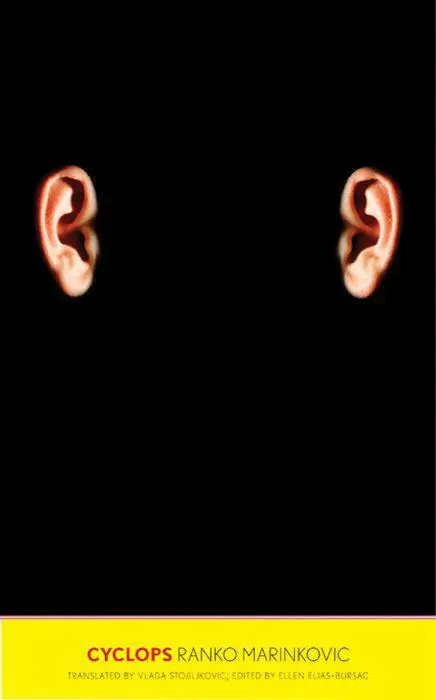
- Название:Cyclops
- Автор:
- Издательство:Yale University Press
- Жанр:
- Год:2010
- ISBN:нет данных
- Рейтинг книги:3 / 5. Голосов: 1
-
Избранное:Добавить в избранное
- Отзывы:
-
Ваша оценка:
Cyclops: краткое содержание, описание и аннотация
Предлагаем к чтению аннотацию, описание, краткое содержание или предисловие (зависит от того, что написал сам автор книги «Cyclops»). Если вы не нашли необходимую информацию о книге — напишите в комментариях, мы постараемся отыскать её.
, Croatian writer Ranko Marinkovic recounts the adventures of young theater critic Melkior Tresic, an archetypal antihero who decides to starve himself to avoid fighting in the front lines of World War II. As he wanders the streets of Zagreb in a near-hallucinatory state of paranoia and malnourishment, Melkior encounters a colorful circus of characters — fortune-tellers, shamans, actors, prostitutes, bohemians, and café intellectuals — all living in a fragile dream of a society about to be changed forever.
A seminal work of postwar Eastern European literature,
reveals a little-known perspective on World War II from within the former Yugoslavia, one that has never before been available to an English-speaking audience. Vlada Stojiljkovic's able translation, improved by Ellen Elias-Bursac's insightful editing, preserves the striking brilliance of this riotously funny and densely allusive text. Along Melkior’s journey
satirizes both the delusions of the righteous military officials who feed the national bloodlust as well as the wayward intellectuals who believe themselves to be above the unpleasant realities of international conflict. Through Stojiljkovic's clear-eyed translation, Melkior’s peregrinations reveal how history happens and how the individual consciousness is swept up in the tide of political events, and this is accomplished in a mode that will resonate with readers of Charles Simic, Aleksandr Hemon, and Kundera.
Cyclops — читать онлайн бесплатно полную книгу (весь текст) целиком
Ниже представлен текст книги, разбитый по страницам. Система сохранения места последней прочитанной страницы, позволяет с удобством читать онлайн бесплатно книгу «Cyclops», без необходимости каждый раз заново искать на чём Вы остановились. Поставьте закладку, и сможете в любой момент перейти на страницу, на которой закончили чтение.
Интервал:
Закладка:
“Oh, so we’ve come to damned this and damned that,” grinned Ugo, taken aback. “This can only mean things are very serious indeed. Couldn’t you grant me pardon all the same, Eustachius? Mercy please!” and he attempted a laugh, his lead-dark fillings managing to elicit a kind of sad sympathy in Melkior. But he would not give in. Indeed his rage flared afresh.
Ugo had felt the new outbreak coming and took care to weather it in the shelter of his resourcefulness.
“All right, Eustachius dear one, all right.” He spoke feelingly, his voice drenched with invisible tears. “I shall remove my disgustingly feather-brained self from your sight, perhaps forever. Perhaps indeed in a way that will make you sorry when you have learned all the details. Farewell.” He turned and walked off.
“Wait, you crazy Parampion, wait!” Melkior ran after him and spun him around. There were genuine wet tears rolling down Ugo’s face. For all that he well knew all the many sources of Ugo’s tears, Melkior fell again for the old trick of Ugo’s, which after all was not entirely false. Ugo had the knack of instantly imagining himself the most wretched creature in all the world: a down-at-the-mouth, despised, rejected orphan suffering from solitude, hunger, and cold, driven from pillar to post in this cruel world and having no recourse but to “end it all,” that is to say take his own life. But the most moving part (and that was where the tears flowed most copiously) was watching “from beyond” the doings of his set , who had been “spared.” There: it is evening, the Give’nTake has come to jovial and noisy life, but he is no longer there. The girls are pretty (well, females, generally speaking — he preferred the more mature, plumper variety), they think of him and of the times they had while he was … But there is nothing to be done — he is gone. As for the fiancée, she already married “the monkey man”— Mr. Romp —and thinks of Ugo no more. Only his aged mother, silver-haired and despondent, weeps at dusk … and the tears flow on and on …
“My dear Parampion. Listen,” said Melkior, moved in some silly way himself, “wait for me here, at the Cozy Corner. I’ll be back in a flash.”
“Wait at the corner …” repeated Ugo in a childishly artless voice.
“That’s right, sit at a table, have a drink …”
“Sit how, dear Eustachius?” sobbed Ugo, his manner quite infantile now.
“On your behind, dear boy, sit on your behind … until I’m back.”
“Money,” stammered Ugo in a paroxysm of sobs, “I’ve got no money. I was trying to sell my old nappies today … the ones I had as a baby … Kikinis wouldn’t buy them.”
“On me,” said Melkior on his way off. “Tell Kurt to put it on my account.” “He invented this nappy business to make himself cry. His old nappies … the ass …” he laughed inside with relief.
Strangely enough, he did not run into ATMAN on the landing. He skulked past the palmist’s door cautiously, on tiptoe, holding his breath, then hurried up the stairs three at a time and lurched breathlessly into his room. His guest was not there. He locked the door behind him without turning on the light. He sank, exhausted, on the first chair he came to and, propping his elbows on the table, dropped his head between his palms. He felt his face under his palms, finding it a curious sensation: it’s as if I were fending off slaps in the face. … At school, in Dom Kuzma’s class … what is love, Seal Penguinsky? … Dom Kuzma’s slaps burned his cheeks with a new, “adult” shame as though he had just brought them, still fresh, back to his room. He felt the heat of his cheeks on his palms. Slaps. So insignificant the physical pain, so lasting and incurable the burn! A slap is the fault of the victim, that is what makes shame indelible.
There begins The Great Recapitulation , but the entire sense of shame clenches itself spasmodically and makes the leap into the present day. Once here, it latches onto Viviana. He notices it latching onto her, notices, too, the phrase onto her with which he has zeroed in on his thought, and feels a tickling current down his back. He pounces upon her vengefully (to hell with hesitation!) and falls mindlessly to embracing her (at last!), pawing and kissing her, pressing impatient hands up and down her dress, undressing her … preparing her, in the rough masculine way, for “surrender.” She puts up a “demure” resistance to the onslaught (oh, what are you doing? Whatever will you think of me?), being refined (for greater triumph), resourcefully fanning his lust. But just at that moment Dom Kuzma enters the field of vision: he is crossing the street; he is headed for the invalid’s machine, his black hat pushed way down (to make the ears less conspicuous), his lips moving — talking to himself. And Viviana’s marvelous body falls apart, melts into defeated anguish. All that remains is a virginally empty skirt and arms embracing ruined desire. And Dom Kuzma’s lackluster eye, full of life’s bitter pain, leans paternally over the broken wave of yearning and speaks in a moralizing way in despair: that’s right, son, that’s right. To have is not victory. To renounce is victory. “Sour grapes!” shouts Melkior into Dom Kuzma’s large ear, “Sour grapes!” and the Ear falls to caressing his face compassionately, panting with deathbed breath: haughty is the fox, haughty. Let the birds of the air peck the grapes that ripen on high, let them carry the grapes back to their nests; they sow not, nor do they reap … so be it! And the son of man … let him travel through the vale of gloom that is this earthly existence — continues Melkior in poetic anguish — over thorns and stones, driven from pillar to post … And when tears come to his eyes he lets them run down his cheeks and lets the poet’s whispered words weep on their own from within:
and his feet are bloody,
and his heart is wounded,
and his bones are weary
and his soul is stricken …
… and Melkior the son of man holds his head in both hands and shakes it vigorously like an enraged Demiurge shaking the skies in his fury. Galaxies shake, scattering stars and setting up a new order in the universe. But Melkior creates no new order with the shaking: all he does is to bring about a crazy whirl of circles around his weary eyes and a dull ache in his bent head. And when somebody knocks at his door the pain in his temples wakes in a muted throb.
The knocking came again as the voice of inanimate things in the hungover dawning of wakefulness and the word, fully awake by now, found itself in Melkior’s mouth. The Police. Down beneath his feet he felt the palmist’s foul existence (he had himself, for a joke, dubbed him ATMAN the Great Spirit) and some dull indifference set him moving toward the door. He unlocked and opened it without fear, giving himself totally over to his lassitude.
Swaying at the door was Four Eyes. First there issued from him a cellarlike breath, a whiff of barrel and mingled smells, and then the herald spoke, gesturing hurriedly.
“Things have taken an interesting turn over yonder … that, if I’m not mistaken, is what I was told to say over here.”
“Who …? Over where?” asked Melkior, upset by the inklings. He thought of his guest and quaked.
“At the Corner is where things have taken this turn,” said Four Eyes with his foul breath; the words were barely audible, “and the message is from Parabrion, is that it? I can remember names even more difficult — Periplectomenos, Batrachomyomachy — from high school. They really force-fed us with the drivel. Your immediate presence is required, everything’s up for grabs. May I go back reassured?”
“Yes, you may.” Melkior was relieved — it was only Ugo “doing his thing.” He leaned against the doorframe in exhaustion.
Читать дальшеИнтервал:
Закладка:
Похожие книги на «Cyclops»
Представляем Вашему вниманию похожие книги на «Cyclops» списком для выбора. Мы отобрали схожую по названию и смыслу литературу в надежде предоставить читателям больше вариантов отыскать новые, интересные, ещё непрочитанные произведения.










Обсуждение, отзывы о книге «Cyclops» и просто собственные мнения читателей. Оставьте ваши комментарии, напишите, что Вы думаете о произведении, его смысле или главных героях. Укажите что конкретно понравилось, а что нет, и почему Вы так считаете.