Ranko Marinkovic - Cyclops
Здесь есть возможность читать онлайн «Ranko Marinkovic - Cyclops» весь текст электронной книги совершенно бесплатно (целиком полную версию без сокращений). В некоторых случаях можно слушать аудио, скачать через торрент в формате fb2 и присутствует краткое содержание. Год выпуска: 2010, Издательство: Yale University Press, Жанр: Современная проза, на английском языке. Описание произведения, (предисловие) а так же отзывы посетителей доступны на портале библиотеки ЛибКат.
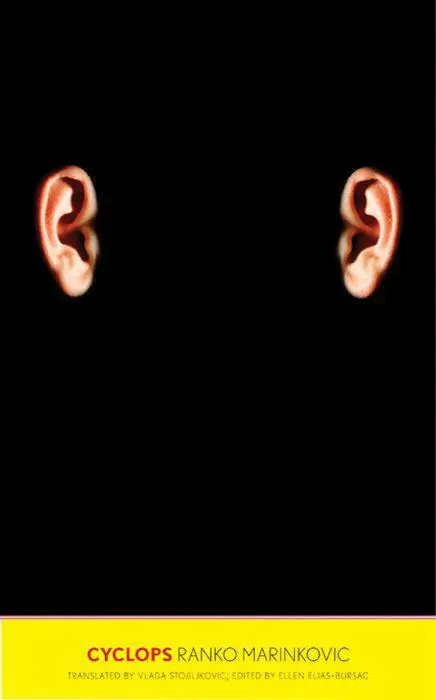
- Название:Cyclops
- Автор:
- Издательство:Yale University Press
- Жанр:
- Год:2010
- ISBN:нет данных
- Рейтинг книги:3 / 5. Голосов: 1
-
Избранное:Добавить в избранное
- Отзывы:
-
Ваша оценка:
Cyclops: краткое содержание, описание и аннотация
Предлагаем к чтению аннотацию, описание, краткое содержание или предисловие (зависит от того, что написал сам автор книги «Cyclops»). Если вы не нашли необходимую информацию о книге — напишите в комментариях, мы постараемся отыскать её.
, Croatian writer Ranko Marinkovic recounts the adventures of young theater critic Melkior Tresic, an archetypal antihero who decides to starve himself to avoid fighting in the front lines of World War II. As he wanders the streets of Zagreb in a near-hallucinatory state of paranoia and malnourishment, Melkior encounters a colorful circus of characters — fortune-tellers, shamans, actors, prostitutes, bohemians, and café intellectuals — all living in a fragile dream of a society about to be changed forever.
A seminal work of postwar Eastern European literature,
reveals a little-known perspective on World War II from within the former Yugoslavia, one that has never before been available to an English-speaking audience. Vlada Stojiljkovic's able translation, improved by Ellen Elias-Bursac's insightful editing, preserves the striking brilliance of this riotously funny and densely allusive text. Along Melkior’s journey
satirizes both the delusions of the righteous military officials who feed the national bloodlust as well as the wayward intellectuals who believe themselves to be above the unpleasant realities of international conflict. Through Stojiljkovic's clear-eyed translation, Melkior’s peregrinations reveal how history happens and how the individual consciousness is swept up in the tide of political events, and this is accomplished in a mode that will resonate with readers of Charles Simic, Aleksandr Hemon, and Kundera.
Cyclops — читать онлайн бесплатно полную книгу (весь текст) целиком
Ниже представлен текст книги, разбитый по страницам. Система сохранения места последней прочитанной страницы, позволяет с удобством читать онлайн бесплатно книгу «Cyclops», без необходимости каждый раз заново искать на чём Вы остановились. Поставьте закладку, и сможете в любой момент перейти на страницу, на которой закончили чтение.
Интервал:
Закладка:
“They lead us out to pasture as if we were their cattle, while he … I ask you, is that fair?”
“No,” says the doctor in sympathy. “But it’s much more unfair that a stupid crocodile might outlive Shakespeare. To say nothing of the various insect species …”
The gods are thirsty, my friend, but they’re not looking for a bedbug, a bloodsucker, to crush — they’re looking for you, a man. Possibly a man of significance, I don’t know — a Danton, as I’ve said … But where are you, secret man? exclaimed Melkior half-aloud in the middle of a noisy street. It was long past noon. They, too , have to eat, be it with angelic moderation, they do have bodies after all …
His own body spoke up, presenting its old demands and clenching the stomach like an enraged fist under his nose. He resisted its demands using the ever-ready force of intellectual reasoning and brandished the threat of the invalid’s weighing machine. You demented fool, would you like to stand in a doorway yourself one day, minus a leg, minus an arm, minus eyesight … next to a weighing machine with a card saying CRIPPLED IN COMBAT and call out beggar-style to the soulless street, “Check your weight — it’s never too late”?
He made the rounds of the large and expensive restaurants with delicate aromas (that was where they went to allay suspicion), going from table to table, peering into the faces above the plates … and, surreptitiously, into the plates themselves. Nothing but mouthfuls, munch-munch and the murmur of prayers, the clink-clink of glasses, corpus homini , trans-substantiation, gluttony … Dominus vobiscum! Melkior turned away in horror at the carefree ways of the “people of his day and age.” Stuffing sacks for better targets. While hiding their bellies under tables like something to be ashamed of. No, the cannibals will not eat the agent! You must intercede on his behalf, Melkior Tresić, don’t let him be eaten. He could come in handy. He could, for instance, organize a future economy. Exports of pineapples, coconuts, bananas, monkeys, and parrots — a large firm with the name PINACOCOBANAMONPAR-EXPORT, Pago Pago, Polynesia. The others, too … The captain … why he could set up a merchant fleet (the TUTUILA-LINE); the chief engineer could build workshops and servicing units to provide the basis for a future industry; the doctor might start a public health service, build hospitals and infirmaries; the first mate could come up with a new, more humane religion forbidding the eating of slain enemies and recognizing the prisoner-of-war status of captives in keeping with the Hague Convention, and the seaman … he would found trade unions and a Labor opposition … Yes, that would be about right. … But all this was wishful thinking as long as the war was on. The status quo ante bellum , i.e., the castaways might still end up being eaten — it would depend on their personal initiative, as well as, to be sure, on Melkior’s imagination, which was today charitably biased in favor of any man in danger.
Again he fell to leafing through the streets, as if they were so many albums with the photographs of strangers. But his untrained attention soon grew tired of a police-style checking of the passersby and he forgot the purpose of his unproductive wandering. He felt the bitter taste of his solitary roaming and all his efforts went into moving his body through bright, sunlit space, which suddenly appeared to him to be terribly large and empty, unnavigable. He therefore utilized every intersection to change direction, hoping for a small discovery. But there always stretched before him again the most merciless of the dimensions — length, with its illusory shortening in perspective. No one, it suddenly occurred to him, had ever built a street which really tapered off at the end. There was no such worldview. It was more dreadful than despair. He imagined two endlessly tall blind gray walls closing in at an acute angle and, between them, a solitary man who was no longer looking back. He went slowly toward the corner, his steps quite short now because he knew this was the end. Everything was now behind him: life and love and trust … and what used to be known as happiness. He was sentenced to live until he reached the corner, but he couldn’t stop because it was time itself that drove him on. He tried zigzagging, discovering the merciful dimension of width. But it, too, grew ever shorter, ever more yielding, ever more inclined to disappear in a mathematical zero. And the zero was the gallows noose, the rifle volley at the wall, the guillotine’s blade, and the severed head was the period that rolled along to the end of the sentence. A bloody, protruding, bitten-through tongue — and the end.
He spotted them from afar as they strolled in confidence down the colorless streets surrounding a block of police buildings which sporadic passersby eyed with suspicious and naïve courage, asserting their own innocence. ATMAN held her arm tucked under his with ostentatious intimacy and was speaking quietly to her, his mouth near her ear. He was not telling her funny stories, Viviana was not laughing. Indeed she had her head inclined toward his the better to hear him.
He didn’t remember to be surprised by the encounter. He himself was wandering around obeying a strange force of motion. Behind those gray walls of government property with barred windows at night old favorites could be heard played on a gramophone. Noisy music overhead, blaring through the attic windows. Underneath there yawned dark inner courtyards, salvation-bringing chasms of desperate heroism. Down there, on the silent, dull concrete, thudded the last answers to questions that had been plied to the musical accompaniment.
Melkior had his guest on his mind and it was this that brought him, via the peculiar convolutions of his restlessness, to this place. And look, what a catch — the two of them! Which of Hell’s gates were the trumpeting angels going to take? He followed them with the black pleasure of despondent disappointment. This of course had to do with Viviana. The mysterious cad he had never trusted or … no, that was not quite true … he had experienced frequent and fundamental changes of opinion about ATMAN. And he now honestly admitted this to himself. Adding the probability of further surprises. Elusive in his muddy waters, the bizarre ATMAN …
There, they were past all the entrances to the institution of torture and walking on, heading due south in the direction of the autumnal migration of birds, whence the trains whistled. But they were now slowing down, halting whimsically every now and then in the manner of a well-established couple with a sweet life of shared love stretching out reliably before them. There was laughter now (her laughter!). To Melkior’s ear it sounded like one of the torturer’s pop songs … blasting up in the attic … Which bitterness was the more bitter? He felt a muffled thumping of beats, either his steps or his heart, he could no longer tell, he was confused, in the middle of the street caught up with the job of spying.
“Ah, Mr. Melkior!” ATMAN was patting him on the shoulder, having suddenly materialized next to him (and he had been following the two of them at a distance of over thirty paces); she was approaching in a hesitant sort of way with the most conventional of smiles.
“Why, we seem to be running into each other every few minutes, like people in love!” At which he gave Viviana a wink, or so it appeared to Melkior. Taken unawares, his attention ripped asunder, he stood in front of them staring at the three pairs of shoes on the ground. His own, old and worn shapeless, the dusty shoes of a weary pedestrian; ATMAN’S, gleaming and new, pointed like beaks pecking at the ground; and her small-size shoes like two light-winged little blackbirds …
Читать дальшеИнтервал:
Закладка:
Похожие книги на «Cyclops»
Представляем Вашему вниманию похожие книги на «Cyclops» списком для выбора. Мы отобрали схожую по названию и смыслу литературу в надежде предоставить читателям больше вариантов отыскать новые, интересные, ещё непрочитанные произведения.










Обсуждение, отзывы о книге «Cyclops» и просто собственные мнения читателей. Оставьте ваши комментарии, напишите, что Вы думаете о произведении, его смысле или главных героях. Укажите что конкретно понравилось, а что нет, и почему Вы так считаете.