Ranko Marinkovic - Cyclops
Здесь есть возможность читать онлайн «Ranko Marinkovic - Cyclops» весь текст электронной книги совершенно бесплатно (целиком полную версию без сокращений). В некоторых случаях можно слушать аудио, скачать через торрент в формате fb2 и присутствует краткое содержание. Год выпуска: 2010, Издательство: Yale University Press, Жанр: Современная проза, на английском языке. Описание произведения, (предисловие) а так же отзывы посетителей доступны на портале библиотеки ЛибКат.
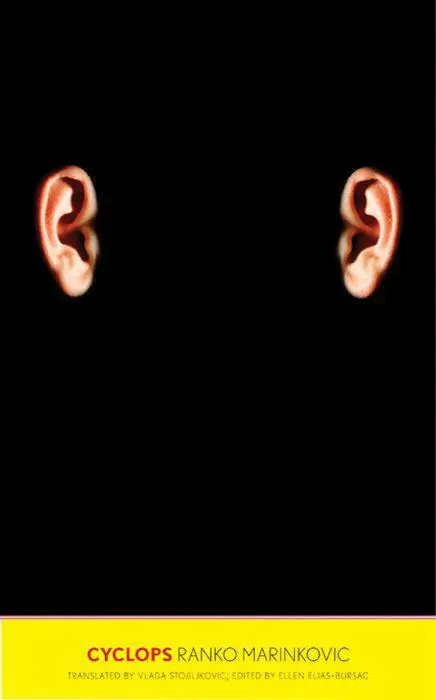
- Название:Cyclops
- Автор:
- Издательство:Yale University Press
- Жанр:
- Год:2010
- ISBN:нет данных
- Рейтинг книги:3 / 5. Голосов: 1
-
Избранное:Добавить в избранное
- Отзывы:
-
Ваша оценка:
Cyclops: краткое содержание, описание и аннотация
Предлагаем к чтению аннотацию, описание, краткое содержание или предисловие (зависит от того, что написал сам автор книги «Cyclops»). Если вы не нашли необходимую информацию о книге — напишите в комментариях, мы постараемся отыскать её.
, Croatian writer Ranko Marinkovic recounts the adventures of young theater critic Melkior Tresic, an archetypal antihero who decides to starve himself to avoid fighting in the front lines of World War II. As he wanders the streets of Zagreb in a near-hallucinatory state of paranoia and malnourishment, Melkior encounters a colorful circus of characters — fortune-tellers, shamans, actors, prostitutes, bohemians, and café intellectuals — all living in a fragile dream of a society about to be changed forever.
A seminal work of postwar Eastern European literature,
reveals a little-known perspective on World War II from within the former Yugoslavia, one that has never before been available to an English-speaking audience. Vlada Stojiljkovic's able translation, improved by Ellen Elias-Bursac's insightful editing, preserves the striking brilliance of this riotously funny and densely allusive text. Along Melkior’s journey
satirizes both the delusions of the righteous military officials who feed the national bloodlust as well as the wayward intellectuals who believe themselves to be above the unpleasant realities of international conflict. Through Stojiljkovic's clear-eyed translation, Melkior’s peregrinations reveal how history happens and how the individual consciousness is swept up in the tide of political events, and this is accomplished in a mode that will resonate with readers of Charles Simic, Aleksandr Hemon, and Kundera.
Cyclops — читать онлайн бесплатно полную книгу (весь текст) целиком
Ниже представлен текст книги, разбитый по страницам. Система сохранения места последней прочитанной страницы, позволяет с удобством читать онлайн бесплатно книгу «Cyclops», без необходимости каждый раз заново искать на чём Вы остановились. Поставьте закладку, и сможете в любой момент перейти на страницу, на которой закончили чтение.
Интервал:
Закладка:
In a shop window, an elegantly dressed mannequin was in a discreetly balletic stance, a sly expression. Embarrassed at being watched by all and sundry. Melkior gave her a long, hard look. She dropped her eyes in shame. She would have fled if she could. Well, Melkior said to her, that’s what you’re there for, miss — to be looked at. He was trying to imagine her naked. I may have seen you naked, come to that. Many a time had he watched the mannequins at night being changed in shop windows behind carelessly drawn gray curtains. Like in a charmed brothel, those stiff, waxen anemic naked ladies with the faces of virgins. The Pompeiian Lupanar after Vesuvius erupted. He was trying to imagine her naked: the gray fabric flowing down her narrow, curved hips, fitting closely in front over the daintily convex delicate breasts. Tits, he said, because he had stripped her naked. He found himself weirdly lusting after the dainty dead girl. And the painful source of lustful restlessness was surfacing gradually as a fear of the similarity of that waist, those (slender) long legs, the narrow hips, those breasts, that fetching motion frozen in mid-stride, those slim, long fingers which she held slightly splayed like a bather going in for a dip. Look — all of it was actually moving in the window: the legs were beginning to walk, the hips to sway, the arms to swing; all of a sudden Viviana emerged from the mannequin! He thought he had gone mad. But no, it was Viviana moving in the window. She was crossing the street. He drew into himself, staring alarmed at her reflection in the glass. The sun was beaming down all over her, she was carrying radiance. He was already blinded by the terrible glare, and his eyes no longer saw anything. But he sensed with his whole body the approach of the fateful star from the mind-numbing skies of chance. He was being demolished inside by a dreadful disorder in his body and mind and thought. He could make nothing of his entire self except for a chaotic sense of awe. Could chance be so cruel as to catch him totally unprepared? He was aware of his long nose and moronically grinning face. And his arms: long, ponderous. He tucked his hands into his pockets. He felt relieved after this little act of tidying up. After achieving a clearer, better defined, more masculine image of a blasé gad about town with his hands in his pockets, an aimless, boredom-driven stroller. The difference that hands in pockets made! It was a great discovery of salvation, as if a comet were approaching. He was ready for a collision of worlds.
The shop window had attracted her attention. But he thought she had spotted him and went immobile like an insect faking death. He got interested in something or other down there in the corner, he even bent down to take a closer look. The eccentric; God knows what he’d discovered. She had flown up to the window like a butterfly, indeed she collided with the glass in her greed of watching; he heard a slight tap, that must have been her forehead. He felt his playacting falling flat and was out of his role again. There were his hands — not in his pockets — and the nose, and the moronic face. And he made an attempt to flee the stage. The movement near her broke off a morsel of precious attention (a male was standing there, after all) and she discovered him like a frightened cricket in the grass. He surrendered. Mercy.
“Well? What do you fancy?” she asked suddenly.
“Her,” he said pointing at the mannequin. He was being “bizarre.” “She looks like you.”
“The mannequin? I don’t know whether I ought to take offense.” As indeed she didn’t. She was smiling irresolutely, fifty-fifty, just in case.
“She’s awfully well built.” He had his hands in his pockets again by now, and that was how he delivered his line: hands-in-pockets style. He was pleased to be carrying it off.
“Yes, that’s all you men care for — the body.”
The body disturbed his diaphragm, queasily. Maestro had sold his body to the clinic, yes, but the word she had chosen hurt Melkior much more intimately, more sadly, like grief over the loss of a kind of innocence.
“You’re frowning? Would you say it wasn’t true?”
“What?” He was losing the thread. Chance’s festivity had been disturbed.
“That men …”
“… have generally had their way with her? No doubt.”
She gave him a surprised and hurt look. “Who are you talking about?”
“Her,” and he nodded in the direction of the mannequin. “I’ve seen her naked at night, being pawed by men. Lustfully, with no tenderness at all. I think they’re all harlots, those shop window dolls.”
She was laughing. But seeing that he was not, she got serious and anxious. “How strange.” And she touched him with her hand like someone touching a sleepwalker to wake him.
He had come to feel at home playing the madman and was loathe to abandon the role so soon. He felt confident and superior in psychological games where she could not follow him while he could say just about anything in lunatic allegories.
“Those shop windows are nothing but small-time brothels. The girls stripping naked at night, receiving customers, mainly shop assistants who behave like impoverished princes of dethroned dynasties. All but dancing with them.”
She gave a short, insecure laugh.
“I’ve no idea what you’re talking about, Mr. Tresić. Have you by any chance been celebrating something today?”
“Drinking? No.” He was feeling a kind of wretched happiness; fearing that it was going to leave him, he quickly went on in Ugo’s manner: “ ‘No, my lady, no, I’m sober indeed, of intoxication. I have no need when in such a fetching patch of sky, made golden by the sun on high, I behold …’ and so on. We could have a drink somewhere though. But not at the Theater, if you please. Maestro and Freddie are in there, unless one or the other isn’t dead by now.”
“They can both be for all I care,” she said coldly and maliciously. “I’m afraid I can’t have that drink. I’ve been making a round of the shops all morning, looking for some fabrics for my aunt. Why don’t you come along to keep me company — if you have nothing more worthwhile to do, that is.”
“More worthwhile — well …” he made a sweeping movement with his hand as if to indicate something far away. “But I truly have nothing more pleasant to do,” he said with unrestrained delight. “I’ll follow you anywhere, even to … Cythera, which doesn’t exist, Viviana.”
“Funny you should say that. I had almost forgotten about my name. I like what you call me very much.”
“So do I. But Viviana doesn’t exist either. I invented her.”
“I thought I was Viviana?”
“You are and you aren’t. You are to me. Or not. What you really are I don’t want to know. Nonny nonny no — I don’t want to know.”
“Singing?” She was laughing. His elation flattered her.
“That was the Duke of Mantua’s aria. Does my singing bother you?”
“Not at all. Do go on.”
“Unfortunately that was the end of the aria.”
“You’re such an amusing fellow. That time at MacAdam’s I thought you were a horrible pessimist.”
So much for “exemplar,” thought Melkior in passing.
“Indeed I am something of the kind on working days. But today’s a holiday. Incidentally, why do you call my friend MacAdam?”
“That’s what that stinking, rotten …”
“Maestro?”
“Yes. That’s what Maestro calls him. There’s a language, he says, where it’s the word for asphalt. Stupid as asphalt, he meant.”
“And you hate him terribly?”
“Mac?”
“No, Maestro.”
She halted in front of a shop window. Offended. To avoid replying. But Melkior, too, seemed to have vaporized beside her: she was totally absorbed in observation, taking no further notice of his presence.
Читать дальшеИнтервал:
Закладка:
Похожие книги на «Cyclops»
Представляем Вашему вниманию похожие книги на «Cyclops» списком для выбора. Мы отобрали схожую по названию и смыслу литературу в надежде предоставить читателям больше вариантов отыскать новые, интересные, ещё непрочитанные произведения.










Обсуждение, отзывы о книге «Cyclops» и просто собственные мнения читателей. Оставьте ваши комментарии, напишите, что Вы думаете о произведении, его смысле или главных героях. Укажите что конкретно понравилось, а что нет, и почему Вы так считаете.