Ranko Marinkovic - Cyclops
Здесь есть возможность читать онлайн «Ranko Marinkovic - Cyclops» весь текст электронной книги совершенно бесплатно (целиком полную версию без сокращений). В некоторых случаях можно слушать аудио, скачать через торрент в формате fb2 и присутствует краткое содержание. Год выпуска: 2010, Издательство: Yale University Press, Жанр: Современная проза, на английском языке. Описание произведения, (предисловие) а так же отзывы посетителей доступны на портале библиотеки ЛибКат.
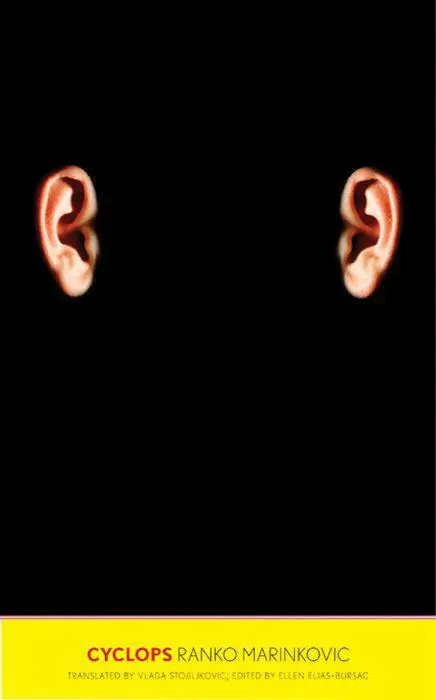
- Название:Cyclops
- Автор:
- Издательство:Yale University Press
- Жанр:
- Год:2010
- ISBN:нет данных
- Рейтинг книги:3 / 5. Голосов: 1
-
Избранное:Добавить в избранное
- Отзывы:
-
Ваша оценка:
Cyclops: краткое содержание, описание и аннотация
Предлагаем к чтению аннотацию, описание, краткое содержание или предисловие (зависит от того, что написал сам автор книги «Cyclops»). Если вы не нашли необходимую информацию о книге — напишите в комментариях, мы постараемся отыскать её.
, Croatian writer Ranko Marinkovic recounts the adventures of young theater critic Melkior Tresic, an archetypal antihero who decides to starve himself to avoid fighting in the front lines of World War II. As he wanders the streets of Zagreb in a near-hallucinatory state of paranoia and malnourishment, Melkior encounters a colorful circus of characters — fortune-tellers, shamans, actors, prostitutes, bohemians, and café intellectuals — all living in a fragile dream of a society about to be changed forever.
A seminal work of postwar Eastern European literature,
reveals a little-known perspective on World War II from within the former Yugoslavia, one that has never before been available to an English-speaking audience. Vlada Stojiljkovic's able translation, improved by Ellen Elias-Bursac's insightful editing, preserves the striking brilliance of this riotously funny and densely allusive text. Along Melkior’s journey
satirizes both the delusions of the righteous military officials who feed the national bloodlust as well as the wayward intellectuals who believe themselves to be above the unpleasant realities of international conflict. Through Stojiljkovic's clear-eyed translation, Melkior’s peregrinations reveal how history happens and how the individual consciousness is swept up in the tide of political events, and this is accomplished in a mode that will resonate with readers of Charles Simic, Aleksandr Hemon, and Kundera.
Cyclops — читать онлайн бесплатно полную книгу (весь текст) целиком
Ниже представлен текст книги, разбитый по страницам. Система сохранения места последней прочитанной страницы, позволяет с удобством читать онлайн бесплатно книгу «Cyclops», без необходимости каждый раз заново искать на чём Вы остановились. Поставьте закладку, и сможете в любой момент перейти на страницу, на которой закончили чтение.
Интервал:
Закладка:
Kurt is totting up the bill “one Wiener schnitzel, one salad …” and the little old man in white is talking, “… and then, my friend, he took after him over the rooftopsh. And you know how shteep London roofsh are. … Anyway, there they are: the detective chayshing, the robber running. Jumping like a cat. Getting hold of chimney potsh and lightning rodzh and such. But the cop shtumbled and fell — right acrosh a torn pieshe of tin sheeting, the poor man — and got hish throat shlashed, my friend! Hizh jugular! He shtarted bleeding shomething awful, shtreaming down the roof and into the drainpipe. Raining blood. And the robber — believe it or not, bud— the robber ran back to hish purshuer and, let’sh fayshe it, enemy, tore a shtrip off hizh own shirt without a moment’sh hezhitation, and shtopped the bleeding. The cop would’ve bled to death on that rooftop if the robber hadn’t had hizh heart in the right playshe.”
Melkior took a long time adjusting his tie, retying the lace on his left shoe, on his right shoe, softening, squeezing, twirling a cigarette between his fingers …
“So what happened next? … the coppersh caught the robber.” So?
“Sho dat’sh my point, bud —dere’zh shome goodnesh in everyone. Even in the worsht kind of robber, az dish cayshe showzh. I forgot to shay de man waz a notorioush murderer. And dey shay, Doshtoyevshky!”
Melkior left disappointed, to Kurt’s bowing and scraping goodbyes.
Dostoyevsky? Everyone goes to Fyodor Mikhaylovich with their little monsters. Try Dickens, the company for quiet compassion. Don’t proclaim every little bastard who can think of an ever so slightly twisted plot to be an Ivan Karamazov, or every lovable idiot, a Prince Mishkin. It’s no use our referring to literature — it will provide no excuses here.
He felt satiety like the release after the enjoyment of sin. Now he repented. Once Appetite, satisfied, had dropped off to sleep, Conscience came on with her retinue of Principles. Where had she been when the Great Carnivore was stirring and howling in his empty madhouse? She herself had served at his court as a jester at the well-laden table, regaling him with stories — during the Wiener schnitzel — of the castaways (whom you, following the requirements of your plot, had induced to vomit) eating copiously and discovering a new faith for their existence: “therefore you must be healthy if you want to survive — for a time, at least. Eat as heartily as you can, it is your only hope.” Oh, you’re too sly by half, Madam! I wouldn’t put it past you to search for the more titillating passages in The Decameron or drool over pornographic pictures. Cinémacochon for the Jesuits. And then it’s, My son, you are forgiven for your sins … in your soul. On the body, however, the bellies remain. Sins and bellies — noumena and phenomena, et substratus est appetitus gloriosus , sang out Melkior like the Credo at High Mass et incarnatus est … and his belly strutted ahead of him, happily burbling its little song:
Penance awaits the gluttonous twit
Yet for the moment I belch and I sing.
Eating is good as it makes you fit
With wine to boot you feel like a king.
I’ll be asking you before long, perhaps as early as tomorrow, about keeping fit, dear Sancho. It may be a question of days, says Kurt. And tomorrow is one of those days it’s “a question of.” Incidentally, what if it really does all start tomorrow? What’s tomorrow, anyway? (If a fool were to hear me he would say Thursday.) Tomorrow is the temporal border between two states of wakefulness, two states of awareness of being. Clocks do not determine tomorrow. Tomorrow is defined only by a visit to Enka, a longed-for encounter with Viviana, a night at the Give’nTake, an uncertain, anxious night in expectation of the day after tomorrow’s tomorrow. The evening smiles winningly, promising me a lovely day — tomorrow. The meteorological tomorrow: continued clear and warm. (Winter delaying its arrival, most kindly bestowing on us this last autumn.) The pedagogical tomorrow: think about tomorrow, my child. The political tomorrow: Stalin giving Hitler a wink— khorosho! — and Hitler winking back— natürlich. The historical tomorrow: and when men discovered the divine power of matter, it came to reign over them, confusing their minds, blighting their lives and then swallowing itself and turning into a Force which destroyed all laws and there is now not a single consciousness left that could proclaim it stupid in the name of Hegel. The esthetical tomorrow: when man discovered the ugliness of matter, artists became tradesmen of the ugly. The geographical tomorrow: and the vast peninsula you see here was given the name of Europe. Here lived a biped who composed certain works they called tragedies , and whose name was Shakespeare. The original spelling is lost, the name having survived only in a script we now call the Russian alphabet. The philosophical tomorrow: there will be no tomorrow. The Force will drink all of time and swallow all of space and sink into eternal sleep from satiety and boredom. An eternity later, it will stretch, give a hungover yawn like a drunkard after a mad binge in the course of which it smashes everything within reach, and ask: Where are the objects, where are the humans? And will feel the crushing solitude and the emptiness all around it. And it will wretch with despair. And out of the vomit there will come into being a New World and in it sentient worms will hatch which will slither in the mud and revel in its beauty. And they will believe themselves to have been created by the Great Worm in His own image and Himself to cover the entire world with His length, which is so infinite as to be beyond their comprehension. Because they are small worms of finite length, though each believes itself to be longer than any other. And from this will spring their belief in the inequality among them. And a minority will manage to persuade the majority that they, the minority, are actually longer than the rest, hence better able to intuit the length of the Great Worm Himself. And they will become exegeticists and prophets among, and eventually rulers of, their equilongitudinal brother worms. And they will bore for themselves sumptuous worm holes on mud heights where the view of mudscapes is better and danger of flood much less and the population density is lower. And they will regard the valley worms with contempt. They will then quarrel over the ownership of the heights. Each will want to acquire the other’s heights for himself — the other heights will seem to each of them to be more attractive and more comfortable — and the heights worms will go saying to the small valley worms: those others have betrayed the Great Worm! They preach that he has no body at all, being of Infinite Length. Or Pure Span. Now, meddling with any of the attributes of His being — and bodily existence is the most essential of them all — would be the first step to disbelief and practically an act of treason. We therefore urge the worms faithful to the Great Worm to fight the infidel unto the death. And so a dreadful war breaks out among the worms, to go on for another eternity. And after that other eternity is done, after the worms have devoured one another in their graves …
And so Melkior the worm entered the worm hole called the Give’nTake. But inside he did not find Ugo the worm nor did he find Viviana the she-worm. The absence smote Melkior sorely to his very core and he bent painfully with the ache. So they were together, tied up in a fornicating knot, those accursed worms! He slithered over to the table at which sat bloated worm Maestro and pale worm Chicory, at the very moment when repugnant caterpillar Thénardier was setting down before them two shots, shot to shot.
Читать дальшеИнтервал:
Закладка:
Похожие книги на «Cyclops»
Представляем Вашему вниманию похожие книги на «Cyclops» списком для выбора. Мы отобрали схожую по названию и смыслу литературу в надежде предоставить читателям больше вариантов отыскать новые, интересные, ещё непрочитанные произведения.







Обсуждение, отзывы о книге «Cyclops» и просто собственные мнения читателей. Оставьте ваши комментарии, напишите, что Вы думаете о произведении, его смысле или главных героях. Укажите что конкретно понравилось, а что нет, и почему Вы так считаете.