Ranko Marinkovic - Cyclops
Здесь есть возможность читать онлайн «Ranko Marinkovic - Cyclops» весь текст электронной книги совершенно бесплатно (целиком полную версию без сокращений). В некоторых случаях можно слушать аудио, скачать через торрент в формате fb2 и присутствует краткое содержание. Год выпуска: 2010, Издательство: Yale University Press, Жанр: Современная проза, на английском языке. Описание произведения, (предисловие) а так же отзывы посетителей доступны на портале библиотеки ЛибКат.
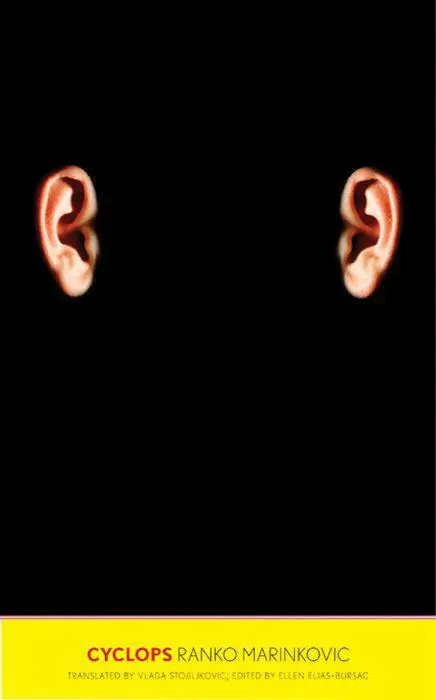
- Название:Cyclops
- Автор:
- Издательство:Yale University Press
- Жанр:
- Год:2010
- ISBN:нет данных
- Рейтинг книги:3 / 5. Голосов: 1
-
Избранное:Добавить в избранное
- Отзывы:
-
Ваша оценка:
Cyclops: краткое содержание, описание и аннотация
Предлагаем к чтению аннотацию, описание, краткое содержание или предисловие (зависит от того, что написал сам автор книги «Cyclops»). Если вы не нашли необходимую информацию о книге — напишите в комментариях, мы постараемся отыскать её.
, Croatian writer Ranko Marinkovic recounts the adventures of young theater critic Melkior Tresic, an archetypal antihero who decides to starve himself to avoid fighting in the front lines of World War II. As he wanders the streets of Zagreb in a near-hallucinatory state of paranoia and malnourishment, Melkior encounters a colorful circus of characters — fortune-tellers, shamans, actors, prostitutes, bohemians, and café intellectuals — all living in a fragile dream of a society about to be changed forever.
A seminal work of postwar Eastern European literature,
reveals a little-known perspective on World War II from within the former Yugoslavia, one that has never before been available to an English-speaking audience. Vlada Stojiljkovic's able translation, improved by Ellen Elias-Bursac's insightful editing, preserves the striking brilliance of this riotously funny and densely allusive text. Along Melkior’s journey
satirizes both the delusions of the righteous military officials who feed the national bloodlust as well as the wayward intellectuals who believe themselves to be above the unpleasant realities of international conflict. Through Stojiljkovic's clear-eyed translation, Melkior’s peregrinations reveal how history happens and how the individual consciousness is swept up in the tide of political events, and this is accomplished in a mode that will resonate with readers of Charles Simic, Aleksandr Hemon, and Kundera.
Cyclops — читать онлайн бесплатно полную книгу (весь текст) целиком
Ниже представлен текст книги, разбитый по страницам. Система сохранения места последней прочитанной страницы, позволяет с удобством читать онлайн бесплатно книгу «Cyclops», без необходимости каждый раз заново искать на чём Вы остановились. Поставьте закладку, и сможете в любой момент перейти на страницу, на которой закончили чтение.
Интервал:
Закладка:
“And yet you use the electric tram!”
“Never!” flared Maestro, hurt. “I walk a full hour to the office. I walk and think. After all, human thought came into being on the foot. The ancient Greeks thought in the street. The peripatetics walked. As people talk, so they walk — that’s my theory, if you don’t find it off-putting. Let the linguists and … whatever those experts are called, hang themselves if they haven’t perceived such a glaring fact. What is speech if not thought? The man whose clogs sink into mud with his every step speaks differently from a man who walks on blacktop. The highlander’s words are as hard as the stone he treads on. Fast walkers are fast speakers; those who drag their feet drag their words as well. The quantities of certain lowlands, the accents of hard, uneven surfaces. Speech has all the relief of the ground underfoot, the tempo of motion in space. The rhythm and the melody of walking. People walk in major or minor key. That’s how they speak, too: brightly or glumly.”
“What about you? Do you walk in major or minor?”
“Minor. Some speeches are gloomy even if they’re about a cheerful subject. I know how I speak. If it were written down you would call it banter. But you’ve got to hear me say it. Which is why I prefer speech to writing. Oral literature.”
“You are a speaker. That, too, is an art form.”
“Because I’m an infantryman. Not in the military sense, of course. Professional soldiers march even as they speak. As for military commands, are they still human speech? You haven’t done your National Service yet, have you? A command consists, my dear sir, of two parts: the preparatory and the executive. Such as ‘Forwarrr … dmarch!’ ‘Dmarch!’ is the executive part. And what is ‘dmarch’? Eh? ‘Forwarrr’ is supposed to stir a special spirit in your bottom; next, ‘dmarch’ gives each soldier a kick in the backside as an initial impulse for getting a move on. Your illustrious behind will go through it in the fullness of time and you’ll remember me then, if for no other reason.”
“Octopus, polyp, cephalopod, vacuum cleaner,” he went on in a kind tone to address Thénardier, who was doing some accounts at the bar, scratching his pelican chin worriedly with a pencil.
“Yes, philosopher Ugly Nose?” responded Thénardier without raising his head from his accounts.
“Listen, you headless cod, raise what you haven’t got when speaking to me. Serve your customers. Shot to shot …”
“No, Maestro. That’s enough for me,” parried Melkior. He had long resolved to get up and was only waiting for a convenient break to flee from Maestro’s thrall. He had to find a phone now, he had to ring Enka. She knows I’m going to ring her. She’s waiting.
“Eustachius the Kind, drop them,” said Maestro all of a sudden, sounding conspiratorial. “You are a man apart.”
“Drop whom?” Melkior pulled free of Enka’s close embrace.
“Them. Ugo and the others. Superficial cads, clowns.” And he went on in a whisper, “As for her, she’ll come crawling to you. She’ll be asking you to mount her, she’ll get down humbly like a hen. I know her. Be a rooster. Head high. Proud.”
“She doesn’t interest me, Maestro. What makes you think I’d …?”
“Come off it, Eustachius! You are consumed by vanity. You keep making comparisons: ‘what’s Ugo got that I …’ And she is beautiful.”
“Yes, so she is. But I don’t care whose she may be.”
“You’re lying, Eustachius, but that doesn’t matter. The hell with her. We could find a better place to talk, you and I, somewhere quiet. We are people who still have something to say. What else have we got left but to talk to each other? Setting our thoughts flowing from one head to another, as it were, letting our minds fertilize each other …”
Maestro’s voice quavered with an odd tenderness over the last few words. Melkior did not dare look at his face: it was bound to have on it that humbly pleading look, the painful expression of unrestrained, miserable sincerity as the very words melt in the throat with the pleasure of abasement.
“Don’t frown. Forgive me, Eustachius,” Maestro all but sobbed. “Did I touch some soft spot of yours? Never mind. I can risk it. I no longer have anything to lose — I no longer have anything. Even this body’s not mine — I’ve sold my cadaver to the Faculty of Medicine. And drank up the proceeds long ago. I’m a man who has consumed his own dead body — I cannot be bothered by the fine points.”
Then suddenly, as though he had been set aglow by an idea, his eyes took on a weird gleam and a smile — superior, triumphant — spread over his face. There appeared spiteful glee.
“Incidentally, the kind of death that mine will be has not been experienced by anyone, ever! Did you notice my choice of words, Eustachius, ‘to experience death’? Ha-ha, nobody can honestly say, ‘I have experienced death.’ Danton noticed it on the eve of being executed: you can’t say, ‘I was guillotined.’ But forget the guillotine — it’s so ordinary.”
Maestro fell silent and seemed to be musing about something.
“I chose my death long ago, before I sold myself to the Institute of Anatomy. (‘Sold myself’ sounds a bit prostitutional, don’t you think?) That was precisely why I sold myself: because I had chosen. What a death, Eustachius, my boy!” He was waxing ecstatic. “Nobody has ever died that way! So appropriately! So ironically triumphant. Symbolic! So complete!”
“Don’t talk nonsense, Maestro,” Melkior was anxious. “You’re not thinking of killing yourself, are you?”
“Kill myself, he says … Don’t drag me through the mud, Eustachius!” Maestro was seriously offended. “Killing oneself is for abandoned pregnant dames and spotty boys crossed in love. Also, you need equipment to kill yourself. I despise it. Maiming your body is undignified and hideous! And that’s precisely what all the suicides do: they shoot themselves in the head, slash their wrists, throats, bellies, drive knives into their hearts (even nails into their brains!), destroy internal organs using all manner of poisonous slops, drown themselves, fling their bodies from great heights, have them mangled and massacred under the wheels of an engine … Horrifying and disgusting. The vicious criminals! The perverted scum! If they didn’t do it themselves it would be necessary to put them to death for it. And rid life of those damned slaughterers and lunatics.
“No, Eustachius,” Maestro went on in a sentimental tone, “my death is going to be brand-new, medicinally pure, so to speak. No blood, no shit. You’ll see. Only I must start urinating more. Urinating harder, that is. I must switch to beer — it promotes micturition. I must begin exercising right away, ha-ha … Don’t ask questions, Eustachius the Merciful. One day this will all make sense.”
It’s revolting all the same, your medicinal purity, thought Melkior, getting up. He was disgusted by poor Maestro. Unless the man was merely dramatizing some rotten affair of his in which he would like to play a major role? A hoax. He had very nearly fallen for it. Or was it all an exercise in purposely fouling some very intimate purity? No telling what all you can find in a dustbin.
“Are you leaving me, merciful Eustachius?” and Maestro stretched out his arms after him, desperately.
“I must,” Melkior replied briefly, to break free as quickly as possible. “You’re not going upstairs, I hope?” Maestro warned him. “I don’t think the time is yet ripe.”
“No, I’m not. By the way, would you mind passing this review on to the Arts Editor? I’ve got some business to attend to elsewhere, it’s …”
“Sexual?” Maestro chortled with libertine envy. “In thy orisons be all my sins remember’d. Remember thee! Ay, thou poor ghost, while memory holds a seat in this distracted globe!”
Читать дальшеИнтервал:
Закладка:
Похожие книги на «Cyclops»
Представляем Вашему вниманию похожие книги на «Cyclops» списком для выбора. Мы отобрали схожую по названию и смыслу литературу в надежде предоставить читателям больше вариантов отыскать новые, интересные, ещё непрочитанные произведения.








Обсуждение, отзывы о книге «Cyclops» и просто собственные мнения читателей. Оставьте ваши комментарии, напишите, что Вы думаете о произведении, его смысле или главных героях. Укажите что конкретно понравилось, а что нет, и почему Вы так считаете.