Walker Percy - The Thanatos Syndrome
Здесь есть возможность читать онлайн «Walker Percy - The Thanatos Syndrome» весь текст электронной книги совершенно бесплатно (целиком полную версию без сокращений). В некоторых случаях можно слушать аудио, скачать через торрент в формате fb2 и присутствует краткое содержание. Год выпуска: 2011, Издательство: Open Road Media, Жанр: Современная проза, на английском языке. Описание произведения, (предисловие) а так же отзывы посетителей доступны на портале библиотеки ЛибКат.
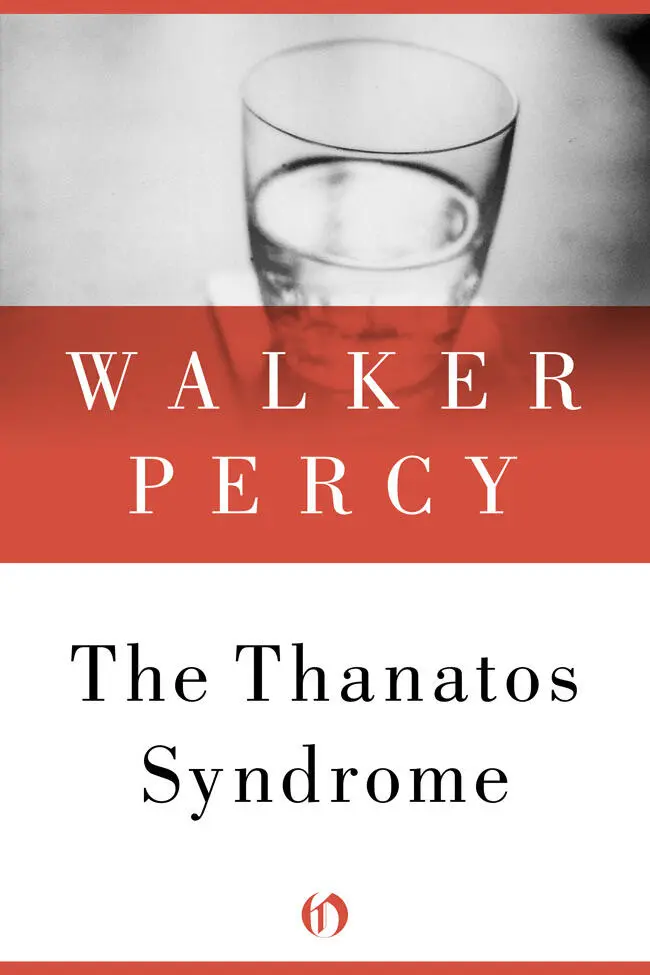
- Название:The Thanatos Syndrome
- Автор:
- Издательство:Open Road Media
- Жанр:
- Год:2011
- ISBN:нет данных
- Рейтинг книги:3 / 5. Голосов: 1
-
Избранное:Добавить в избранное
- Отзывы:
-
Ваша оценка:
The Thanatos Syndrome: краткое содержание, описание и аннотация
Предлагаем к чтению аннотацию, описание, краткое содержание или предисловие (зависит от того, что написал сам автор книги «The Thanatos Syndrome»). Если вы не нашли необходимую информацию о книге — напишите в комментариях, мы постараемся отыскать её.
Dr. Tom More returns to his parish in Louisiana determined to live a simpler life. Fresh out of prison after getting caught selling uppers to truck drivers, he wants nothing more than to live “a small life.” But when everyone in town begins acting strangely — from losing their sexual inhibitions to speaking only in blunt, truncated sentences — More, with help from his cousin Lucy Lipscomb, takes it upon himself to reveal what and who is responsible. Their investigation leads them to the highest seats of power, where they discover that a government conspiracy is poised to rob its citizens of their selves, their free will, and ultimately their humanity.
The Thanatos Syndrome — читать онлайн бесплатно полную книгу (весь текст) целиком
Ниже представлен текст книги, разбитый по страницам. Система сохранения места последней прочитанной страницы, позволяет с удобством читать онлайн бесплатно книгу «The Thanatos Syndrome», без необходимости каждый раз заново искать на чём Вы остановились. Поставьте закладку, и сможете в любой момент перейти на страницу, на которой закончили чтение.
Интервал:
Закладка:
“Never mind. I’m leaving.”
“Very well. What are you going to tell Father Placide and Dr. Comeaux?”
“I am going to tell Father Placide that you are too disturbed to be of any use to him at St. Michael’s. I am going to tell Dr. Comeaux that you are also too disturbed to operate the hospice and that I hope you will sell it to him. Now will you let me out of here?”
“I appreciate your frankness,” says the priest, nodding vigorously, hands making and unmaking fists in his pockets. “Shall I be frank with you?”
“Sure, if you’ll open this damn door.”
“I will. But please allow me to tell you something about yourself for your own good.”
“Please do.”
“You are an able psychiatrist, on the whole a decent, generous, humanitarian person in the abstract sense of the word. You know what is going to happen to you?”
“What?”
“You are a member of the first generation of doctors in the history of medicine to turn their backs on the oath of Hippocrates and kill millions of old useless people, unborn children, born malformed children, for the good of mankind — and to do so without a single murmur from one of you. Not a single letter of protest in the august New England Journal of Medicine. And do you know what you’re going to end up doing? You a graduate of Harvard and a reader of The New York Times and a member of the Ford Foundation’s Program for the Third World? Do you know what is going to happen to you?”
“No,” I say, relieved to be on a footing of simple hostility, “—even though I did not graduate from Harvard, do not read The New York Times, and do not belong to the Ford Foundation.”
The priest aims the azimuth at me, but then appears to lose his train of thought. Again his preoccupied frown comes back.
“What is going to happen to me, Father?” I ask before he gets away altogether.
“Oh,” he says absently, appearing to be thinking of something else, “you’re going to end up killing Jews.”
“Okay,” I say. Somehow I knew he was going to say this.
Somehow also he knows that we’ve finished with each other. He reaches for the trapdoor, turns the rung. “Give my love to Ellen and the kids.”
“Sure.”
At the very moment of his touching the rung, there is a tapping on the door from below. The door lifts against his hand.
“That’s Milton,” says Father Smith in his workaday ham-operator voice and lifts the door.
A head of close-cropped iron-gray hair pops up through the opening and a man springs into the room.
To my astonishment the priest pays no attention to the new arrival, even though the three of us are now as close as three men in a small elevator. He takes my arm again.
“Yes, Father?”
“Even if you were a combination of Edward R. Murrow, Walter Cronkite, and Charles Kuralt rolled into one — no, especially if you were those guys—”
“As a matter of fact, I happen to know Charlie Kuralt, and there is not a sweeter guy, a more tenderhearted person—”
“Right,” says the priest ironically, still paying not the slightest attention to the stranger, and then, with his sly expression, asks, “Do you know where tenderness always leads?”
“No, where?” I ask, watching the stranger with curiosity.
“To the gas chamber.”
“I see.”
“Tenderness is the first disguise of the murderer.”
“Right.”
The stranger has sprung up through the opening with no assistance, even though he’s carrying a plastic pail of water in one hand and an A&P shopping bag in the other. Evidently he’s used to doing this.
“Well—” I say, stepping down. We needn’t shake hands.
“Here’s the final word,” says the priest, taking hold of my arm.
“Good,” I say.
Now we three are standing facing in the same direction, the stranger evidently waiting for me to leave, not even having room to set down pail and shopping bag.
“If you are a lover of Mankind in the abstract like Walt Whitman, who wished the best for Mankind, you will probably do no harm and might even write good poetry and give pleasure, right?
“Right.”
“If you are a theorist of Mankind like Rousseau or Skinner, who believes he understands man’s brain and in the solitariness of his study or laboratory writes books on the subject, you are also probably harmless and might even contribute to human knowledge, right?”
“Right.”
“But if you put the two together, a lover of Mankind and a theorist of Mankind, what you’ve got now is Robespierre or Stalin or Hitler and the Terror, and millions dead for the good of Mankind. Right?”
“Right,” I say indifferently.
Now the stranger places the pail in a corner and lines up items from the bag on the table next to the azimuth: two bars of soap, a pack of small Hefty bags, a double roll of Charmin toilet paper, three large boxes of Sunkist raisins, half a dozen cans of food, including, I notice, Vienna sausage and Bartlett pears.
The priest introduces me. “Dr. Thomas More, this is Milton Guidry, my indispensable friend and assistant. He keeps me in business, brings me the essentials, removes wastes, serves Mass. Unlike me, he is able to live a normal life down there in the world. He used to run the hospice almost single-handedly, plus milk the cows. He still milks the cows. Now he works as a janitor at the A&P. Between his small salary there and my small salary from the forestry service and selling the milk, we make out very well, don’t we, Milton?”
The newcomer nods cheerfully and stands almost at attention, as if waiting for an order. Milton Guidry is a very thin but wiry man of an uncertain age. He could be a young-looking middle-aged man or a gray-haired young man. His face is unlined. His neat flat-top crewcut, squared at the temples, frames his octagonal rimless glasses, which flash in the sun. The bare spot at the top of his head could be the result of a beginning of balding or a too-close haircut. He wears a striped, long-sleeved shirt and a bow tie — he could have bought both at the A&P — neatly pressed jeans, and pull-on canvas shoes. He is of a type once found in many rectories who are pleased to hang around and help the priest. In another time, I suppose, he would be called a sacristan. He listens intently while the priest gives him instructions. It does not seem to strike him as in the least unusual that Father Smith is perched atop a hundred-foot tower in the middle of nowhere and giving him complicated instructions about getting cruets, hosts, and wine. This, Milton’s attentive attitude seems to say, is what Father does.
“Do you say Mass here?” I ask the priest. We stand at close quarters, our eyes squinted against the sun now blazing in the west.
“Oh yes. Every morning at six. And Milton has not been late yet, have you, Milton?”
Milton nods seriously, hands at his sides. “It is easy,” Milton explains to me, “because I have an alarm clock and I live in the shed below.” He points to the floor. “I set the alarm for five-thirty.”
“I see.”
“I used to set my alarm for five-forty-five, but I felt rushed. I like to give myself time.”
“I see.” I really have to get out of here.
“Milton has to work mornings next week,” says the priest, eyeing me. “Would you like to assist?”
“No thanks.”
The priest seems not to mind. In the best of humors now, he holds the trapdoor open for me and again sends his love to Ellen and the children.
“Tom,” he says, holding the door in one hand and shaking my hand with the other, “take care of yourself.”
“I will.”
“Let me say this, Tom,” he says in a low voice, not letting go of my hand, pulling me close.
Читать дальшеИнтервал:
Закладка:
Похожие книги на «The Thanatos Syndrome»
Представляем Вашему вниманию похожие книги на «The Thanatos Syndrome» списком для выбора. Мы отобрали схожую по названию и смыслу литературу в надежде предоставить читателям больше вариантов отыскать новые, интересные, ещё непрочитанные произведения.









Обсуждение, отзывы о книге «The Thanatos Syndrome» и просто собственные мнения читателей. Оставьте ваши комментарии, напишите, что Вы думаете о произведении, его смысле или главных героях. Укажите что конкретно понравилось, а что нет, и почему Вы так считаете.