Walker Percy - The Thanatos Syndrome
Здесь есть возможность читать онлайн «Walker Percy - The Thanatos Syndrome» весь текст электронной книги совершенно бесплатно (целиком полную версию без сокращений). В некоторых случаях можно слушать аудио, скачать через торрент в формате fb2 и присутствует краткое содержание. Год выпуска: 2011, Издательство: Open Road Media, Жанр: Современная проза, на английском языке. Описание произведения, (предисловие) а так же отзывы посетителей доступны на портале библиотеки ЛибКат.
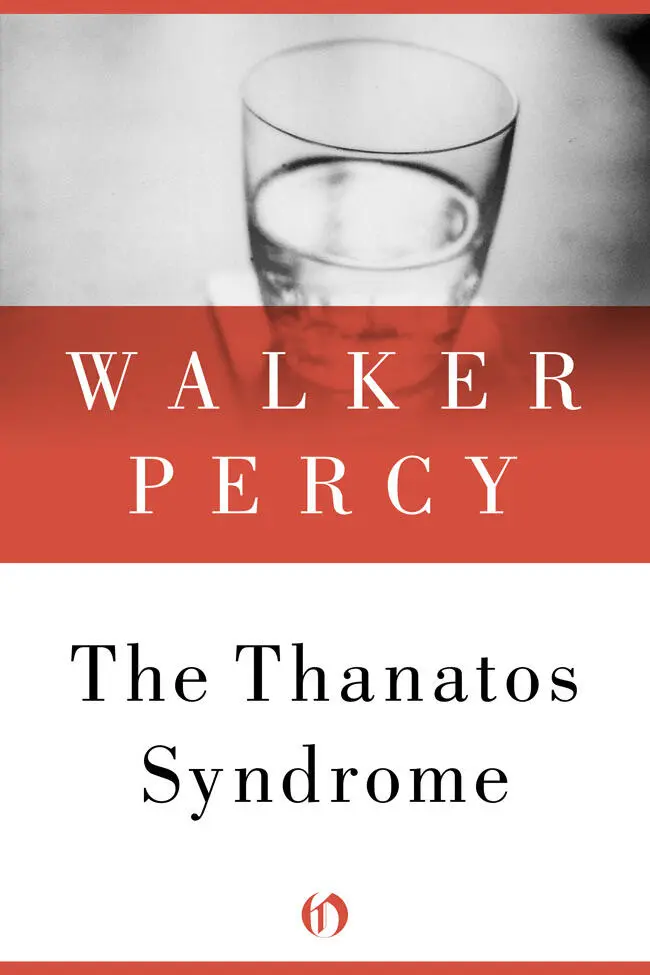
- Название:The Thanatos Syndrome
- Автор:
- Издательство:Open Road Media
- Жанр:
- Год:2011
- ISBN:нет данных
- Рейтинг книги:3 / 5. Голосов: 1
-
Избранное:Добавить в избранное
- Отзывы:
-
Ваша оценка:
The Thanatos Syndrome: краткое содержание, описание и аннотация
Предлагаем к чтению аннотацию, описание, краткое содержание или предисловие (зависит от того, что написал сам автор книги «The Thanatos Syndrome»). Если вы не нашли необходимую информацию о книге — напишите в комментариях, мы постараемся отыскать её.
Dr. Tom More returns to his parish in Louisiana determined to live a simpler life. Fresh out of prison after getting caught selling uppers to truck drivers, he wants nothing more than to live “a small life.” But when everyone in town begins acting strangely — from losing their sexual inhibitions to speaking only in blunt, truncated sentences — More, with help from his cousin Lucy Lipscomb, takes it upon himself to reveal what and who is responsible. Their investigation leads them to the highest seats of power, where they discover that a government conspiracy is poised to rob its citizens of their selves, their free will, and ultimately their humanity.
The Thanatos Syndrome — читать онлайн бесплатно полную книгу (весь текст) целиком
Ниже представлен текст книги, разбитый по страницам. Система сохранения места последней прочитанной страницы, позволяет с удобством читать онлайн бесплатно книгу «The Thanatos Syndrome», без необходимости каждый раз заново искать на чём Вы остановились. Поставьте закладку, и сможете в любой момент перейти на страницу, на которой закончили чтение.
Интервал:
Закладка:
Thumbtacked to a post at the foot of the tower are three cards, two ordinary business cards and an old-fashioned holy picture of the Sacred Heart, each with the scribbled note: “Thanks for favors granted.” On the metal upright of the tower I notice several penciled crosses, like the plus signs a child would make.
The stairs run smack into the floor of the tiny house. The trapdoor is open. Father Smith gives me a hand.
I haven’t seen him in months. We were both in Alabama, he almost next door on the Gulf Coast at a place named Hope Haven for impaired priests, mostly drunks. I used to attend his Mass, not for religious reasons, but to get away from Fort Pelham, the golf course, the tin-roofed rec hall, the political arguments, and the eternal stereo-V.
He has aged. He still looks like an old Ricardo Montalban with a handsome seamed face as tanned as cordovan leather, hair like Brillo, and the same hairy futbol wrists. His chest is a barrel suspended by tendons in his neck. Emphysema. As he pulls me up past him, his breath has an old-man’s-nose smell. But he is freshly shaven and wears a clean polo shirt, unpressed chinos, and old-fashioned sneakers.
He is different. It comes to me that the difference is that he is unsmiling and puzzled. He inclines his head to the tiny room. The gesture is not clear. It could mean make yourself at home.
Home is exactly (I find out) six feet square. He is more than six feet tall. I see a bedroll against the wall. I reckon he sleeps on the floor catercornered.
The room is furnished with a high table in the center, two chairs like barstools, in one corner a chemical toilet, and nothing more. Mounted on the table is a bronze disk azimuth, larger than a dinner plate, fitted with two sighting posts and divided into 360 degrees. The four sides of the cubicle are glass above the wainscot except for a wall space covered by a map. Hanging from the map are strings weighted by fish sinkers. Next to the map is a wall telephone.
Outside, the gently rolling terrain stretches away, covered by pines as far as the eye can see. In the slanting afternoon sun the crowns of the pines are bluish and rough as the pile of a shag rug. The countryside seems strangely silent and unpopulated except toward the south, where the condos and high-rises on the lakefront stick up like a broken picket fence.
“It’s good to see you, Father.” I offer my hand, but he does not seem to notice. Perhaps he regarded his pulling me up through the trapdoor as a handshake. Then I see that something is wrong with him. He is standing indecisively, fists in his pockets, brows knitted in a preoccupied expression. He does not look crazy but excessively sane, like a busy man of the world, with a thousand things on his mind, waiting for an elevator. Then suddenly he snaps his fingers softly as if he had just remembered something, seems on the very point of mentioning it, and as suddenly falls silent.
We stand so for a while. I wait for him to tell me to sit. But he’s in a brown study, frowning, hands deep in pockets, making and unmaking fists. So, why not, I invite him to have a seat. He does.
We sit on the high stools opposite each other, the azimuth between us.
“Allow me to state my business, Father. Two pieces of business. Father Placide wanted to know how you were and wanted me to inquire whether you might help him out. Dr. Comeaux wanted to know whether you have decided to recommend his purchase of the buildings and property of St. Margaret’s.”
Again he gives every sign of understanding, seems on the point of replying, but again falls silent and gazes down at the azimuth with terrific concentration, as if he were studying a chess board.
“Father,” I say presently, “I know you must be upset about the hospice closing.”
Nodding agreeably, but then frowning, studying the table.
“I know how you feel about the Qualitarian program taking over, the pedeuthanasia, the gereuthanasia, but—”
“No no,” he says suddenly, but not raising his eyes. “No no.”
“No no what?”
“It wasn’t that.”
“Wasn’t what?”
“They have their reasons. Not bad reasons, are they? They make considerable sense, wouldn’t you agree? They’re not bad fellows. They make some sense,” he says, nodding and repeating himself several times in the careless musing voice of a bridge player studying his hand. “Well, don’t they?” he asks, almost slyly, cocking his head and almost meeting my eyes.
“It could be argued,” I say, studying him. “Then are you going to approve the sale to Dr. Comeaux?”
“Hm.” Now he’s drumming his fingers and tucking in his upper lip as if he had almost decided on his next play. “But here’s the question,” he says in a different, livelier voice — and then hangs fire.
“Yes?”
“Tom,” he says, nodding, almost himself now, but concentrating terrifically on each word, “what would you say was wrong with a person who is otherwise in good health but who has difficulties going about his daily duties, that is — say — when he is supposed to go to a meeting, a parish-council meeting, a school-board meeting, visit the nursing home, say Mass — his feet seem to be in glue. He can hardly set one foot in front of the other, can hardly pick up the telephone, can hardly collect his thoughts, has to struggle to answer the simplest question. What would you say was wrong with such a person?”
“I’d say he was depressed.”
“Hm. Yes. Depressed.”
I wait for him to go on, but he doesn’t.
“Were you, are you, able to say Mass?”
“Mass,” he repeats, frowning mightily. “Yes,” he says at last in his musing voice. “Oh yes.”
“Could you preach?”
“Preach.” Again the cocked head, the sly near-smile. “No no.”
“No? Why not?”
“Why not? A good question. Because — it doesn’t signify.”
“What doesn’t signify?”
“The words.”
“The words of the sermon, of the Mass, don’t signify?”
“That’s well put, Tom,” he says, not ironically. “But the action does.”
“Why don’t the words signify?”
“Let me ask you a question as a scientist and a student of human nature,” he says, almost in his old priest-friend-colleague voice.
“Sure.”
“Do you think it is possible that words could be deprived of their meaning?”
“Deprived of their meaning. What words?”
“Name it! Any words. Tom, U.S.A., God, Simon, prayer, sin, heaven, world.”
“I’m afraid I don’t understand the question.”
“Here’s the question,” he says in a brisk rehearsed voice. Again, for some reason, he reminds me of a caller calling in to a radio talk show. He almost raises his eyes. “If it is a fact that words are deprived of their meaning, does it not follow that there is a depriver?”
“A depriver. I’m afraid—”
“What other explanation is there?” he asks in a rush, as if he already knew what I would say.
I always answer patients honestly. “One explanation, if I understand you correctly, is that a person can stop believing in the things the words signify.”
“Ah ha,” he says at once, smiling as if I had taken the bait. “But that’s the point, isn’t it?”
“What’s the point?”
“Don’t you see?” he asks in a stronger voice, eyes still lowered, but hitching closer over the azimuth.
“Not quite.”
“It is not a question of belief or unbelief. Even if such things were all proved, if the existence of God, heaven, hell, sin were all proved as certainly as the distance to the sun is proved, it would make no difference, would it?”
“To whom?”
“To people! To unbelievers and to so-called believers.”
“Why wouldn’t it?”
Читать дальшеИнтервал:
Закладка:
Похожие книги на «The Thanatos Syndrome»
Представляем Вашему вниманию похожие книги на «The Thanatos Syndrome» списком для выбора. Мы отобрали схожую по названию и смыслу литературу в надежде предоставить читателям больше вариантов отыскать новые, интересные, ещё непрочитанные произведения.










Обсуждение, отзывы о книге «The Thanatos Syndrome» и просто собственные мнения читателей. Оставьте ваши комментарии, напишите, что Вы думаете о произведении, его смысле или главных героях. Укажите что конкретно понравилось, а что нет, и почему Вы так считаете.