Norman Rush - Mortals
Здесь есть возможность читать онлайн «Norman Rush - Mortals» весь текст электронной книги совершенно бесплатно (целиком полную версию без сокращений). В некоторых случаях можно слушать аудио, скачать через торрент в формате fb2 и присутствует краткое содержание. Год выпуска: 2003, ISBN: 2003, Издательство: Vintage Books, Жанр: Современная проза, на английском языке. Описание произведения, (предисловие) а так же отзывы посетителей доступны на портале библиотеки ЛибКат.
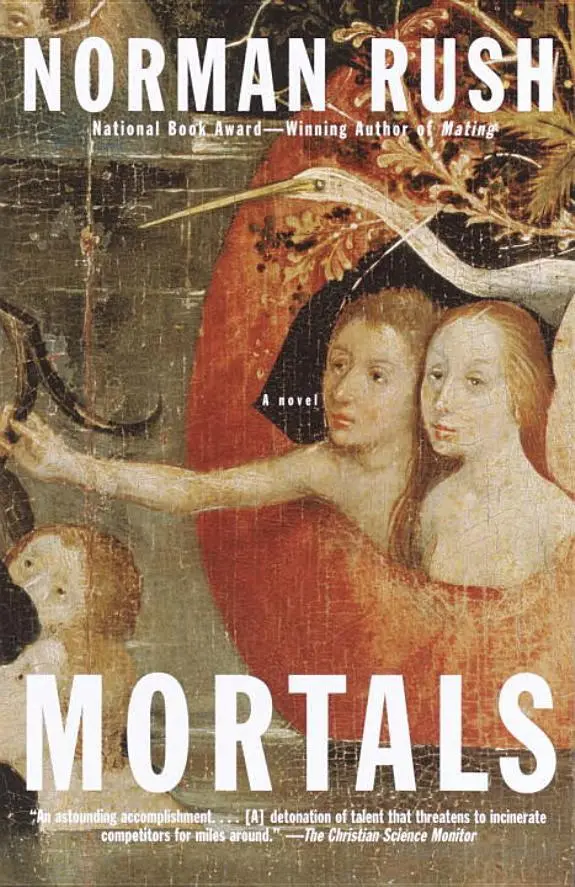
- Название:Mortals
- Автор:
- Издательство:Vintage Books
- Жанр:
- Год:2003
- ISBN:9780307789365
- Рейтинг книги:3 / 5. Голосов: 1
-
Избранное:Добавить в избранное
- Отзывы:
-
Ваша оценка:
Mortals: краткое содержание, описание и аннотация
Предлагаем к чтению аннотацию, описание, краткое содержание или предисловие (зависит от того, что написал сам автор книги «Mortals»). Если вы не нашли необходимую информацию о книге — напишите в комментариях, мы постараемся отыскать её.
As a spy, the compulsively literate Ray ought to have no trouble confirming his suspicions. But there’s the distraction of actual spying. Most of all, there’s the problem of love, which Norman Rush anatomizes in all its hopeless splendor in a novel that would have delighted Milton, Nabokov, and Graham Greene.
Mortals — читать онлайн бесплатно полную книгу (весь текст) целиком
Ниже представлен текст книги, разбитый по страницам. Система сохранения места последней прочитанной страницы, позволяет с удобством читать онлайн бесплатно книгу «Mortals», без необходимости каждый раз заново искать на чём Вы остановились. Поставьте закладку, и сможете в любой момент перейти на страницу, на которой закончили чтение.
Интервал:
Закладка:
“Where did you hear about it, Iris? Are they covering it on TV?”
“No, not really. In the paper.”
“The local paper there?”
“It must’ve been. Ray I didn’t ask about Dimakatso. You know to give her my love. But how is she doing?”
It was possible it had been in the paper, but he didn’t believe it. And now she was showing regret, showing she wanted to get off the subject and he didn’t like that. He could be wrong. He could be. He wanted to be wrong.
He had made himself too unhappy to continue.
“I haven’t eaten,” he said.
“Well for goodness’ sake go and eat. I’ll talk to you tomorrow or the next day.”
“Right, and my love to everybody. I love you. Get a name for that baby. I’ll talk to Ellen, one of these calls, tell her.”
“I love you,” she said.
He said, “And so, goodnight.”
21. The Apostles of Reason
Pony had overproduced, at first. Ray hadn’t been prepared for it and had even run low on replacement cassettes at one point. And then there had been a change. A trajectory was developing in Pony’s attitude that was making Ray uncomfortable and wary. The issue of a chartering letter, which had come up twice, sharply, after Pony had begun this work, was now gone, dropped. And information on the whereabouts of Pony’s debtor, the absconded haulier, very preliminary information at that, had been received perfunctorily. Pony had gone from tense volubility, from presenting Ray with full lists of attendees so that all the voices on the tapes could be identified, to a new mode of dreaminess and diffidence. And when it came to identifying participants Pony had gotten vaguer and vaguer, claiming forgetfulness, claiming not to have been introduced to half the group attending. Nor was Pony pressing for supplementary payments, Ray realized. He had the money for him. Something was up.
But then something was always up. Even if Pony was planning to exit the assignment, that would be manageable, because he had been so copious to date that Ray was dealing with more material than he’d had time to get decently through, much less decently assess. Critical information had come out of the tapes. Morel was creating two groups, a public group called the Apostles of Reason, and an inner, esoteric group, cadres, whose name Ray had yet to discover. Morel was recruiting cadres, which was why the tape he was going to listen to tonight, for the second time, was worth better attention than he’d been able to give it. It represented a sort of catechism session of a young fellow from Mahalapye, an assistant pharmacist, Themba Kise, someone being groomed to go out and beat the drum for irreligion in the northeast part of the country, a sort of franchise being given to him. Apparently the way it worked was that the most promising contacts, the ones considered eligible for the inner circle of proselytizers, would come and stay with Morel for a residential immersion lasting a week or so, ending in catechism.
Dark of night galvanized him. It was very late. He was at ease on the sofa, his bare feet up on the vast plain of glass that was their coffee table. The living room blinds were tightly drawn. The odor of charred garlic was heavy in the air, heavy and sweet. That evening he had cooked his third steak dinner of the week. He could get frozen fish tomorrow, hake. The best parts of his thesis had been written in the middle of the night, before he’d met Iris. Now that she was away he was being reminded how much he liked to work at night. Maybe he was regressing in a general way. He had a craving for creamed chipped beef, a dish he hadn’t had since high school, a specialty, if you could call it that, of his mother’s. At night your enemies are asleep, he thought. Working for the agency did provide him with more occasions for solitary late night work than the usual job would. He shouldn’t complain. But marriage and teaching can’t help but nail us to the light of day, he thought. He was happy tonight, he supposed. He put the earphones on.
He had to bear down on this tape, not let his mind drift. It was important. His periphery was reasonably clear. Iris was all right. It was obviously a piece of luck that her landfall in America had been Florida, which was turning out to be more floridly, so to speak, part of the Bible Belt than either of them had realized. She had reported hearing a young girl’s call to a religious radio talk program. The child had been anxious to know if it was allowed to sleep late in heaven. Ellen had settled on a name for her daughter, Mame. He didn’t care. It had been between Mame and Mitzi. It was good that Wemberg had shifted his hiding place out of the university library and to someplace unknown. That had been a relief to Ray. There was a story around that Wemberg was sleeping rough in the maize fields in Sebele.
He was ready to begin. Hearing this taped session the first time had brought home to him how little interest he had in changing anyone’s mind on any subject, any important subject. He thought about that a little more. He had been part of a war all his adult life, but he had never felt impelled to try to change the views of any of his opponents, ever. He had tried to trip them up, dismay them, undo them, but the idea of attempting to convert any one of them to his own views was embarrassing to him. So Morel, who was making a passionate vocation out of changing the minds of other adults, was what, a horse of another color altogether.
Part of the prologue was missing. They were a little way into the catechism. Morel’s voice was without much color. He was tense. His voice was high. He was working to keep himself at the right level for his listeners. He was conforming his speech pattern to what he thought was appropriate for his English-as-a-second-language Batswana audience, speaking more slowly and formally. We all do the same thing, he thought.
“So, then, what do we say to the question, Who was this man Jesus? We accept that he was real, unlike Moses, he was real, and he walked the earth of ancient Palestine.
“A Jew. Always a Jew. Up to the end, a Jew. And is there anything about his name that might be mentioned?”
“I forgot. His name in truth was Jeshua, which is saying in Hebrew that Yahweh is soon to come back. Yahweh the God of the Jews.”
“So go on with more. How else do we know he was still a Jew?”
“Rra, because he wore the boxes on his body …”
“Yes, those are called phylacteries. It’s good to use the correct name if you can remember. And what are phylacteries?”
“Rra, they are foolish small boxes with Jewish writing on little scraps.”
“But remember, Themba, we try never to mock … as we go. We describe … And what else shows that this Jesus was a Jew?”
“He said go to the temple many times if you have done something wrong, and give taxes …”
“Let me interrupt, rra. The tax, which he agreed all Jews should pay, was one thing. It supported the temple, maintained it. But he also said that Jews should be dutiful and pay the fees for atonement for particular sins. You might purchase a dove to sacrifice, to make up for some wrong you may have done. And of course it would have to be a dove that was perfect, which we are coming to.”
“Ehe, and he wore earlocks, although we are not sure. Yet we think so.”
“These earlocks, they are called …?”
“I forget what.”
“Just a minor thing. Peyot. They are called peyot.”
“Peyot, ehe. And fringes to his sleeves.”
“Good. And they are called …?”
“Tzitzit.” But he had hesitated over the last syllable.
“Themba, if you are unsure as to pronouncing a word, a foreign word, it’s best not to try, because there may be someone who will catch you on it to destroy your greater message. But tzitzit is correct. Now, and what is it that is recorded that Jesus said, that shows him to be a faithful Jew?”
Читать дальшеИнтервал:
Закладка:
Похожие книги на «Mortals»
Представляем Вашему вниманию похожие книги на «Mortals» списком для выбора. Мы отобрали схожую по названию и смыслу литературу в надежде предоставить читателям больше вариантов отыскать новые, интересные, ещё непрочитанные произведения.







Обсуждение, отзывы о книге «Mortals» и просто собственные мнения читателей. Оставьте ваши комментарии, напишите, что Вы думаете о произведении, его смысле или главных героях. Укажите что конкретно понравилось, а что нет, и почему Вы так считаете.