Norman Rush - Mortals
Здесь есть возможность читать онлайн «Norman Rush - Mortals» весь текст электронной книги совершенно бесплатно (целиком полную версию без сокращений). В некоторых случаях можно слушать аудио, скачать через торрент в формате fb2 и присутствует краткое содержание. Год выпуска: 2003, ISBN: 2003, Издательство: Vintage Books, Жанр: Современная проза, на английском языке. Описание произведения, (предисловие) а так же отзывы посетителей доступны на портале библиотеки ЛибКат.
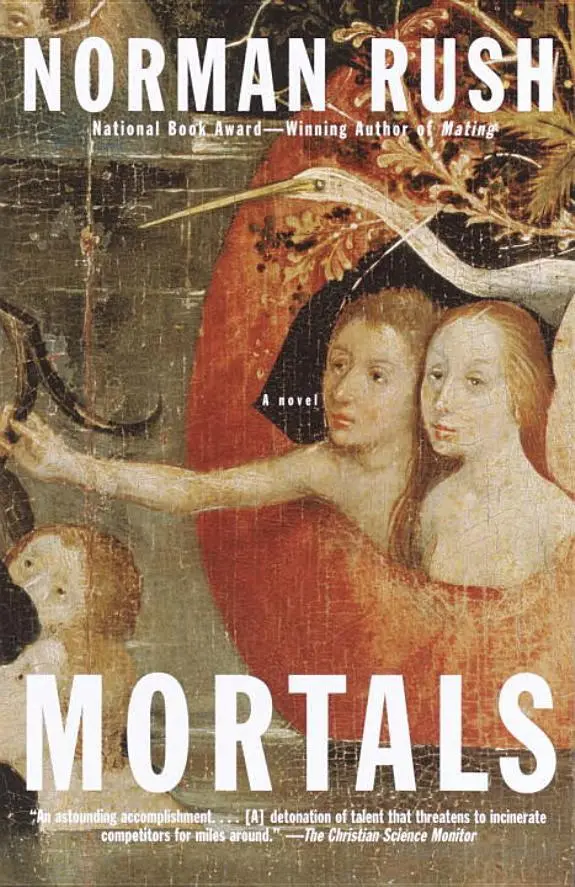
- Название:Mortals
- Автор:
- Издательство:Vintage Books
- Жанр:
- Год:2003
- ISBN:9780307789365
- Рейтинг книги:3 / 5. Голосов: 1
-
Избранное:Добавить в избранное
- Отзывы:
-
Ваша оценка:
Mortals: краткое содержание, описание и аннотация
Предлагаем к чтению аннотацию, описание, краткое содержание или предисловие (зависит от того, что написал сам автор книги «Mortals»). Если вы не нашли необходимую информацию о книге — напишите в комментариях, мы постараемся отыскать её.
As a spy, the compulsively literate Ray ought to have no trouble confirming his suspicions. But there’s the distraction of actual spying. Most of all, there’s the problem of love, which Norman Rush anatomizes in all its hopeless splendor in a novel that would have delighted Milton, Nabokov, and Graham Greene.
Mortals — читать онлайн бесплатно полную книгу (весь текст) целиком
Ниже представлен текст книги, разбитый по страницам. Система сохранения места последней прочитанной страницы, позволяет с удобством читать онлайн бесплатно книгу «Mortals», без необходимости каждый раз заново искать на чём Вы остановились. Поставьте закладку, и сможете в любой момент перейти на страницу, на которой закончили чтение.
Интервал:
Закладка:
“Those children, myself, your friend the engineer, Kerekang. Toward the end there were other people coming over who wanted to exchange pleasantries with Davis. He has a following. Patients and people who’ve heard about him.”
“Now this is after his mission statement?”
“You’re getting the wrong picture. This wasn’t something he declaimed, some grandiose statement he was just waiting to unveil. You could tell he knew it was going to sound grandiose. And it was said more or less man to man, to your friend. I happened to be there. He wasn’t being portentous in any way. Okay, I would even say there was some irony in the way he said it, although at that point I was pretty much in an eavesdropping position. My point is that it wasn’t something being declared for the benefit of one and all, and certainly not for my benefit. What I think happened is that your friend …”
“Stop calling him my friend. I don’t know this man Kerekang.”
“Well, but you seem to like him. So do I …”
“And I don’t keep referring to him as your friend, do I?”
“No, but you obviously like him. So did Davis. He’s very appealing. You approve of him.”
“Well let’s call him Kerekang, for simplicity. I call your doctor by his last name and you and I call Kerekang by his last name. Or for even greater simplicity we could both refer to your doctor by his last name. No? Jesus, what is this? Everything is getting in the way.”
“I know, and it’s not coming from me. Anyway.
“Anyway, they went back and forth about Christianity for a while. I think Davis was trying to feel Kerekang out on the subject, find out where he stood. They were sizing each other up. It was fun to watch.
“I’m now, for this discussion, in a different memory palace, by the way.
“Kerekang seemed to be taking the position that even though Christianity wasn’t exactly true, Africans had some things to be grateful to certain Christians for. And he mentioned how Livingstone and Moffat had run guns to the Batswana so they could repel the Boers. And in a more general way he was saying that he didn’t see that it was so terrible for people to have in their minds a model of someone unfailingly kind, acting kindly. And then the discussion got a little miscellaneous on his part and he alluded to the role Christians had played in getting cab horses treated decently in London in the nineteenth century and also to the part they played in stopping the gladiatorial games, although I had the sense that Davis had some alternate explanation for that that he couldn’t quite lay his hands on, or didn’t, anyway. And then Kerekang went on to the work of Christians in ending the slave trade, although he did say that Christians had participated in it and profited from it from the beginning. And Kerekang also admitted that Christians in Europe had basically forced the Jews into being slave traders during the Middle Ages by making it one of the few trades Jews were allowed to engage in.
“So then Davis wanted him not to rely on single instances, but to look at the larger effects of the doctrine in Africa, and not to look at this or that good act by white Christians here and there in Africa. He wanted him to focus on what Christianity had done to Africans, to the African minds it had penetrated and was still penetrating. Wait a minute.”
She closed her eyes.
“Okay, then Davis gave as an example what Christianity had done to homosexuality in Africa, making the point that universally there was no stigma attached to being homosexual within the traditional cultures, but that Christianity had brought persecution of homosexuality with it, introduced it where it hadn’t been. Kerekang took this for a good point.”
The flagpoles of the Gaborone Sun were coming into view.
“Then, and this was very sotto voce between them, they talked about abortion and how all the churches were united against legalization, which is true. And then they came to AIDS.
“Davis is passionate about it. He hears things through the medical grapevine that other people don’t know. In the morgues in Zimbabwe they are stacking the AIDS corpses three to a tray, for example. The Catholics are against condoms and the Protestant churches are barely in favor of them and the independent African churches are bastions of insane folklore remedies for AIDS, which is galloping unbelievably. He thinks seropositivity is almost twenty percent here.
“Then Kerekang tried to take a sort of evolutionary position. This was that people would progress from animism and local gods to monotheism, the monotheisms, and then to Deism and finally out into post-religion. We would all someday be like Sweden, where nobody believed anything having to do with religion anymore. He’s visited Sweden. But Davis was absolute against that view, saying that it’s the liberal denominations that are declining into unimportance and the fundamentalist branches of religion that are gaining strength. And he wanted Kerekang to admit that this was especially true in Africa, which Kerekang did admit. Davis said Kerekang was a religious Menshevik, thinking that religion was going to turn into secularism the way the Mensheviks thought capitalism was going to evolve itself into socialism. For some reason this was a big hit with Kerekang. He has a wonderful laugh. How am I doing as a rapporteur?”
“You’re astonishing me.”
She was very pleased. He loved this flushed, sturdy creature. All this was for him, all this effort.
She said, “ Then … what?… I think a reprise of the question of white Christians doing good things, which Kerekang couldn’t quite escape from, ending up in this exchange … Kerekang saying Some people come to Africa to help us very much. Davis saying So did I. Kerekang saying They came to build things up. Davis saying Like me. Kerekang saying They came to create things. Davis saying Yes and the things they came to build are falling on the heads of Africans all around us.
“And then I believe this is the end of it. And I learned something I didn’t know. Davis pointed out that Kerekang, who’s a Xhosa, should appreciate that Christianity was behind the destruction of his people. In this way. In 1856 a prophetess ordered them to slaughter their entire national herd, half a million cattle, as a sacrifice, which they did and which impoverished them, it ruined them, it’s so horrible. The prophetess …”
“Nongqawuse.”
“You see, you know everything.”
“Not quite, babe.”
“But that’s really impressive.”
“No it isn’t. It’s one of the main events in the history of the region. The Xhosas who settled here in Botswana came north after the cattle massacre. There’s a big settlement near Mahalapye, which is where Kerekang comes from, if my guess is correct.”
“Well in any case she was a Christian convert who had decided that all the cattle had to be killed because they had been reared by people who practiced witchcraft, as the Xhosas had for generations, which meant that the cattle were defiled because the Christian god hated witchcraft. They were in a period of stress at the time. I don’t know if it was drought or what. They were continually under pressure from the Zulus. So the prophetess promised that their tribulations would be over once they’d killed off all the cattle. He made the point, Davis did, that most people think of this act of destruction as something arising from primitive tribal craziness. But this was not a thing the pre-Christian tribes had ever done. It was Christianity that did it to them. Did you know that?”
He hadn’t. He hadn’t known that Nongqawuse was a Christian convert. “I may have known that, once. Maybe not. No, I don’t think I did. No, I didn’t.”
“Any last comments on my report?”
Читать дальшеИнтервал:
Закладка:
Похожие книги на «Mortals»
Представляем Вашему вниманию похожие книги на «Mortals» списком для выбора. Мы отобрали схожую по названию и смыслу литературу в надежде предоставить читателям больше вариантов отыскать новые, интересные, ещё непрочитанные произведения.




Обсуждение, отзывы о книге «Mortals» и просто собственные мнения читателей. Оставьте ваши комментарии, напишите, что Вы думаете о произведении, его смысле или главных героях. Укажите что конкретно понравилось, а что нет, и почему Вы так считаете.