Norman Rush - Mortals
Здесь есть возможность читать онлайн «Norman Rush - Mortals» весь текст электронной книги совершенно бесплатно (целиком полную версию без сокращений). В некоторых случаях можно слушать аудио, скачать через торрент в формате fb2 и присутствует краткое содержание. Год выпуска: 2003, ISBN: 2003, Издательство: Vintage Books, Жанр: Современная проза, на английском языке. Описание произведения, (предисловие) а так же отзывы посетителей доступны на портале библиотеки ЛибКат.
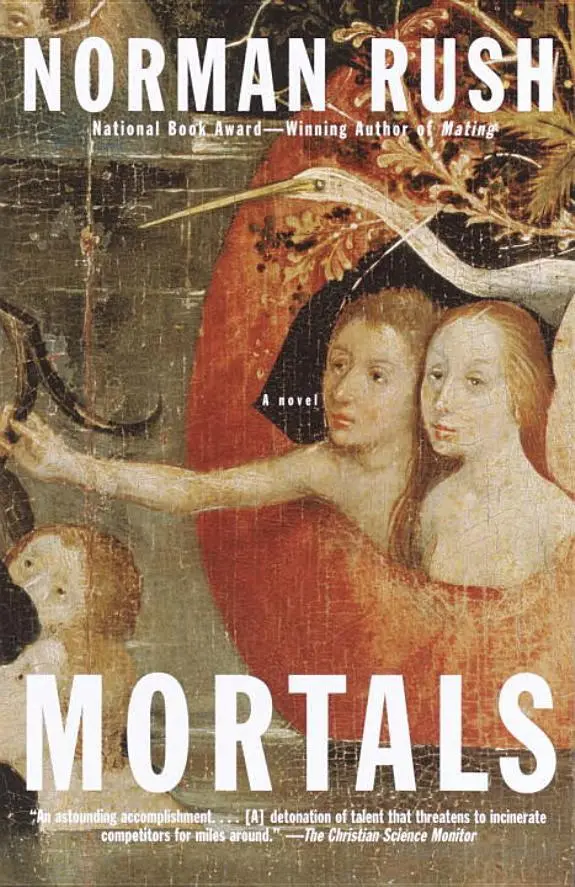
- Название:Mortals
- Автор:
- Издательство:Vintage Books
- Жанр:
- Год:2003
- ISBN:9780307789365
- Рейтинг книги:3 / 5. Голосов: 1
-
Избранное:Добавить в избранное
- Отзывы:
-
Ваша оценка:
Mortals: краткое содержание, описание и аннотация
Предлагаем к чтению аннотацию, описание, краткое содержание или предисловие (зависит от того, что написал сам автор книги «Mortals»). Если вы не нашли необходимую информацию о книге — напишите в комментариях, мы постараемся отыскать её.
As a spy, the compulsively literate Ray ought to have no trouble confirming his suspicions. But there’s the distraction of actual spying. Most of all, there’s the problem of love, which Norman Rush anatomizes in all its hopeless splendor in a novel that would have delighted Milton, Nabokov, and Graham Greene.
Mortals — читать онлайн бесплатно полную книгу (весь текст) целиком
Ниже представлен текст книги, разбитый по страницам. Система сохранения места последней прочитанной страницы, позволяет с удобством читать онлайн бесплатно книгу «Mortals», без необходимости каждый раз заново искать на чём Вы остановились. Поставьте закладку, и сможете в любой момент перейти на страницу, на которой закончили чтение.
Интервал:
Закладка:
Sweeping his torchbeam around the bedroom one last time, he noticed a possible accessory for his human bomb costume. A metal crank showed at the edge of the heavy purple drapes shrouding the windows. That was how the windows were opened and closed. He wanted the crank. He seized it and tugged at it and it slipped easily off the shank it was meant to turn. The shank was square and it fit into a square slot in the butt of the crank. There was no securing pin or screw. He had been worried that the crank mechanism might have been rusted. But in the Kalahari nothing rusted. That was worth keeping in mind. He wanted to laugh. He had the crank. It was going to look good. He forced the butt of the crank deeply into the overlapped tape bindings so that the handle projected at the foot of the bundle, where his right hand could quickly grasp it. Of course, it was a joke. But it was a joke that only had to remain unpenetrated for a relatively short period of time. He went to the mirror again and lit himself up, armed as he was for war. He realized that there was a sense in which to the intelligent eye the crank would seem to imply that the bomb he was carrying was primed by clockwork of some kind. He didn’t care. It was the overall effect that counted and the overall effect was good.
He disheveled his hair. It was an afterthought. It seemed appropriate.
In the corridor again, he felt he was getting better oriented. This main building was in the shape of a laterally stretched-out block letter U, with the shorter elements, the uprights, constituted by the east and west wings, and the long base span between them constituting the central mass of the building. It was a considerable piece of construction. He was through with this wing of the building. The stairway connecting the first and second floors was located at the southwest elbow of the building. The endless-looking corridor to the east wing lay unexplored before him.
The place was eccentric. The baseboards were carved in the same serpentine pattern as the banisters. Armies of people had been charged with keeping the woodwork polished. There were heavy black beams in the ceilings. He didn’t want this place to burn.
Exactly halfway down the corridor of the main section of the building he found what he was looking for. There was an alcove with a narrow tin-clad door set into one wall. There were nail-punch designs in the tin facing, fruit motifs, insofar as he could tell. This was not going to be a door leading to a closet or pantry. He didn’t know how he knew, but he did.
The door was unlocked.
He inched the door open. There was light coming down from above. A wash of heat touched him. A steep, straight flight of iron stairs led to the open sky. The sky was streaked with smoke. There was a trapdoor at the top of the stairs and it seemed to be secured in the open position. He closed the door. There had been blood on the stair treads. He knew the smell.
He could go up immediately or he could go back and retrieve his gun. He was feeling strongly that he had cached the gun too far away. If he had the gun, he could drag it inconspicuously behind him as he proceeded with his original plan or he could stow it someplace closer to where he was going to be. It wasn’t that he was giving up his plans, his plan, it was that he was trying to refine what he was going to do.
He ran to retrieve the rifle and returned with it to the alcove, where he let himself collapse, sinking down against the door, to get his breath. He was hungry.
He had to go up there now. He supposed his idea was to terrify people into doing something he ordered them to. He would decide how to act once he saw what he was going to be confronted with, that is, whether he should act like a fou, a nut, or like a coldblooded type, a zealot but cold.
He started up the stairs. He couldn’t let go of the gun. He thought, Anyway, we are all fragile puddings, doomed slumping puddings trying to stay hard as long as we can. It was conceivable he was just about to expose himself to sudden death. He had to get himself in order, be clear, concentrate his mind. He couldn’t set aside more time to do it because he’d already dithered enough. He had to be in order, though. He would give himself until he got to the top of the stairway to the roof. He would have to be succinct. But he had to mount the stairs very deliberately anyway, because he had to avoid slipping in the blood on the stairs and because he had to favor his knees, his right knee, spare it for whatever exertions were going to be called for.
He began the ascent. The angle was not quite vertical and there was no railing to grip. Dragging the rifle up with him, behind him, was difficult and made for slower going. He wanted to be clear, as clear about what he was doing as Yeats’s Irish airman.
One, step one, was Iris, and there was nothing to say about Iris beyond love and the size of his loss and that was it. If he was going to be shot to death and Iris was the last thing on his mind he wouldn’t mind.
Two was Africa. He had been happy in Africa and he was guilty about that and he would do something for Africa in the next act, because it looked bad for Africa, and not only Botswana. There was the virus, seropositivity as they called it, and Morel saying that it was going to be a holocaust. There was nothing he could do about it. Of course Morel no doubt thought the answer was to go and dynamite churches, and possibly Parliament as well. They were doing nothing, and Africa was slipping into the valley of the shadow of death. He didn’t know whose fault it was. He wanted Morel to be wrong about this and for science to come up with something. He prayed for it.
Three was the agency. He had to have mixed feelings about the agency. After all it had come into existence only after the West realized that the communists had organized a huge espionage machine larger and more aggressive and successful than anything in the West or even than the whole West together, and after the West realized that legal communist parties everywhere were being used as spotters and resources for spies, and after it became obvious the communists were setting new standards in ruthlessness, as in throwing oppositionists into crematoria during the Spanish Civil War. And then there had been the likelihood that the people at the top of the communist machine were clinically insane, paranoid, as the Moscow Trials demonstrated. So, all that was true. But then the agency had gone wrong, in places, in many places, in the marches of the empire, in Indonesia for sure, in Central America the same, in Afghanistan, and in Africa, especially in Malawi and Zaire, but not only there. And he knew that the agency was going to survive the collapse of the Russians and continue using its power dubiously, which was why he had to be out if he escaped this alive. Being in the agency meant making impossible judgments, weighing justifiable or virtuous acts against inexcusable ones, mainly because so much on either side of the equation remained secret.
The rifle was proving useful as a crutch. Four was English Literature. He loved it. It was always with him. He thought, On the roof I will do such things as will be the terror of the earth, but what they will be exactly I have no idea, like Tamburlaine. He had been attracted to the Elizabethans, Webster especially, but had decided they were too bloody. Imagine that, he thought.
The stair treads were fixed in a metal casing. There were no risers. He had to grasp at the treads above, using one hand only, and drag himself up, hellward. Sweat was sliding into his eyes but the best he could do to get rid of it was to rub his eyes against his shoulders, which was ineffective. He needed a spare arm. The smell of blood was making him ill.
Five was Rex. He wondered how anyone was supposed to compete with a brother whose first word was brioche and whose last word, according to what had been reported to Iris and relayed to Morel and then to him, whose last word was Mama. My first word was car, he thought. Apparently his parents had given Rex a bite of brioche at some early point and he had loved it and wanted more and voilà. Ray had gotten tired of hearing about it and about Rex’s magnificent and precocious vocabulary in general. Rex had been impossible, but still, on his own end, Ray knew he had mismanaged things. He would do what he could for his brother, who was one of the aoroi , the dead-too-early. He didn’t know why he remembered that. In any case, if he lived, he was going to do a Life of his brother, a vignette, and maybe a chapbook of the best bits and pieces from Strange News .
Читать дальшеИнтервал:
Закладка:
Похожие книги на «Mortals»
Представляем Вашему вниманию похожие книги на «Mortals» списком для выбора. Мы отобрали схожую по названию и смыслу литературу в надежде предоставить читателям больше вариантов отыскать новые, интересные, ещё непрочитанные произведения.




Обсуждение, отзывы о книге «Mortals» и просто собственные мнения читателей. Оставьте ваши комментарии, напишите, что Вы думаете о произведении, его смысле или главных героях. Укажите что конкретно понравилось, а что нет, и почему Вы так считаете.