Norman Rush - Mortals
Здесь есть возможность читать онлайн «Norman Rush - Mortals» весь текст электронной книги совершенно бесплатно (целиком полную версию без сокращений). В некоторых случаях можно слушать аудио, скачать через торрент в формате fb2 и присутствует краткое содержание. Год выпуска: 2003, ISBN: 2003, Издательство: Vintage Books, Жанр: Современная проза, на английском языке. Описание произведения, (предисловие) а так же отзывы посетителей доступны на портале библиотеки ЛибКат.
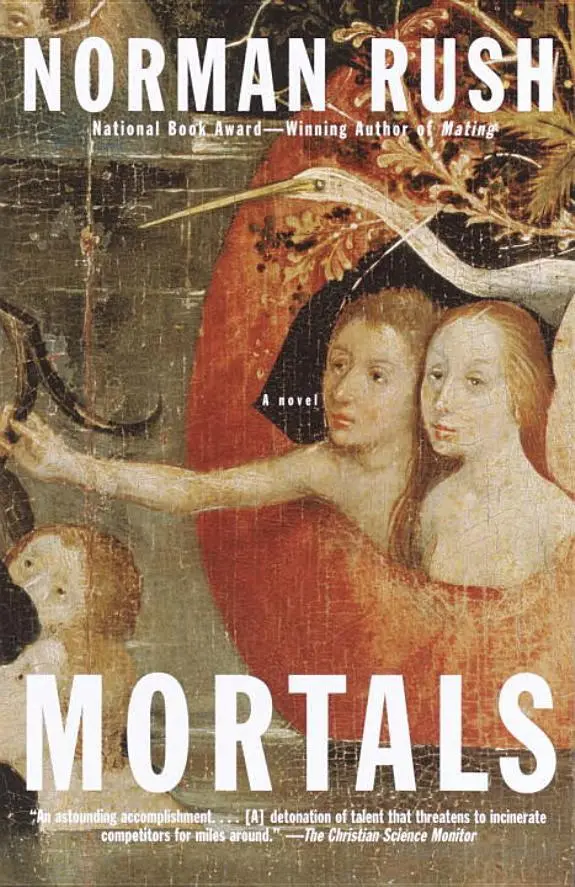
- Название:Mortals
- Автор:
- Издательство:Vintage Books
- Жанр:
- Год:2003
- ISBN:9780307789365
- Рейтинг книги:3 / 5. Голосов: 1
-
Избранное:Добавить в избранное
- Отзывы:
-
Ваша оценка:
Mortals: краткое содержание, описание и аннотация
Предлагаем к чтению аннотацию, описание, краткое содержание или предисловие (зависит от того, что написал сам автор книги «Mortals»). Если вы не нашли необходимую информацию о книге — напишите в комментариях, мы постараемся отыскать её.
As a spy, the compulsively literate Ray ought to have no trouble confirming his suspicions. But there’s the distraction of actual spying. Most of all, there’s the problem of love, which Norman Rush anatomizes in all its hopeless splendor in a novel that would have delighted Milton, Nabokov, and Graham Greene.
Mortals — читать онлайн бесплатно полную книгу (весь текст) целиком
Ниже представлен текст книги, разбитый по страницам. Система сохранения места последней прочитанной страницы, позволяет с удобством читать онлайн бесплатно книгу «Mortals», без необходимости каждый раз заново искать на чём Вы остановились. Поставьте закладку, и сможете в любой момент перейти на страницу, на которой закончили чтение.
Интервал:
Закладка:
He started down. He would go looking as innocent as he could. He would appear as a passerby.
“Hallo,” he shouted, Britishly, not quite sure why he was choosing that mode. It was true that many Batswana seemed to like the racist British more than they did the what, the better Americans. The Brits got more loving care in the hospitals than Americans, as a rule, if he could believe a certain person who had the bad luck to get treatment in the Princess Marina Hospital in a ward where Brit patients were being fawned over whilst, as the Brits would put it, the Batswana nurses mocked the Americans behind their backs for their attempts at egalitarian camaraderie toward them.
“Hallo,” he said again, striding as properly as he could down the rough far slope of the ridge.
Kerosene had been splashed liberally around everywhere in pursuance of arson, but the attempt had obviously been hurried and on some recalcitrant surfaces the kerosene had simply burned off, as it had on the kraal at the center of the cattle post. They had not gotten it to burn. It was an oval kraal made of gnarled sections of log meshed with smaller tree limbs all locked together with windings of different calibers of wire. It was not one of the classic traditional kraals, which were works of art, the logs set deep into the ground and artfully interlinked with the tree limbs into mighty fencing that could resist the worst lunges of irritated cattle, but interlinked without resort to any supplementary binding material. It was a dying art, like thatching. Thatching was being wretchedly done, according to the elderly.
God would help him now. There were two rondavels side by side. He ran to the leg and bent over and pulled on it. The victim was face down. A body followed the one leg. As he pulled, the other leg bent, and folded up under the abdomen. It was a man. It was a man, grown, not old. Something had crushed the left side of his head. He was wearing khaki shorts and a ragged tee shirt. He was shoeless. He was a small man. Ray turned him over. His eyes were open. Someone had to bury this man, to keep wild animals from getting at him, or the body had to be put under something or into something to keep it intact. He would figure it out.
Ray held his forearm across his mouth and nose and entered the rondavel, probing the burning thatch on the floor with his knobkerrie. The interior was full of burning or half-burned items of bedding, furnishings. Anything the size of a man he probed at. He retreated, satisfied that there were no further bodies there.
The second rondavel was a problem. The interior was pure fire. He got as close to it as he could manage and pointlessly shouted into the fire, saying in Setswana both “I am here” and “Are you in there?”
He tried to tell by the smell of the fire in the second rondavel if flesh was being consumed by it. It was all futile and he was taking in too much smoke. He didn’t know how to proceed, except that it seemed to him urgent to pull the body of the dead man farther out, into the yard, and lay it out with the legs straight and together and the arms crossed, until he could think what to do to protect this shell of a human being. And it was even more urgent to find something to wrap around his wound so that he could look at this dead, thin person.
As soon as the conflagration in the second rondavel got less he would tackle it. Ray had a bandanna crammed into his back pocket. He had tied it across his lower face earlier during his transit through the beds of brush between the ridges but had decided against sporting it when he arrived at the site, on the theory that it might not be helpful to look at first glance like a bandit, to whomever he might encounter. He used the bandanna to cover the dead man’s wound.
He guessed that the victim was a Mokgalagadi, basing that on the elaborate initiation scars on his cheeks and on a yellowish tendency in his complexion. He was somewhere in his thirties. He had a small face. His soles and palms were thickly callused. The whites of his eyes were charged with blood, but whether that was related to the way he had died or represented some prior condition was unknowable. He was thin but not emaciated. The man had been brained. He was a herder, probably the only one in a post of such modest size, he had lived a life of unremitting toil, he had all his front teeth, he had lived in unimaginable solitude, now he was dead. He appeared to be staring at something that displeased him, was how Ray would have to describe his expression. There was nothing to identify him in the pockets of his shorts. There was no time for communing. He wanted to apologize. There was no time. “I apologize,” he said. He felt fairly safe, fairly sure that the malefactors were off and away, that this had been a hit-and-run affair, fairly sure of that but not certain. Someone might be aiming at him from anywhere. Let them, he thought. There were fresh treadmarks in the sandy track leading out of the compound and away ultimately to the same road he and Keletso were following. The good idea came to him of putting his knobkerrie down lest someone from a distance mistake it for a firearm. He had to finish, he had to look into the kraal, had to add things up and quickly, because he was tiring. His knees hurt. He hadn’t been noticing, but they were painful.
It felt wrong to abandon the body, but he had to. Bitter truisms were tormenting him, all variants of the fact that this man would be leading his life if Ray had never come to Africa, never been born, never sent Pony to surveil Morel, never put Pony in a position to betray Kerekang. It was that the man’s life had been so minor, such a crust of a life. No one had a right to interrupt so meager an existence. He had lived his days in a clearing a couple of hundred yards across, the ground baked into white iron, no softness, nothing to look at … although the terrain to the north was more rumpled and presumably more interesting than the sheer flatness commencing back where Keletso was waiting, waiting safely, God willing. God would keep him. And what had this man done with his spare time, if that was even an applicable concept? There was a shattered transistor radio on the rondavel stoop. He had listened to Radio Botswana and to the incessant sounds the animals made and what else. Animals never shut up, Ray thought.
He was ready to go. But he was seeing something wrong. He was picking up a shudder in the arras, the brown and acid-green tapestry the bush on the far side of the donga represented. Something was moving, possibly hiding, moving in fits and starts. Now it was not moving. Nothing was. Whatever was moving was light in color. He might be in danger. There was something to attend to. He knew what the possibilities were. There could be a wounded survivor in hiding, or a raider not wounded at all. Now he couldn’t go. He was exhausted and he couldn’t go. He was profoundly exhausted.
Black drifts of smoke were masking the part of the terrain he had to understand. When they weakened and he could see again he was ready. He knew he needed to continue looking as happenstantial as he could, given his butcherous appearance. He had to be unthreatening. He took off his sunglasses.
He proceeded to shout “Wapenduka” first, which was the Herero greeting. There were Baherero herders, although very few if any of them worked for Tswana cattle owners. But he happened to know the greeting.
He switched to Setswana, shouting “O tsogile,” a request to know how a respondent was doing, actually how a respondent was standing, oddly enough.
He needed the Bushman greeting. He didn’t know what it was. It was normal to find Bushmen working at the most casual level of labor at the cattle posts, coming and going, working for salt, sugar, and tobacco and room and board, coming and going like phantoms. They had to be managed gently because they could waltz out and live comfortably in hell, getting water out of tubers, dancing through hell.
Читать дальшеИнтервал:
Закладка:
Похожие книги на «Mortals»
Представляем Вашему вниманию похожие книги на «Mortals» списком для выбора. Мы отобрали схожую по названию и смыслу литературу в надежде предоставить читателям больше вариантов отыскать новые, интересные, ещё непрочитанные произведения.







Обсуждение, отзывы о книге «Mortals» и просто собственные мнения читателей. Оставьте ваши комментарии, напишите, что Вы думаете о произведении, его смысле или главных героях. Укажите что конкретно понравилось, а что нет, и почему Вы так считаете.