Ruth Prawer Jhabvala - Heat and Dust
Здесь есть возможность читать онлайн «Ruth Prawer Jhabvala - Heat and Dust» весь текст электронной книги совершенно бесплатно (целиком полную версию без сокращений). В некоторых случаях можно слушать аудио, скачать через торрент в формате fb2 и присутствует краткое содержание. Год выпуска: 2011, Издательство: Hachette Digital, Жанр: Современная проза, на английском языке. Описание произведения, (предисловие) а так же отзывы посетителей доступны на портале библиотеки ЛибКат.
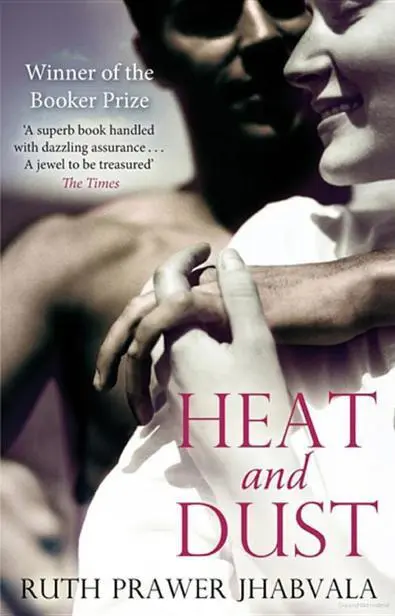
- Название:Heat and Dust
- Автор:
- Издательство:Hachette Digital
- Жанр:
- Год:2011
- ISBN:нет данных
- Рейтинг книги:3 / 5. Голосов: 1
-
Избранное:Добавить в избранное
- Отзывы:
-
Ваша оценка:
Heat and Dust: краткое содержание, описание и аннотация
Предлагаем к чтению аннотацию, описание, краткое содержание или предисловие (зависит от того, что написал сам автор книги «Heat and Dust»). Если вы не нашли необходимую информацию о книге — напишите в комментариях, мы постараемся отыскать её.
Set in colonial India during the 1920s, Heat and Dust tells the story of Olivia, a beautiful woman suffocated by the propriety and social constraints of her position as the wife of an important English civil servant. Longing for passion and independence, Olivia is drawn into the spell of the Nawab, a minor Indian prince deeply involved in gang raids and criminal plots. She is intrigued by the Nawab's charm and aggressive courtship, and soon begins to spend most of her days in his company. But then she becomes pregnant, and unsure of the child's paternity, she is faced with a wrenching dilemma. Her reaction to the crisis humiliates her husband and outrages the British community, breeding a scandal that lives in collective memory long after her death.
Heat and Dust — читать онлайн бесплатно полную книгу (весь текст) целиком
Ниже представлен текст книги, разбитый по страницам. Система сохранения места последней прочитанной страницы, позволяет с удобством читать онлайн бесплатно книгу «Heat and Dust», без необходимости каждый раз заново искать на чём Вы остановились. Поставьте закладку, и сможете в любой момент перейти на страницу, на которой закончили чтение.
Интервал:
Закладка:
What was happening to Olivia was also like a dream.
Although no one could have been more matter-of-fact than the women attending her: two homely, middle-aged midwives doing the job they had been commissioned for. The maid servant who had brought her had also been quite matter-of-fact. She had dressed Olivia in a burqa and made her follow her on foot through the lanes of Khatm. No one took any notice of them — they were just two women in burqas, the usual walking tents. The street of the midwives was reached by descending some slippery steps (here Olivia, unused to her burqa, had to be particularly careful). The midwives' house was in a tumble-down condition — very likely it would go in the next monsoon; the stairs looked especially dangerous. They were so dark that her escort had to take Olivia's hand — for a moment Olivia shrank from this physical contact but only for a moment, knowing that soon she would be touched in a far more intimate manner and in more intimate places.
The midwives made her lie on a mat on the floor. Since the house opposite was no longer there, she had a clear view through the window of a patch of sky. She tried to concentrate on that and not on what they were doing to her. But this was in any case not unpleasant. They were massaging her abdomen in an enormously skilful way, seeking out and pressing certain veins within. One of the women sat astride her while the other squatted on the floor. Their hands worked over her incessantly while they carried on their conversation. The atmosphere was professional and relaxed. But when sounds were heard on the stairs, the two midwives looked at each other in consternation. One of them went to the door, and the other quickly hid Olivia under a sheet. As if I'm dead, Olivia thought. She wondered who had come. Also she wondered what would happen — what would they do — if she did die there in the room as a result of the abortion. They would have to dispose of her body quickly and secretly. Olivia guessed that such a disposal could be managed without too much difficulty. The Begum would arrange about it just as easily as she had arranged for the abortion. Probably she had already thought about it and laid suitable plans.
It was the Begum herself who had come, with only one attendant. Both of them were shrouded in black burqas but Olivia knew which was the Begum from the deferential way in which the midwives treated her. She appeared keenly interested in the operation (such personal attention, Olivia thought; I ought to be flattered). The Begum watched from behind her burqa as the two midwives continued their massage. Then one of them got up and went to prepare something in a corner of the room. Olivia tried to see what it was, and the Begum was also curious and followed to that corner. Olivia lifted her head slightly but the other midwife pressed it down again so she only swivelled her eyes in that direction. She saw the midwife showing the Begum a twig on to which she was rubbing some paste. The Begum was so interested that she put up the front of her burqa in order to see better. Now Olivia was curious to see both the twig and the Begum's face. She had forgotten what she looked like — that visit with Mrs. Crawford seemed long ago — and wanted to check up whether she had any resemblance to the Nawab.
The midwife with the twig came towards her, holding it.
Olivia understood that it was to be introduced into herself. The two women opened Olivia's legs and one of them held on to her ankles while the other pointed the twig. The Begum also bent over her to watch. Although the midwife worked swiftly and skilfully, the twig hurt Olivia as it entered into her. She was unable to stifle a cry. Then the Begum bent over her to look into her face and Olivia stared back at her. She did look like the Nawab, very much. She seemed as interested to study Olivia 's face as Olivia was to study hers. For a moment they gazed into each other's eyes and then Olivia had to shut hers, as the pain down below was repeated.
* * * *
Beth Crawford did not allow herself to speak about Olivia until many years — a lifetime — had passed. I don't know whether she thought about her at all during those years. Probably not: Great-Aunt Beth knew where lines had to be drawn, not only in speech and behaviour but also in one's thought. In the same way she had never let her mind dwell on the Begum and her ladies once the half-hour of obligatory social intercourse with them was over. She had had no desire to speculate about what went on in those purdah quarters once she had left them behind and the European chairs were put away and the ladies alone again and at ease on their divans. Beth felt that there were oriental privacies — mysteries — that should not be disturbed, whether they lay within the Palace, the bazaar of Satipur, or the alleys of Khatm. All those dark regions were outside her sphere of action or imagination — as was Olivia once she had crossed over into them.
The only person not to be reticent about Olivia was Dr. Saunders. It was he who had found her out. The midwives at Khatm had done their work well, and Olivia began to miscarry that same night. She woke up Douglas who took her to the hospital, and early next morning Dr. Saunders curetted her. But he knew about Indian "miscarriages" and the means employed to bring them about. The most common of these was the insertion of a twig smeared with the juice of a certain plant known only to Indian midwives. In his time Dr. Saunders had extracted many such twigs from women brought to him with so — called miscarriages. Afterwards he confronted the guilty women and threw them out of the hospital. Sometimes he slapped them — he had strong ideas about morality and how to uphold it. But even he admitted that certain allowances might be made for these native women born in ignorance and dirt. There was no such extenuating circumstance for Olivia. "Now my young madam," he said as he confronted her. The matron, a Scottish woman born in India — between them, she and Dr. Saunders kept the hospital clean and strict — stood grimfaced behind him. Both were outraged, but Dr. Saunders was somewhat triumphant as well, having been proved right. He had always known that there was something rotten about Olivia: something weak and rotten which of course the Nawab (rotten himself) had found out and used to his advantage.
No one ever doubted that the Nawab had used Olivia as a means of revenge. Even the most liberal and sympathetic Anglo-Indian, such as Major Minnies, was convinced of it. Like the Crawfords, and presumably Douglas himself (who allowed no one to guess his feelings), Major Minnies banished Olivia from his thoughts. She had gone in too far. Yet for many years he reflected not so much on her particular case as on its implications. It all fitted in with his theories. Later, during his retirement in Ooty, he had a lot more time to think about the whole question, and he even published — at his own expense, it was not a subject of much general interest — a monograph on the influence of India on the European consciousness and character. He sent it around to his friends, and that was how Great-Aunt Beth had a copy which I read.
Although the Major was so sympathetic to India, his piece sounds like a warning. He said that one has to be very determined to withstand — to stand up to — India. And the most vulnerable, he said, are always those who love her best. There are many ways of loving India, many things to love her for — the scenery, the history, the poetry, the music, and indeed the physical beauty of the men and women — but all, said the Major, are dangerous for the European who allows himself to love too much. India always, he said, finds out the weak spot and presses on it. Both Dr. Saunders and Major Minnies spoke of the weak spot. But whereas for Dr. Saunden it is something, or someone, rotten, for the Major this weak spot is to be found in the most sensitive, often the finest people — and, moreover, in their finest feelings. It is there that India seeks them out and pulls them over into what the Major called the other dimension. He also referred to it as another element, one in which the European is not accustomed to live so that by immersion in it he becomes debilitated, or even (like Olivia) destroyed. Yes, concluded the Major, it is all very well to love and admire India — intellectually, aesthetically, he did not mention sexually but he must have been aware of that factor too — but always with a virile, measured, European feeling. One should never, he warned, allow oneself to become softened (like Indians) by an excess of feeling; because the moment that happens — the moment one exceeds one's measure — one is in danger of being dragged over to the other side. That seems to be the last word Major Minnies had to say on the subject and his final conclusion. He who loved India so much, knew her so well, chose to spend the end of his days here! But she always remained for him an opponent, even sometimes an enemy, to be guarded and if necessary fought against from without and, especially, from within: from within one's own being.
Читать дальшеИнтервал:
Закладка:
Похожие книги на «Heat and Dust»
Представляем Вашему вниманию похожие книги на «Heat and Dust» списком для выбора. Мы отобрали схожую по названию и смыслу литературу в надежде предоставить читателям больше вариантов отыскать новые, интересные, ещё непрочитанные произведения.





Обсуждение, отзывы о книге «Heat and Dust» и просто собственные мнения читателей. Оставьте ваши комментарии, напишите, что Вы думаете о произведении, его смысле или главных героях. Укажите что конкретно понравилось, а что нет, и почему Вы так считаете.