Eduardo Galeano - The Memory of Fire Trilogy - Genesis, Faces and Masks, and Century of the Wind
Здесь есть возможность читать онлайн «Eduardo Galeano - The Memory of Fire Trilogy - Genesis, Faces and Masks, and Century of the Wind» весь текст электронной книги совершенно бесплатно (целиком полную версию без сокращений). В некоторых случаях можно слушать аудио, скачать через торрент в формате fb2 и присутствует краткое содержание. Год выпуска: 2014, ISBN: 2014, Издательство: Open Road Media, Жанр: Современная проза, на английском языке. Описание произведения, (предисловие) а так же отзывы посетителей доступны на портале библиотеки ЛибКат.
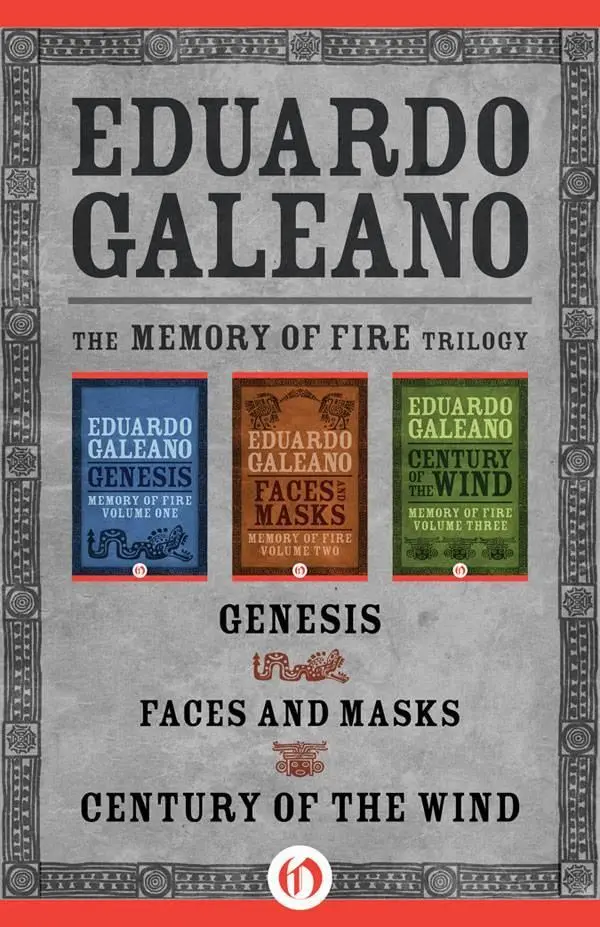
- Название:The Memory of Fire Trilogy: Genesis, Faces and Masks, and Century of the Wind
- Автор:
- Издательство:Open Road Media
- Жанр:
- Год:2014
- ISBN:9781480481497
- Рейтинг книги:3 / 5. Голосов: 1
-
Избранное:Добавить в избранное
- Отзывы:
-
Ваша оценка:
The Memory of Fire Trilogy: Genesis, Faces and Masks, and Century of the Wind: краткое содержание, описание и аннотация
Предлагаем к чтению аннотацию, описание, краткое содержание или предисловие (зависит от того, что написал сам автор книги «The Memory of Fire Trilogy: Genesis, Faces and Masks, and Century of the Wind»). Если вы не нашли необходимую информацию о книге — напишите в комментариях, мы постараемся отыскать её.
Eduardo Galeano’s
defies categorization — or perhaps creates its own. It is a passionate, razor-sharp, lyrical history of North and South America, from the birth of the continent’s indigenous peoples through the end of the twentieth century. The three volumes form a haunting and dizzying whole that resurrects the lives of Indians, conquistadors, slaves, revolutionaries, poets, and more.
The first book,
, pays homage to the many origin stories of the tribes of the Americas, and paints a verdant portrait of life in the New World through the age of the conquistadors. The second book,
, spans the two centuries between the years 1700 and 1900, in which colonial powers plundered their newfound territories, ultimately giving way to a rising tide of dictators. And in the final installment,
, Galeano brings his story into the twentieth century, in which a fractured continent enters the modern age as popular revolts blaze from North to South.
This celebrated series is a landmark of contemporary Latin American writing, and a brilliant document of culture.
The Memory of Fire Trilogy: Genesis, Faces and Masks, and Century of the Wind — читать онлайн бесплатно полную книгу (весь текст) целиком
Ниже представлен текст книги, разбитый по страницам. Система сохранения места последней прочитанной страницы, позволяет с удобством читать онлайн бесплатно книгу «The Memory of Fire Trilogy: Genesis, Faces and Masks, and Century of the Wind», без необходимости каждый раз заново искать на чём Вы остановились. Поставьте закладку, и сможете в любой момент перейти на страницу, на которой закончили чтение.
Интервал:
Закладка:
The vice president of the United States, John Calhoun, believes that God created blacks to cut wood, pick cotton, and carry water for the chosen people. Textile factories demand more cotton and cotton demands more land and more blacks. There are powerful reasons, said Calhoun last year, for Texas to form part of the United States. At that time President Jackson, who breathes frontiers with an athlete’s lungs, had already sent his friend Sam Houston to Texas.
The rugged Houston forces his way in with his fists, makes himself an army general, and proclaims the independence of Texas. The new state, soon to be another star on the United States flag, has more land than France.
And war breaks out against Mexico.
(128 and 207)
1836: San Jacinto
The Free World Grows
Sam Houston offers land at four cents an acre. Battalions of North American volunteers pour in by every road and weapons arrive by the shipload from New York and New Orleans.
The comet that announced calamity in the skies over Mexico was no news to anybody. Mexico has lived in a perpetual state of calamity since the murderers of Hidalgo and Morelos declared independence in order to grab the country for themselves.
The war does not last long. Mexican General Santa Anna arrives calling for a bloodbath, and makes one at the Alamo, but at San Jacinto loses four hundred men in a quarter of an hour. Santa Anna gives up Texas in exchange for his own life and returns to Mexico City with his beaten army, his personal chef, his seven-thousand-dollar sword, his countless decorations and his wagonload of fighting cocks.
General Houston celebrates his victory by naming himself president of Texas.
Texas’s constitution assures the master perpetual rights over his slaves, as legitimately acquired property. Extend the area of liberty had been the slogan of the victorious troops.
(128)
1836: The Alamo
Portraits of the Frontier Hero
At the outbreak of the Texas war, when fortune still smiles on the Mexican troops, Colonel Davy Crockett falls pierced by bayonets. He falls in the Alamo fort, together with his band of heroic outlaws, and the buzzards finish his story.
The United States, which fattens on the lands of Indians and Mexicans, has lost one of its frontier heroes. Davy Crockett had a rifle named Betsy which could kill five bears with a single bullet.
Crockett could well have been the son of Daniel Boone, the legendary pioneer of the previous century, a very macho and lonely killer, who hated civilization but earned a living by placing colonists on lands robbed from his Indian friends. And he could well have been the father of Natty Bumppo, a fictional character so famous that he now seems flesh and blood.
Since Fenimore Cooper published The Last of the Mohicans, Natty Bumppo, the crude and noble hunter, has incorporated himself into the daily life of the United States. Nature has taught him all he knows of morality and his energy comes from the mountains and the woods. He is ugly, only one tooth in his enormous mouth; but without expecting anything in return he protects beautiful white virgins, who, thanks to him, pass invincible through thicket and desire. Natty Bumppo praises silence with many words and tells no lie when he says that he doesn’t fear death, or when he admires the Indians while ruefully killing them.
(149 and 218)
1836: Hartford
The Colt
Samuel Colt, engineer, registers in Hartford, Connecticut, the patent of the “revolving pistol” he has invented. It is a pistol with a revolving cylinder of five shots, which kills five times in twenty seconds.
From Texas comes the first order.
(305)
1837: Guatemala City
Morazán
A storm of cassocks explodes. Rafael Carrera is the lightning flash that instills fear, and all over Guatemala roll the thunderclaps: “Long live religion! Death to the foreigners! Death to Morazán!”
No candle stays unlit. Nuns pray so fast that in nine seconds they roll off nine novenas. Choirs intone salutations to Mary and curse Morazán with the same fervor.
Francisco Morazán, president of Central America, is the heretical foreigner who has unleashed these mystical furies. Morazán, born in Honduras, has not only unified the Central American provinces into one nation, he has also reduced counts and marquesses to the category of mere citizens, and has created public schools that teach things of this world and say nothing of Heaven. According to his laws, a cross is no longer necessary for a grave nor a priest for a wedding, and he makes no distinction between a child born in the conjugal bed and a child made, without previous contract, on the straw of a stable, the one having the same inheritance rights as the other. Gravest of all, Morazán has separated Church and State, decreed freedom to believe or not to believe, suppressed the tithes and first fruits of the Lord’s officers and put their lands up for sale.
The monks blame Morazán for the plague that is devastating Guatemala. Cholera is killing people off, and from the pulpits rain fulminating accusations: Morazán has poisoned the water; the Antichrist has pacted with the Devil to sell him the souls of the dead.
The people of the mountains rise against the poisoner. Rafael Carrera, the hog farmer who leads the insurrection, is just over twenty and already has three bullets in his body. He goes about covered with scapularies and medals and with a green bough stuck in his hat.
(220 and 253)
1838: Buenos Aires
Rosas
Great tamer of ponies and people, Juan Manuel de Rosas is the boss of the River Plata ranges. Guitarist and dancer, he tells the stories that provoke the most fear or laughter around the campfire, but he is made of marble and even his children call him “master.” He has the cook who ruins his chicken arrested; and he has himself whipped when he carelessly violates one of his own rules.
His estancias are the most prosperous; his meat-salting plants are the best organized. Rosas owns the best of the sea of grasslands that extend from the port of Buenos Aires to the Indian villages.
Rosas governs. He has decreed a customs law that protects Argentinian production of ponchos and mattresses, shoes, carriages, ships, wine and furniture, and he has closed the interior rivers to foreign merchants.
The Revue des Deux Mondes demands that France give a lesson in civilization and discipline to the degenerate sons of the Spanish conquest. The French squadron, under command of Admiral Leblanc, blockades Buenos Aires, the only Argentine port equipped for overseas commerce.
(166, 271, and 336)
1838: Buenos Aires
The Slaughterhouse
Esteban Echeverría writes the first story of River Plata literature. In The Slaughterhouse, the Rosas dictatorship is the harassment of a defenseless Buenos Aires doctor by a knife-wielding mob.
Born in the slums and hardened by street-fights, but polished in Paris, Echeverría despises “the rabble.” A slaughterhouse in the south of the city offers a fantastic setting for the writer to describe dogs fighting over entrails with the black women eviscerators, and to tell of the “fuck-you’s” bubbling up from vulgar throats as blood flows from the beasts’ necks. The throat-cutter of the story wears a gaucho’s poncho, has his face daubed with blood, buries his knife up to the handle in a steer’s throat, and later corners the elegant black-tied gentleman who has refused him common courtesy.
(104)
More on Cannibalism in America
Читать дальшеИнтервал:
Закладка:
Похожие книги на «The Memory of Fire Trilogy: Genesis, Faces and Masks, and Century of the Wind»
Представляем Вашему вниманию похожие книги на «The Memory of Fire Trilogy: Genesis, Faces and Masks, and Century of the Wind» списком для выбора. Мы отобрали схожую по названию и смыслу литературу в надежде предоставить читателям больше вариантов отыскать новые, интересные, ещё непрочитанные произведения.












Обсуждение, отзывы о книге «The Memory of Fire Trilogy: Genesis, Faces and Masks, and Century of the Wind» и просто собственные мнения читателей. Оставьте ваши комментарии, напишите, что Вы думаете о произведении, его смысле или главных героях. Укажите что конкретно понравилось, а что нет, и почему Вы так считаете.