Alain Robbe-Grillet - The Voyeur
Здесь есть возможность читать онлайн «Alain Robbe-Grillet - The Voyeur» весь текст электронной книги совершенно бесплатно (целиком полную версию без сокращений). В некоторых случаях можно слушать аудио, скачать через торрент в формате fb2 и присутствует краткое содержание. Город: New York, Год выпуска: 1994, ISBN: 1994, Издательство: Grove Press, Жанр: Современная проза, на английском языке. Описание произведения, (предисловие) а так же отзывы посетителей доступны на портале библиотеки ЛибКат.
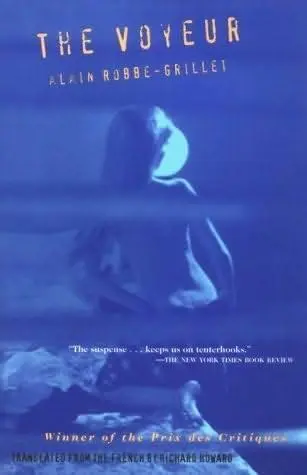
- Название:The Voyeur
- Автор:
- Издательство:Grove Press
- Жанр:
- Год:1994
- Город:New York
- ISBN:978-0802131652
- Рейтинг книги:5 / 5. Голосов: 1
-
Избранное:Добавить в избранное
- Отзывы:
-
Ваша оценка:
The Voyeur: краткое содержание, описание и аннотация
Предлагаем к чтению аннотацию, описание, краткое содержание или предисловие (зависит от того, что написал сам автор книги «The Voyeur»). Если вы не нашли необходимую информацию о книге — напишите в комментариях, мы постараемся отыскать её.
A triumphant display of the techniques of the “new novel,”
achieves the impossible feat of keeping us utterly engrossed in the mystery of the child’s murder while systematically raising doubts about whether it really occurred.
The Voyeur — читать онлайн бесплатно полную книгу (весь текст) целиком
Ниже представлен текст книги, разбитый по страницам. Система сохранения места последней прочитанной страницы, позволяет с удобством читать онлайн бесплатно книгу «The Voyeur», без необходимости каждый раз заново искать на чём Вы остановились. Поставьте закладку, и сможете в любой момент перейти на страницу, на которой закончили чтение.
Интервал:
Закладка:
Mathias lifted his head again. He was alone on the moor. In front of him, in the grass, in the center of the little hollow, he saw a short cigarette butt—which Julian must have thrown away as he was leaving—or else it was the one he had been looking for himself since morning—or perhaps they were one and the same. He came closer. It was only a little pebble, cylindrical, white, and smooth, which he had already picked up once, when he had come here.
Mathias headed slowly toward the big lighthouse, taking the customs road along the edge of the cliff. He could not help laughing at the thought of the dramatic retreat Julian had just made in order to reveal his discovery: a metal box fastened behind the luggage rack…. The salesman had never denied it! Was this detail so imporïant that he ought to have corrected Julian when he spoke of a bag under the seat? If he had no proof better than that…
He might just as well have said that the gray sweater was not lying “on the rocks,” but “on a projection of the rocks”—or that only one of the mahonias was budding at the Marek farm. He might have said: “The road is not altogether level, nor entirely straight, between the crossroads and the fork leading to the mill”—“The bulletin-board is not precisely in front of the café-tobacco shop door, but slightly to the right, and does not block the entrance”—“The little square is not really triangular: the apex is flattened by the plot of grass around the public building so as to form a trapezoid”—“The enameled iron skimmer sticking out of the mud in the harbor is not the same color blue as the one in the hardware store”—“The pier is not rectilinear, but turns in the center at an angle of one hundred seventy-five degrees.”
Similarly the time wasted at the crossroads to the Marek farm did not amount to forty minutes. The salesman had not arrived there before eleven-forty-five or eleven-fifty, taking into account the long detour to the mill. On the other hand, before meeting up with the old country woman at twelve-twenty, he had spent nearly fifteen minutes repairing the gearshift on his bicycle—with the help of the tools that were in the box… etc. There remained just enough time to make the trip to the farm and back—including the wait in the courtyard, near the mahonia bush, and the first two attempts to deal with the abnormal friction of the chain: on the little path, then in front of the house.
The customs road did not actually follow the edge of the cliff very closely—at least not continuously—and often diverged from it for three or four yards, sometimes for much greater distances. Besides, it was not easy to determine where this “edge” actually was, for with the exception of the areas where a steep rock wall towered above the sea for the whole height of the cliff, there were also grassy slopes running down almost to the water, as well as heaps of jagged rock more or less encroaching on the moor, and even planes of schist that ended in huge lumps of rubble and earth.
Sometimes the indentations along the shore were enlarged by a deep fault cutting into the cliff, or a sandy bay forming an even larger jag. The salesman had been walking for a long time—it seemed to him—when the lighthouse suddenly rose up before him, high above the mass of auxiliary constructions, walls and turrets clustered together.
Mathias turned left, toward the village. A man in fisherman’s clothes had been walking ahead of him on the road for some time now. Following him, Mathias again came out onto the main road where the first houses began, and walked into the café.
There were many people, much smoke and noise. The electric lights hanging from the ceiling had been turned on; they were harsh and blue. Scraps of almost incomprehensible conversation were momentarily audible in the general uproar; here and there a gesture, a face, a grin emerged from the shimmering haze for a few seconds.
There was no table free. Mathias headed toward the bar. The other customers pressed a little closer together to make room for him. Exhausted by his day’s walking, he would have preferred to sit down.
The fat, gray-haired woman recognized him. He had to make explanations all over again: the boat he had missed, the bicycle, the bedroom… etc. The proprietress, fortunately, had too much to do to listen or question him. He asked her for some aspirin. She had none. He ordered an absinthe. Besides, his headache was bothering him less now; it had become a sort of cottony humming in which his whole brain was steeped.
An old man next to him was telling a story to a group of the lighthouse workmen. They were young, and laughed at him, or nudged one another with their elbows, or else interrupted with bantering, apparently serious observations which produced still more laughter. The narrator’s low voice was lost in the din. Only a few phrases, a few words reached Mathias’ ears. Nevertheless, he understood, as a result of the old man’s deliberation and his incessant repetitions, as well as from the sarcastic remarks of his listeners, that he was telling an old local legend—which Mathias had never heard mentioned in his childhood, however: each spring, a young virgin had to be hurled from the top of the cliff to appease the storm-god and render the sea kind to travelers and sailors. Rising from the deep, a gigantic monster with the body of a serpent and the head of a dog devoured the victim alive under the eyes of the sacrificer. It was doubtless the little shepherdess’ death that had provoked such a story. The old man furnished a quantity of mostly inaudible details about the ceremony; it was strange that he used only the present tense: “they make her kneel down,” “they tie her hands behind her back,” “they blindfold her,” “down in the water they can see the slimy coils of the dragon”… A fisherman slipped in between Mathias and the group of men to reach the counter. The salesman squeezed in the opposite direction. Now he could hear nothing but the young men’s exclamations and laughter.
“…little Louis was mad at her too… their engagement… had threatened her…” This voice was loud and sententious; it came from the opposite direction, over the heads of three or four drinkers.
Behind Mathias, several people were still discussing the recent sensation. The whole room, the whole island, was passionately interested in the tragic accident. The fat woman served the newcomer on the salesman’s left a glass of red wine. She was holding the bottle in her left hand.
On the wall, above the top row of apéritifs, hung a yellow placard attached by four tacks: “Buy your watch at your jeweler’s.”
Mathias finished his absinthe. No longer feeling the little suitcase between his legs, he lowered his eyes toward the floor. The suitcase had disappeared. He thrust his hand into his duffle coat pocket to rub his grease-spotted fingers against the wad of cord, keeping his eyes fixed on the salesman. The proprietress thought he was looking for change and shouted out the price of his drink; but it was the absinthe he was going to pay for. He turned to face the fat woman, or the woman, or the girl, or the young barmaid, then set down the suitcase in order to pick up the suitcase while the sailor and the fisherman sneaked between, crept between, came between, Mathias and the salesman…
Mathias passed his hand over his forehead. It was almost night now. He was sitting in a chair in the middle of the street—in the middle of the road—in front of the Black Rocks café.
“Feeling better now?” asked a man wearing a leather jacket.
“Much better, thank you,” Mathias answered. He had already seen this person somewhere. He wanted to justify his indisposition, and said, “It’s the smoke, the noise, so much talk…” He could not find words to express himself. Yet he stood up with no difficulty.
Читать дальшеИнтервал:
Закладка:
Похожие книги на «The Voyeur»
Представляем Вашему вниманию похожие книги на «The Voyeur» списком для выбора. Мы отобрали схожую по названию и смыслу литературу в надежде предоставить читателям больше вариантов отыскать новые, интересные, ещё непрочитанные произведения.










Обсуждение, отзывы о книге «The Voyeur» и просто собственные мнения читателей. Оставьте ваши комментарии, напишите, что Вы думаете о произведении, его смысле или главных героях. Укажите что конкретно понравилось, а что нет, и почему Вы так считаете.