Oakley Hall - Warlock
Здесь есть возможность читать онлайн «Oakley Hall - Warlock» весь текст электронной книги совершенно бесплатно (целиком полную версию без сокращений). В некоторых случаях можно слушать аудио, скачать через торрент в формате fb2 и присутствует краткое содержание. Год выпуска: 2005, Издательство: NYRB Classics, Жанр: Современная проза, на английском языке. Описание произведения, (предисловие) а так же отзывы посетителей доступны на портале библиотеки ЛибКат.
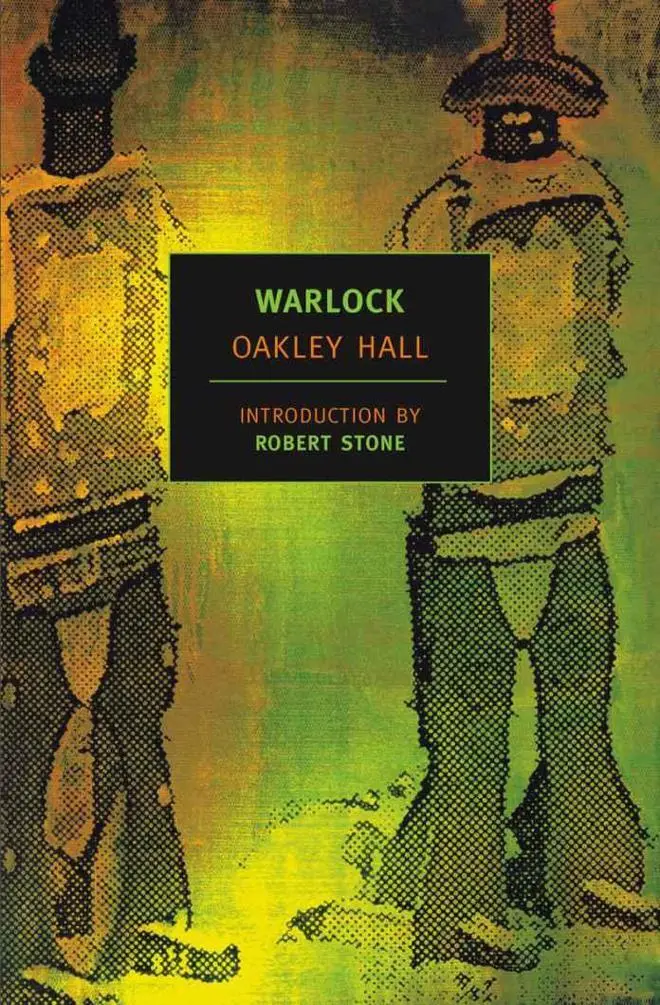
- Название:Warlock
- Автор:
- Издательство:NYRB Classics
- Жанр:
- Год:2005
- ISBN:нет данных
- Рейтинг книги:4 / 5. Голосов: 1
-
Избранное:Добавить в избранное
- Отзывы:
-
Ваша оценка:
Warlock: краткое содержание, описание и аннотация
Предлагаем к чтению аннотацию, описание, краткое содержание или предисловие (зависит от того, что написал сам автор книги «Warlock»). Если вы не нашли необходимую информацию о книге — напишите в комментариях, мы постараемся отыскать её.
revisits and reworks the traditional conventions of the Western to present a raw, funny, hypnotic, ultimately devastating picture of American unreality. First published in the 1950s, at the height of the McCarthy era, Warlock is not only one of the most original and entertaining of modern American novels but a lasting contribution to American fiction.
"Tombstone, Arizona, during the 1880's is, in ways, our national Camelot: a never-never land where American virtues are embodied in the Earps, and the opposite evils in the Clanton gang; where the confrontation at the OK Corral takes on some of the dry purity of the Arthurian joust. Oakley Hall, in his very fine novel Warlock has restored to the myth of Tombstone its full, mortal, blooded humanity. Wyatt Earp is transmogrified into a gunfighter named Blaisdell who. . is summoned to the embattled town of Warlock by a committee of nervous citizens expressly to be a hero, but finds that he cannot, at last, live up to his image; that there is a flaw not only in him, but also, we feel, in the entire set of assumptions that have allowed the image to exist. . Before the agonized epic of Warlock is over with — the rebellion of the proto-Wobblies working in the mines, the struggling for political control of the area, the gunfighting, mob violence, the personal crises of those in power — the collective awareness that is Warlock must face its own inescapable Horror: that what is called society, with its law and order, is as frail, as precarious, as flesh and can be snuffed out and assimilated back into the desert as easily as a corpse can. It is the deep sensitivity to abysses that makes
one of our best American novels. For we are a nation that can, many of us, toss with all aplomb our candy wrapper into the Grand Canyon itself, snap a color shot and drive away; and we need voices like Oakley Hall's to remind us how far that piece of paper, still fluttering brightly behind us, has to fall." — Thomas Pynchon
Warlock — читать онлайн бесплатно полную книгу (весь текст) целиком
Ниже представлен текст книги, разбитый по страницам. Система сохранения места последней прочитанной страницы, позволяет с удобством читать онлайн бесплатно книгу «Warlock», без необходимости каждый раз заново искать на чём Вы остановились. Поставьте закладку, и сможете в любой момент перейти на страницу, на которой закончили чтение.
Интервал:
Закладка:
March 4, 1881
Buck Slavin, the doctor, Schroeder, et al. back. The jury is deliberating. They had waited over a day after the jury had left the box, but it was still out. They seem certain Blaisedell will be acquitted, and that the jury’s delay is only to enjoy as many meals upon the county as possible. Still, I notice that they seem worried that Luke Friendly’s outrageous lies may have told heavily against Blaisedell. Buck is bitter about the prosecuting attorney, Pierce, and that Judge Alcock did not cut him short more often than he did.
Evidently Pierce sought to inflame the jury with Billy Gannon’s youth, with the fact that less than a month ago the three Cowboys had been declared innocent in the same court, and with Blaisedell’s “murderous presumption” in setting aside the court’s decision and declaring himself “Judge and Executioner.” Buck says that the same rumor we have had here — that Morgan and Blaisedell were actually the road agents themselves, and murdered the “innocents” in an effort both to silence and permanently affix the blame on them — has been sown in Bright’s City, and, although not much believed there (Bright’s City has not seen as much of McQuown as we have, but they have seen enough) had evidently been heard by Pierce, and it was Pierce’s hints and implications along these lines that Buck felt Judge Alcock should have dealt with more firmly. As all agree that Friendly was a poor witness against Blaisedell, so do they agree that Morgan was the best witness in Blaisedell’s behalf; that he was cool and convincing, and gave as good as he got from Pierce, several times calling forth peals of laughter from the courtroom at the prosecutor’s expense.
From all I have heard I am glad I did not attend the trial. Poor Blaisedell; I pity him what he has gone through. Yet it was at his own instigation, and I am certain no charges would have been brought against him had he not wished it. Buck says, however, that he has been most calm throughout, and apparently took no umbrage at Pierce’s blackguardly accusations.
“What stronger breastplate than a heart untainted?
Thrice is he armed that hath his quarrel just;
And he but naked, though locked up in steel,
Whose conscience with injustice is corrupted.”
March 5, 1881
Blaisedell was acquitted yesterday. Peter Bacon arrived this morning with the news, having ridden all night. I sent a note around immediately to Miss Jessie, expressing my pleasure at hearing it, but there was no reply other than her verbal thanks to my mozo .
Now that Blaisedell is free and absolved, I am neither pleased nor relieved. The blackguardly statements with which Pierce harangued the jury, the jury’s inexcusable delay, Friendly’s damnable lies about what happened in the Acme Corral, and General Peach’s actions throughout [1] — how must these have affected him? He must have gone to court wishing absolution, and received only a poor, grudging, and besmudged verdict in his behalf. The official verdict, however, will not affect the verdict here, and I think in days to come there will be bad blood between Warlock men and Bright’s City men. Although I will say that the Bright’s City paper has treated Blaisedell with great respect in its columns and especially in its editorials, and I will congratulate Editor Jim Askew on these when next I see him.
I find myself deeply emotionally subscribed to all this. It seems to me that I, and all of us here, have a stake and an investment in the Marshal. He has produced, and, looking back, I see that he did from the beginning produce, an intense division for or against him. But Clay Blaisedell is not the rock upon which we are divided, he is only a symptom. We do not break so simply as some think into the two camps of townsmen and Cowboys. We break into the camps of those wildly inclined, and those soberly, those irresponsible and those responsible, those peace-loving and those outlaw and riotous by nature; further, into the camps of respect, and of fear — I mean for oneself, and for all decent things besides. These are the poles between which we vibrate, and Blaisedell has only emphasized the distance between them. It is too simple perhaps to say that those who fear themselves and fear their fellow men, fear and hate Blaisedell, while those who respect themselves, and Man, respect him. Yet I hold that this is true in a broad sense.
For the arguments continue, what happened in the Acme Corral compounded by the Bright’s City court and those who spoke there. I feel strongly that not merely I, but everyone here, sees himself affected personally by all this, and that, somehow, the truth or falsity of the whole affair reflects through and upon each of us. Fine points are argued as heatedly as the whole — how many shots, how many paces, who was stationed in exactly what position, and so on ad infinitum . So must the schoolmen have argued in their day, in their own saloons, the number of angels who could dance on the head of a pin.
[1] General Peach evidently, upon one occasion, shouted down the judge to say that Blaisedell should properly have been tried by a military tribunal, and that he, General Peach, would have had him shot. Why the military governor was not declared in contempt of court for his interference is perhaps understandable, and references to his peculiar actions, most delicately handled, are contained in the Bright’s City Star-Democrat’s reports of the trial.
27. CURLEY BURNE AND THE DOG KILLER
CURLEY rode in from the river on his way back to San Pablo from Bright’s City, blowing on his mouth organ. The music was pleasant to his ears in the silence around him, and the sun was pleasant upon his back as the gelding Dick plodded over the bare brown ridges and down the grassy draws. The Dinosaurs towered to the southwest with the sun on their slopes like honey, and from the elevation of the ridges he could see the irregular line of cottonwoods marking the river’s course toward Rattlesnake Canyon.
His cheerful mood vanished as he saw the chimney of the long-gone old house, and the windmill on the pump house. He was not bringing good news from Bright’s City.
Finally he came in sight of the ranch house, low to the ground and weathered gray as a horned toad; and now he could see the bunk-house, cook shack, horse corral — the porch of the ranch house. There were two figures seated there.
Going down the last slope Dick quickened his pace expectantly. Curley dropped the mouth organ back inside his shirt, flicked Dick with his spurs, and went down toward the house at a run, bending low in the saddle with his hat flying off and its cord cutting against his throat. He drew up with a yell before the porch, dismounted in a whirl of dust and barking dogs, and went up the steps. The other man he had seen was Dechine, Abe’s neighbor to the south, dropped in to pay a call. Dad McQuown was lying on a cot in the sun.
Abe sat staring at the mountains with his hat tipped forward to shade his face, scratching a thumb through his beard. He was leaning back with his boots crossed up on the porch rail.
Curley said, “Well, howdy, Dechine. How’s it?”
“Fine-a-lee,” Dechine said, fanning dust away with his hat. He was a short, pot-bellied fellow with little reddened eyes and a nose like half a red pear stuck to his face.
The old man propped himself up on one elbow. “Well, what happened, Curley? They set him loose?”
“They did,” he said. Abe sat there silently, staring off at the Dinosaurs with the long creases in his cheeks like scars. All the starch had gone out of him since the boys had got killed in the Acme Corral; sometimes he acted as though there were nothing left in him at all.
The old man spat tobacco juice in a puddle beside his pallet, swiped at his little red mouth, and said, “Buggers.”
Читать дальшеИнтервал:
Закладка:
Похожие книги на «Warlock»
Представляем Вашему вниманию похожие книги на «Warlock» списком для выбора. Мы отобрали схожую по названию и смыслу литературу в надежде предоставить читателям больше вариантов отыскать новые, интересные, ещё непрочитанные произведения.


Обсуждение, отзывы о книге «Warlock» и просто собственные мнения читателей. Оставьте ваши комментарии, напишите, что Вы думаете о произведении, его смысле или главных героях. Укажите что конкретно понравилось, а что нет, и почему Вы так считаете.