Christopher Beha - Arts & Entertainments - A Novel
Здесь есть возможность читать онлайн «Christopher Beha - Arts & Entertainments - A Novel» весь текст электронной книги совершенно бесплатно (целиком полную версию без сокращений). В некоторых случаях можно слушать аудио, скачать через торрент в формате fb2 и присутствует краткое содержание. Год выпуска: 2014, Издательство: Ecco, Жанр: Современная проза, на английском языке. Описание произведения, (предисловие) а так же отзывы посетителей доступны на портале библиотеки ЛибКат.
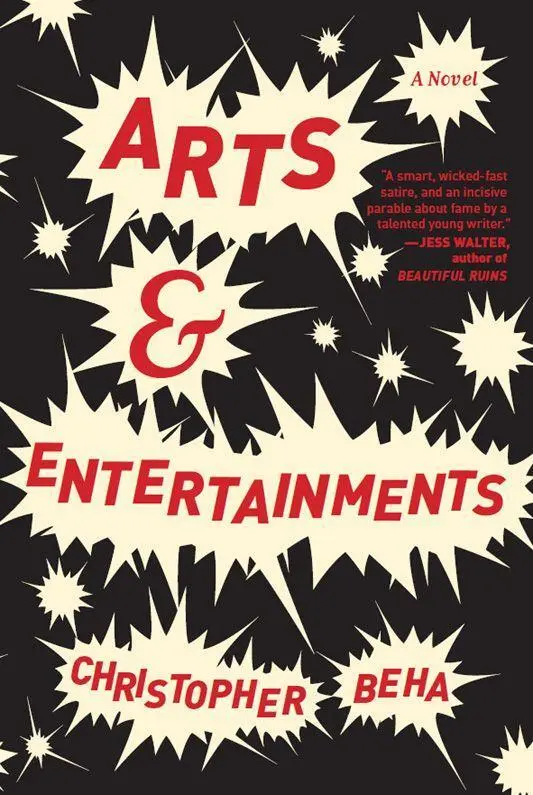
- Название:Arts & Entertainments: A Novel
- Автор:
- Издательство:Ecco
- Жанр:
- Год:2014
- ISBN:нет данных
- Рейтинг книги:4 / 5. Голосов: 1
-
Избранное:Добавить в избранное
- Отзывы:
-
Ваша оценка:
Arts & Entertainments: A Novel: краткое содержание, описание и аннотация
Предлагаем к чтению аннотацию, описание, краткое содержание или предисловие (зависит от того, что написал сам автор книги «Arts & Entertainments: A Novel»). Если вы не нашли необходимую информацию о книге — напишите в комментариях, мы постараемся отыскать её.
Weighted down with debt, Susan's mounting unhappiness, and his own deepening sense of failure, Eddie is confronted with an alluring solution when an old friend-turned-Web-impresario suggests Eddie sell a sex tape he made with an ex-girlfriend, now a wildly popular television star. In an era when any publicity is good publicity, Eddie imagines that the tape won't cause any harm — a mistake that will have disastrous consequences and propel him straight into the glaring spotlight he once thought he craved.
A hilariously biting and incisive takedown of our culture's monstrous obsession with fame,
is also a poignant and humane portrait of a young man's belated coming-of-age, the complications of love, and the surprising ways in which the most meaningful lives often turn out to be the ones we least expected to lead.
Arts & Entertainments: A Novel — читать онлайн бесплатно полную книгу (весь текст) целиком
Ниже представлен текст книги, разбитый по страницам. Система сохранения места последней прочитанной страницы, позволяет с удобством читать онлайн бесплатно книгу «Arts & Entertainments: A Novel», без необходимости каждый раз заново искать на чём Вы остановились. Поставьте закладку, и сможете в любой момент перейти на страницу, на которой закончили чтение.
Интервал:
Закладка:
The person he needed to help him through all this was Susan. After their one conversation, he’d imagined they would talk regularly again. But he called every few days after that, and she never picked up. Their brief conversation — and the visit from the photographer that followed — felt like some special message to him. But he didn’t know what the message meant. So he waited where he was.
THIRTEEN
SUSAN’S SHOW PREMIERED ON the Tuesday after Thanksgiving with an hour-long episode, which Eddie watched from his king-sized bed. The episode began with Martha’s arrival at the apartment. The scene seemed designed to signal to viewers who Susan was and why they were supposed to be interested in her without the work of lengthy exposition. Something had happened that brought Susan’s life into contact with the likes of Martha Martin, and this was enough to demand the world’s attention. Martha was a stand-in for all the events that had precipitated this premiere. All of this heartened Eddie somewhat. Even if he wasn’t included on the show, the story still required him to connect these two women now hugging each other on his TV. Soon they were both crying. Alex had been right: it humanized Martha. She seemed so caring, like a real person.
“I can’t believe you’re having triplets,” she said, running her hand over Susan’s belly. “Carrying just one around is hard enough for me.”
“It’s a bit overwhelming,” Susan admitted, though she didn’t look overwhelmed. She looked beautiful, even next to Martha.
After a commercial break, an exterior shot established a new location, which Eddie recognized as the gallery. Inside, a camera ran across a series of small works in charcoal hanging on one wall. They were more inviting than Carl’s usual tastes. Eddie assumed this was by design. He knew the gallery was meant to be important to the show, but he was surprised that Martha would take the time to go into work with Susan. As the scene progressed, he realized that their visit was in fact over. It had already done its job, without any mention of Eddie. Anyone watching would have known that he was the thing connecting these two women, but they hadn’t even said his name. Martha’s presence was apparently enough to tell viewers everything.
“Carl von Verdant is one of the most highly respected dealers in the city,” Susan explained to the camera. “I’ve been working with him for five years now, and I’m currently the gallery’s associate curator.”
Eddie had never heard this title before. Susan had always been one of Carl’s assistants. In the past, she’d described him as brusque and condescending, but in the half hour that followed he asked her advice about everything — where to hang a piece, what to look for at an upcoming fair. The friendly conversations Susan shared with the other assistants — now presumably her subordinates — didn’t at all match her long-standing complaints about the gallery’s atmosphere. Eddie couldn’t be sure the depiction was false. Perhaps Susan had been exaggerating her problems at work. What Eddie saw on-screen was entirely believable.
Susan left the group to take a call from Richard Oh, a young artist whose debut show she was organizing.
“It’s going to be great,” she told Richard. “You’ll be the toast of New York.”
After the call, Richard spoke to the camera from a nondescript room somewhere. He was an Asian American in his early twenties. The right side of his head was shaved, the hair on the left pulled into a long pigtail.
“I’m so excited to be working with Susan Hartley,” he said. “She’s the reason I chose Von Verdant to represent me.”
Later in the show, a shipment of Richard’s work went briefly missing, creating the episode’s only real bit of drama. Carl yelled at two of the young assistants while Susan went about locating the lost packages. She was the calm center around which the gallery revolved. She advised Carl with confidence, and the answers she gave him were smart and knowledgeable, which didn’t seem to Eddie something that could be faked. Her job bore no resemblance to the menial frustrations she’d so often described to Eddie at home.
Had everything really changed for her so quickly? Their jobs had long been a shared source of disappointment in their lives. Perhaps Susan had been all along doing better than she’d let on. Perhaps she had persisted in presenting herself as a failure out of a sense of solidarity, or because she thought he wasn’t capable of appreciating her success. She’d probably been right to suspect this, if in fact she had suspected it.
There was a simpler explanation: he was watching a fictional television character, based only loosely on his wife, and he was wrong to compare the particulars of this character’s life to those of the Susan he knew. This seemed comforting at first, but it was ultimately troubling in its own way, because this fictional Susan already seemed so real after less than half an hour. More than that: he wanted this Susan to exist. He liked her better this way.
After work, the assistants Carl had berated took Susan out to a bar, where they gossiped while she sipped on club soda. It was obvious that the others looked up to her, but there was also a sense of camaraderie. They joked about naming one of the babies after Carl. The scene was broken by an interview with Tomaka, the gallery’s youngest employee. She’d been working at the gallery for just a few months, but she was the prettiest of the assistants, and she’d been given the most screen time.
“Susan is the happiest we’ve seen her in years,” she said. “I think all these changes in her life have been really good for her.”
The show’s tone changed in the second half. Susan sat in a doctor’s waiting room while in a voice-over she explained that she was getting her first ultrasound.
“I’m scared to be doing this alone,” she said. “It makes me think how hard it’s all going to be.”
You don’t have to do it alone, Eddie wanted to say. The doctor took Susan to an examination room and talked in an understated voice about the risks presented by multiples. Susan pulled her hospital gown over her belly, where the nurse applied a layer of gel. The doctor set down the transducer, and a picture came on the screen. It wasn’t clear to Eddie exactly what it showed, until all of a sudden it was. Those were his children. He was seeing them for the first time, alongside a million other people.
The picture was replaced on-screen by a close-up of Susan’s crying face.
“They’re so beautiful,” she said, looking into the camera. “I can’t believe they’re inside me. I’ve never been so happy. But it’s scary, too, knowing I have to go through all this by myself.”
Eddie was sorry not to be there, sorry to see her scared, but he felt something else, too. She needs me, Eddie thought. She can’t do it by herself. Everyone said that Brian Moody knew what he was doing. He must have created this tension— between professional confidence and personal uncertainty— for a reason. To satisfy it, they would have to bring Eddie back. Susan had nearly said as much. I’m not ready yet, she’d told him, which he took now to mean: we have to establish the story first.
As the credits ran, Eddie searched for his name online and found a post titled “Take Him Back!” on what appeared to be a Christian television blog. It said that Moody would be sending a “strong message about the importance of the traditional family” if he reunited Susan and Eddie. The post compared Susan’s situation to that of Justine Bliss with a logic that struck Eddie as somewhat imperfect, though he was happy to read it. A small but persistent movement existed in his favor.
But that movement could only be found by looking for it. Most pages that Eddie read had nothing good to say about him. In fact, the majority of commenters didn’t mention him at all. They talked about the visit from Martha, about the gallery, about the babies. Most of all, they talked about Susan. She seemed human and “relatable,” an ugly word that came up in nearly every post. Relatability was, apparently, the gold standard for a character, and Susan possessed it. The term connoted precisely the things about Susan that had made her suffer in Eddie’s eyes when compared to Martha. She was pretty but not overwhelmingly beautiful. She was smart but not intimidating in her intelligence. She was confident but not domineering. Vulnerable but not needy. Kind but not desperate for approval. She was just Susan, and everyone loved her. I loved her first, Eddie wanted to say, though he understood that in some sense he’d seen this Susan for the first time just when everyone else did.
Читать дальшеИнтервал:
Закладка:
Похожие книги на «Arts & Entertainments: A Novel»
Представляем Вашему вниманию похожие книги на «Arts & Entertainments: A Novel» списком для выбора. Мы отобрали схожую по названию и смыслу литературу в надежде предоставить читателям больше вариантов отыскать новые, интересные, ещё непрочитанные произведения.












Обсуждение, отзывы о книге «Arts & Entertainments: A Novel» и просто собственные мнения читателей. Оставьте ваши комментарии, напишите, что Вы думаете о произведении, его смысле или главных героях. Укажите что конкретно понравилось, а что нет, и почему Вы так считаете.