Adam Mars-Jones - Cedilla
Здесь есть возможность читать онлайн «Adam Mars-Jones - Cedilla» весь текст электронной книги совершенно бесплатно (целиком полную версию без сокращений). В некоторых случаях можно слушать аудио, скачать через торрент в формате fb2 и присутствует краткое содержание. Год выпуска: 2008, Издательство: Faber and Faber, Жанр: Современная проза, на английском языке. Описание произведения, (предисловие) а так же отзывы посетителей доступны на портале библиотеки ЛибКат.
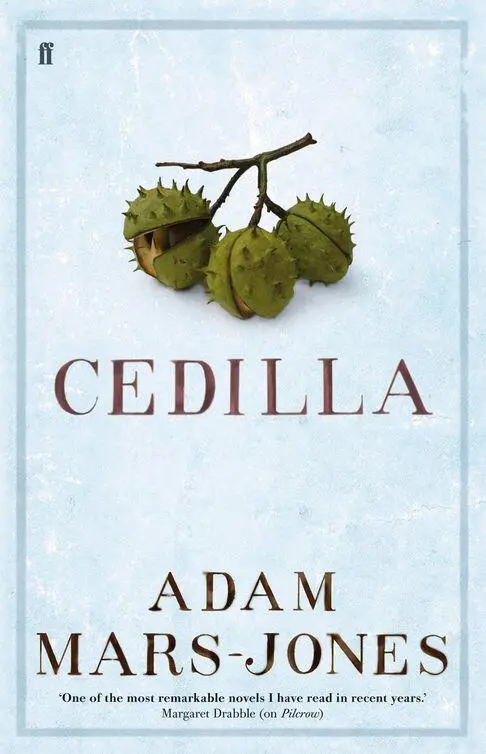
- Название:Cedilla
- Автор:
- Издательство:Faber and Faber
- Жанр:
- Год:2008
- ISBN:нет данных
- Рейтинг книги:3 / 5. Голосов: 1
-
Избранное:Добавить в избранное
- Отзывы:
-
Ваша оценка:
Cedilla: краткое содержание, описание и аннотация
Предлагаем к чтению аннотацию, описание, краткое содержание или предисловие (зависит от того, что написал сам автор книги «Cedilla»). Если вы не нашли необходимую информацию о книге — напишите в комментариях, мы постараемся отыскать её.
Cedilla — читать онлайн бесплатно полную книгу (весь текст) целиком
Ниже представлен текст книги, разбитый по страницам. Система сохранения места последней прочитанной страницы, позволяет с удобством читать онлайн бесплатно книгу «Cedilla», без необходимости каждый раз заново искать на чём Вы остановились. Поставьте закладку, и сможете в любой момент перейти на страницу, на которой закончили чтение.
Интервал:
Закладка:
‘One of our boys went over to these Christians and consequently never learned our initiations and our ways. Do you know what? A year or two after he had defected, a girl in that compound was raped … That is unthinkable amongst our peoples. All our women are loved and cherished here. They do not even know what rape is. No atrocity like that happens here. If it were ever committed, the punishment would be death. What is so “civilised” about those people?
‘In our tribe we fully know and understand the way we are made by the gods. If that boy had been here, he would have been initiated into drinking the semen of his elders. When he reached puberty and started to make his own sperm, he would have a younger boy to drink his semen for him, and when the younger boy grew older he would have another boy to service him, and so on. Thus the sacred fluids are kept in trust among our peoples … To this degree we respect the gods and all our wonderful life.’
Despite his diffidence, our guest speaker held us spellbound. Even the ping of the timer on the Tonys’ electric oven, arriving in the middle of the lecture, had no power to break our concentration.
I dare say that like most of the life-changing texts of the 1960s and ’70s — Desiderata (‘Go softly’, and so forth) or the ‘Cree Indian proverb’ (‘Only when the last tree has died and / The last river has been poisoned and / The last fish has been caught, / Will we realise that / We cannot eat money’) — this plea was more or less made up. It doesn’t even matter. The text changes your life not by virtue of being true but because you are ready for the transformation it announces.
In Hall, as the academic year wound down, I heard people talking about their plans for the summer. One person was going to work in a pub in Argyll, another had found work repairing slate roofs on a farm in Cornwall. And what were my plans? Not quite in that class, though ambitious enough in their way. I would be spending the long vacation in the bosom of my family, trying not to choke on the bullying nipple of Mum’s need to look after me despite all protests.
Dancing with eyes averted
There was a rather hectic atmosphere as May Week approached. I had already noticed that students made a point of breaking up their love affairs near the end of a term. A little wave of tears would break over the undergraduate population just before Christmas and Easter, and then the heartbroken would go home to mope with their families, casting a pall on the celebrations. May Week, though (which lasted more than a week and took place in June), was high jilting season, particularly for third-years, many of whom seemed determined to wipe the emotional slate clean before they moved on into the ‘world’ and the next stage of their lives.
I dare say there were a few women who called the shots, but it was more of a female fate in those days to start May Week as the cornerstone of your boyfriend’s existence, and to end it more in the rôle of a stepping-stone, one on which he had wiped his shoes in passing.
Tickets for May Balls were very expensive, since they included food, drink and entertainment from mid-evening till dawn. Many couples had bought tickets well in advance, deposits had been paid for the hire of evening dress, so they went through the festivities despite the fact of rupture. Champagne, Pimm’s No.1 cup, whole roast boar, smoked salmon, all to be endured rather than enjoyed, at a sombre carnival that was like a wake without a body (unless you count the boar). I heard enough accounts of these events to be able to build up a composite picture. Couples would hang on grimly till dawn, dancing with eyes averted, then trudge away from the pleasure-grounds through a tide of plastic glasses and discarded kebabs. Really it was a relief not to be going. I counted my blessings. I don’t like tears and don’t like silences that seethe with reproach.
Not that there was much silence on the night. If the Nasty Thing had survived so long, the ambient vibrations would surely have done it in. I remember a slow blues that seemed to have twelve hundred bars rather than the specified twelve. Sometimes between numbers I could hear a more distant uproar, presumably Pembroke’s Ball or perhaps even Emmanuel’s, according to the dictates of the breeze. Homerton was also a possibility, I suppose, though the Balls at women’s colleges had the reputation of being a little more restrained, even staid. They were rumoured to serve vegetarian food and hire trad jazz bands. These were highly effective passion-killing measures even when imposed separately. In combination they made the successful production and maintenance of an erection, its shepherding to a climax, a practical impossibility.
Finally the echoes of sobbing died away from the courtyards of the golden colleges. Spilt emotion evaporated relatively quickly from ancient flagstones, but for quite a while many undergraduate hearts would feel an affinity with the lawns where marquees had stood, drained to yellowness and marked by the sharp heels of hollow revelry.
I stayed in A6 just as long as I could. I would have loved to convalesce at Mr Johnson’s Home in Bognor, but from health there can be no convalescence. Any other sort of institution might take me in but wasn’t guaranteed to let me out. Finally there was nothing for it but to face the family, with nothing to shield me but a thick sheaf of the strongest prescriptions I could think of, endorsed with the autographs which Flanny distributed so freely.
Peter was away on holiday. He took a train to Inverness and spent the summer hitch-hiking round the Highlands. Audrey was in residence, but we had never really been friends. She was in a state of wildly excited transition, spending most of the time with her best friend Lorraine Leeming. They would walk around with rolled-up tights stuffed into their tops, modelling the soft shapeliness to come. They would shout, ‘What God has forgotten we stuff with cotton!’ then roll on the floor shrieking with laughter, till their makeshift busts were squashed flat.
Looked good in a kaftan
The rest of the time they would write cheques in each other’s favour. Pay Audrey Cromer Two Million Pounds. Pay Lorraine Leeming Two Million Pounds. It was always two. A single million wasn’t enough for these plutocrats in the making. They were too young to have chequebooks so they drew their own from scratch. Freed from the constraints of plausibly representing legal instruments of exchange their cheques grew physically large, sometimes made up of several pieces of cardboard taped together.
The closest thing I had to allies in Bourne End were the Washbournes, Malcolm who shared my spiritual interests and his wife Priscilla who warmly mocked them. ‘Call me Prissie,’ Priscilla said from the first, meaning I suppose that she wasn’t. Wasn’t prissy, that is.
Mum seemed to think that the Washbournes were only trying to be youthful and trendy by being friendly to me, sucking up to the young, as if I was obviously a waste of an older person’s time. I said to Dad once, I don’t think Mum is very keen on the Washbournes, and Dad said, ‘Let’s face it, John, your mother isn’t very keen on anybody.’ Which was true enough but didn’t help in the short term.
The women were different types, and had no use for each other. Everyone always complimented Mum on how thin she was — how did she manage it? What was her secret?
Her secret was not eating. No great mystery. And to Prissie’s eyes Mum was actually too thin, a monument to appetite repressed. ‘You need some meat on your bones, Laura dear,’ she said once, which I think Mum never forgave. In her own eyes, if she wasn’t thin, she wasn’t anything.
Prissie for her part made her mark in the short period, a half-decade perhaps of heyday, when undernourishment was not quite compulsory and the phrase earth mother had an edge of awe rather than disdain. She looked good in a kaftan, the only one I ever saw (in that age of kaftans) who did. She could carry herself.
Читать дальшеИнтервал:
Закладка:
Похожие книги на «Cedilla»
Представляем Вашему вниманию похожие книги на «Cedilla» списком для выбора. Мы отобрали схожую по названию и смыслу литературу в надежде предоставить читателям больше вариантов отыскать новые, интересные, ещё непрочитанные произведения.








Обсуждение, отзывы о книге «Cedilla» и просто собственные мнения читателей. Оставьте ваши комментарии, напишите, что Вы думаете о произведении, его смысле или главных героях. Укажите что конкретно понравилось, а что нет, и почему Вы так считаете.