Adam Mars-Jones - Cedilla
Здесь есть возможность читать онлайн «Adam Mars-Jones - Cedilla» весь текст электронной книги совершенно бесплатно (целиком полную версию без сокращений). В некоторых случаях можно слушать аудио, скачать через торрент в формате fb2 и присутствует краткое содержание. Год выпуска: 2008, Издательство: Faber and Faber, Жанр: Современная проза, на английском языке. Описание произведения, (предисловие) а так же отзывы посетителей доступны на портале библиотеки ЛибКат.
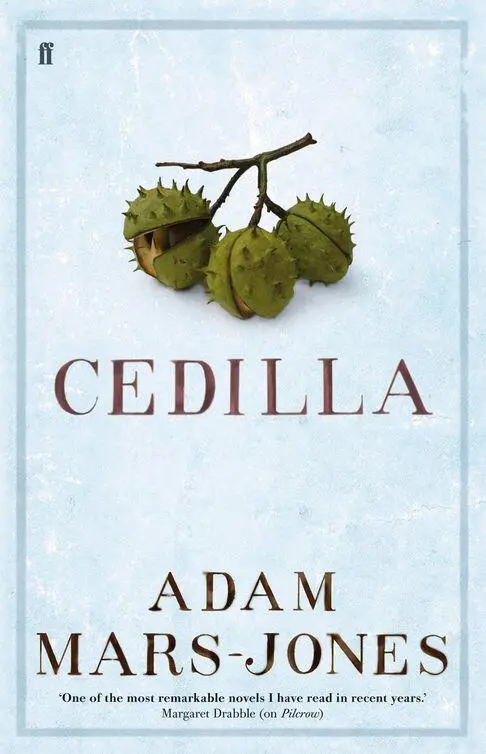
- Название:Cedilla
- Автор:
- Издательство:Faber and Faber
- Жанр:
- Год:2008
- ISBN:нет данных
- Рейтинг книги:3 / 5. Голосов: 1
-
Избранное:Добавить в избранное
- Отзывы:
-
Ваша оценка:
Cedilla: краткое содержание, описание и аннотация
Предлагаем к чтению аннотацию, описание, краткое содержание или предисловие (зависит от того, что написал сам автор книги «Cedilla»). Если вы не нашли необходимую информацию о книге — напишите в комментариях, мы постараемся отыскать её.
Cedilla — читать онлайн бесплатно полную книгу (весь текст) целиком
Ниже представлен текст книги, разбитый по страницам. Система сохранения места последней прочитанной страницы, позволяет с удобством читать онлайн бесплатно книгу «Cedilla», без необходимости каждый раз заново искать на чём Вы остановились. Поставьте закладку, и сможете в любой момент перейти на страницу, на которой закончили чтение.
Интервал:
Закладка:
I could have asked Noel to collect me from Downing, but that wasn’t the point. The point was that I was forcing myself to put in the effort, hoping that there would come a moment when I stopped noticing all the hard work I was doing. That was the moment I would find my place among the mobile.
The Arts Cinema lay down its own little passage off Market Hill (a hill which isn’t a hill at all, thank God, but a square with a slight tilt), so it was particularly unhandy for me to get to, even in a city of awkward access. Cambridge and above all its university is strongly fortified even against the able-bodied — the grass is always greener in the Fellows’ Garden, and that’s out of bounds to students except for the occasional summer party.
I hitch-lifted my way out of the car and into the wheelchair, but no one seemed to be going my way, and I ended up having to punt myself laboriously down Arts Cinema Passage.
When I arrived, Noel was looking at the showcases of stills from forthcoming attractions. Rather daunting attractions: troubled Nordic eyes and stern cheekbones gazed out of the cases. It must have been a Bergman season. Noel turned to greet me with a dazzling smile, as if he too was about to be photographed, wanting his expression to be at its peak of bloom when flashbulbs exploded to record it.
The ushers at the Arts were normally students themselves, friendly rather than businesslike. They watched with interest as I gave Noel instructions about propping me against the wall while he collapsed the wheelchair, then toting me into the cinema. Noel seemed happy to be observed coping so splendidly. Good luck to him! He might not enjoy the same level of attention if it came along every minute of the day.
When we were in the modest little auditorium I indicated a couple of empty seats in the middle of a row. That’s where I wanted us to sit. Why should I have a sidelong view just to save him a little trouble? Let him earn his keep. ‘They’re numbered seats, John,’ he whispered, ‘and ours are here.’
‘Tell you what, then,’ I said. ‘We’ll move if we’re asked.’ I wasn’t normally so bolshie, but I wanted to make clear that I wasn’t just a charity parcel. You like being conspicuous? I’ll give you conspicuous.
As Noel carried me along the row of seats I could feel little extra movements in his arms, which made me suspect that he was shrugging every few feet, to convey an apology to the people we were disturbing. Terribly sorry. This is what he’s like.
He needn’t have bothered. The people in those seats couldn’t do enough to oblige us. They were practically hurling themselves out of our way. They’d have lain flat on the floor if they’d thought it would help, they would have stood on the backs of their chairs. It’s wonderful what a little embarrassment can do. Most of the time I work hard to put people at their ease, but once in a while it’s good to let rip and have everyone cower in their Englishness.
Then in the dark I had to revert to a meeker style. I found that I couldn’t see the bottom of the screen — and consequently the subtitles — so I had to ask Noel to improvise a cushion for me out of his rolled-up coat. I certainly wasn’t going to allow him to ask for one of the cushions they keep for children’s screenings. Before I had new hips installed my position in a cinema seat was more upright, since I wasn’t actually sitting. It was more that I was leant against the seat like an umbrella. Still, it’s not something you can expect to find in even the smallest print, is it? Warning: artificial hips may limit your enjoyment of foreign-language films.
As the film got into its dour stride I realised that there were compensations to having company. Noel had brought along some butterscotch. Not just any butterscotch but the good stuff, Callard & Bowser’s, which came in an oddly fortified packet, braced with cardboard, wrapped first in paper and then cellophane. Perhaps it still does. In those innocent days of packaging, it was a very distinctive product. It suggested a childish treat that was only accessible to deft and determined adult fingers. The sweet itself came in double tablets, wrapped one more time in a sturdy lined silver paper which retained traces of the sticky virtue it had wrapped and kept safe.
The naked butterscotch
The double shape of the sweet suggested that a mother might snap it in two where the brittle toffee narrowed, before popping one tablet in her child’s mouth and one in her own. Personally I had always favoured sucking the sweet entire, though the double tablet would hardly fit in my mouth. The opposite ends of the flat finger of burnt sugar poked at the insides of my cheeks in a way that was almost painful, until the oral solvents had done their leisurely work.
Noel asked in a whisper if I wanted him to unwrap the butterscotch for me. Why ever not? I wasn’t in the mood for handicraft. He got points for treating me as his equal in greed — it didn’t seem to occur to him to snap the tablet in two. He posted the naked butterscotch into my mouth, his fingers brushing past my lips in a way that I didn’t find presumptuous or unpleasant. Then my consciousness slid back into the film and all its radiant gloom.
At the end of the showing I stayed put, and not only because it would be foolish to make a move immediately, before the lights were put on, and be jostled in the crush. It was still my habit to watch the screen till the very last credit.
To me it was a tiny crime not to finish a film or a book or even a record. I stood firm even on the issue of ‘Within You Without You’ at the beginning of Side Two of Sergeant Pepper , when everyone else wanted to plunge the needle straight into ‘When I’m Sixty-Four’. I fought many battles on behalf of George Harrison’s rotten pseudo-Indian song.
Swedish end-credits were no less entitled to sympathetic vibration than English ones, sympathy being distinct from understanding, and many of the names were beguiling in their own right. After Wild Strawberries , Noel had the sense to humour me, perhaps seeing from the set of my body that I wasn’t prepared to budge just yet. He set off to retrieve the wheelchair, which had been tucked in the box office for safe-keeping.
As we left the Arts, Noel scanned the dispersing crowd while remaining attached to me. ‘Are you looking for someone?’ I asked, but he said no, he was all mine. When we reached the car, I asked if there was somewhere I could drop him — an absurd idea, since he lived in Christ’s, barely a hundred yards away. Even I could walk that distance, though perhaps not in one go. ‘Do you want me to see you home?’ he asked, as if I was a debutante at a dance. I was going to tell him not to bother — how did he think I coped on a daily basis? — when I realised that by this time the Tennis Court Road gate would be closed. I would need to get someone to open up, and I might as well take Noel along. He could scamper into the Porter’s Lodge and make the request on my behalf. It isn’t easy to summon people with a toot on your horn without seeming lordly.
The colleges were still officially sealed by a ten o’clock curfew, but in practical terms they were porous. Authority was crumbling of its own accord, without needing to be actively overthrown. It was common knowledge which sets of railings offered easy informal access to the various colleges. Monumental architecture offered any number of handholds to youth and recklessness stoked by beer. The back streets of the town were full of excited young men, clambering up and sliding down. Some stretches of railing saw heavy traffic even on weeknights.
If men were reckless mountaineers of the railings after dark, then women still liked to be climbed up to, rather than doing the climbing themselves. They had a rooted preference for Juliet’s rôle in the balcony scene, looking down on her swain as he ascended, sweating and cursing, with a bottle of rock-bottom Hirondelle from his college buttery sticking precariously out of his jacket pocket.
Читать дальшеИнтервал:
Закладка:
Похожие книги на «Cedilla»
Представляем Вашему вниманию похожие книги на «Cedilla» списком для выбора. Мы отобрали схожую по названию и смыслу литературу в надежде предоставить читателям больше вариантов отыскать новые, интересные, ещё непрочитанные произведения.






Обсуждение, отзывы о книге «Cedilla» и просто собственные мнения читателей. Оставьте ваши комментарии, напишите, что Вы думаете о произведении, его смысле или главных героях. Укажите что конкретно понравилось, а что нет, и почему Вы так считаете.