Adam Mars-Jones - Cedilla
Здесь есть возможность читать онлайн «Adam Mars-Jones - Cedilla» весь текст электронной книги совершенно бесплатно (целиком полную версию без сокращений). В некоторых случаях можно слушать аудио, скачать через торрент в формате fb2 и присутствует краткое содержание. Год выпуска: 2008, Издательство: Faber and Faber, Жанр: Современная проза, на английском языке. Описание произведения, (предисловие) а так же отзывы посетителей доступны на портале библиотеки ЛибКат.
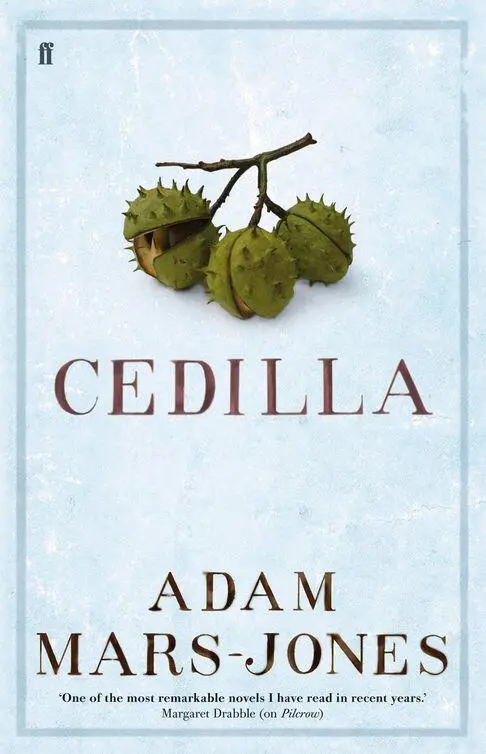
- Название:Cedilla
- Автор:
- Издательство:Faber and Faber
- Жанр:
- Год:2008
- ISBN:нет данных
- Рейтинг книги:3 / 5. Голосов: 1
-
Избранное:Добавить в избранное
- Отзывы:
-
Ваша оценка:
Cedilla: краткое содержание, описание и аннотация
Предлагаем к чтению аннотацию, описание, краткое содержание или предисловие (зависит от того, что написал сам автор книги «Cedilla»). Если вы не нашли необходимую информацию о книге — напишите в комментариях, мы постараемся отыскать её.
Cedilla — читать онлайн бесплатно полную книгу (весь текст) целиком
Ниже представлен текст книги, разбитый по страницам. Система сохранения места последней прочитанной страницы, позволяет с удобством читать онлайн бесплатно книгу «Cedilla», без необходимости каждый раз заново искать на чём Вы остановились. Поставьте закладку, и сможете в любой момент перейти на страницу, на которой закончили чтение.
Интервал:
Закладка:
Is this the end for John Wallace Cromer?
The night before, I had dreamed of the Abominable Snowman. The dream was somehow in the style of a B-movie from the 1950s. I was being hurried to safety through snow by a group of helpers who suddenly scattered and deserted me. The dream wasn’t from my point of view, exactly, but the guiding principle was film cliché rather than astral travel. If I was scared in the dream then perhaps Mrs O’s remarks about the importance of following dream fear to its source remained with me on these lower levels of mental life, so that I over-rode the reflex of waking.
Now the camera craned up and looked down at me, and I saw that the wheelchair was sitting squarely in the middle of an enormous footprint in the snow. Then there was either a commentary or a caption, as if this was an episode of a serial reaching its cliff-hanger ending: IS THIS THE END FOR JOHN WALLACE CROMER, TORN APART BY A MYTHICAL MONSTER IN A PART OF INDIA WHERE HE HAS NEVER EVEN BEEN? In the interior spaces of the dream I was uneasily aware that Tibet was somehow wrong.
The fact of my being in the wheelchair in the dream already put it into a special category. I walk without difficulty in most of my dreams, I glide along, but this was either wish-fulfilment of a higher sort or something other than wish-fulfilment. Then an enormous shadow fell over the enormous footprint.
Next thing I knew the Abominable Snowman was cradling me in his arms, which were warm and very soft. I couldn’t see his face, but I was swept up into an ecstasy of mammal safety and release.
I had conjured up a place of altitude and hardship which was no doubt partly a plaintive self-portrait of the modern pilgrim and his travails. It was also a fantasy of relief from the heat I had been in so constantly for a month now, a dream of snow. Yet into that imaginary cold I had smuggled warmth and comfort. The strong arms of the Abominable Snowman, densely covered with black fur, squeezed me in a surging rhythm like a global heartbeat. My bones made no protest as I was hugged to that mighty chest. My bones were glad, were only glad. I was enclosed in something like the mechanism of a cat’s purr, only a million times larger. Then little by little the vision receded and I became awake. It was a little after dawn, on the last morning I would spend on Mrs Osborne’s verandah, as a guest of the oldest mountain on earth.
It was an undignified ending to my Indian adventure. I had set off with hopes of celibacy and self-realisation, but all I had achieved was disappointment and distraction. Now my unconscious mind had even broken my presumptuous vow. I had wanted to pitch all my thinking at an elevated level, to soar above my limitations — but then I had to go and crash-land my own quest by having a wet-dream about the Yeti.
4 Dark Ages
I felt very low on the plane home, suffering a sense of spiritual failure that was like a hangover. This Maharajah had no desire to be served champagne in the sky as he headed wearily for home. I was on the wagon, and all the fizz had gone out of me.
Even so, my depression didn’t last for the whole flight. The more distance I put between India and myself, the rosier my vision of the visit became. The grotty bits tactfully disappeared, while the good moments rooted themselves firmly in my memory and sent up tender shoots. Mrs Osborne herself started to shine like a saint in my mind, which was never an illusion that I had entertained when she was sitting opposite me, hissing her savage sibilants and grieving over rock cakes when she wasn’t beating stray dogs.
I had expected too much from the huge endeavour of displacing myself to India. I had banked on apotheosis and received only a holiday, something I had no use for. I had hoped to realise my Self, but I was still trapped in the lower case, confined by the daily self which so obviously offers too little but also too much. The self of every day is like some hectoring street hawker, touting bangles and sweetmeats, guides to the museum, sexual use of his family in exhaustive combinations, trayfuls of watches but never the right time. I must still engage daily with Maya, who by pulling some sort of typographical strings has managed to become capitalised on the sly herself.
Still, I knew from Dad’s horticultural lectures that if you take an established plant and transfer it to another climate it never really settles down. I needed a more realistic plan, and this is what I came up with: I would graft onto my English life all the things I had learned in India.
I felt I had understood the essence of what I should do, being deceived only about details of location. I had thought I would melt into the mountain like butter into holy toast, which was greatly presumptuous. Parvati in penitent devotion had indeed vanished into Arunachala, leaving that single bosom behind, but that was different. It had been absurd for me to imagine I could do the same, leaving later generations of devotees to trace the shape of my McKee pins in the mystically absorptive rock.
I had set my sights too high. My job was to be more like a gardener’s, taking a cutting and starting new growth in another bed, and my mission would be in Britain.
I took comfort from an old episode in the history of Arunachala. Four hundred years previously a guru had ordered his prime disciple to go away, to what is now Bangalore. It was there that he must carry the inner torch. The explanation was that two mighty trees can never thrive next to each other. This wasn’t banishment but husbandry. The seeds spread and scatter, and the strength is in the distance, not the closeness. And after all, Bangalore (or whatever it was called back then) is on the Deccan plateau, well elevated and much cooler. Having to go back to England was no more than the modern equivalent of being sent to Bangalore.
In my mind I had staked everything on the transformation India was going to work on me, and I had given no thought to coming home. In my mind I had staked everything on the transformation India was going to work on me, and I had given no thought to coming home. My previous concerns had been trumped by spiritual awareness. Making progress in the world was no longer a tempting illusion. I was too old to go through the motions. Cleverness and willpower had been my bath toys, and I had played with them very happily, until the day I looked out of the window and saw the sea.
A guinea-pig in a wheelchair
Now I had little interest in reading Modern Languages at world-famous Cambridge University, and none whatever in being a guinea-pig in a wheelchair, as Downing College’s first disabled student. I had lost heart for another round of the obstacle race, but really, what was the alternative?
At Cambridge there would be people responsible for my welfare, and Mum and Dad — however little I wanted to depend on them — would be no more than a telephone call away, yet it was a far more daunting prospect than the voyage I had made to India alone, when there was a real possibility of my having to sleep by a roadside infested by brigands. I had much less to fear from going to Cambridge, but incomparably slighter grounds for hope.
Nevertheless I managed to convince myself that there was a spiritual mission involved, quite distinct from the next scheduled phase of my mundane education. My job was to plant the seeds of Self-Enquiry and Ramana Maharshi, first in the heart of Buckinghamshire, and then in Cambridge University itself. Why else would a place be waiting for me there? It came to me suddenly. I was to be a teacher disguised as a student, providing a wisdom that bubbled up from underneath, not mere knowledge filtering down from above.
Cambridge was still some weeks off in the future. What mattered during that interval was the Here and the Now: Trees, Abbotsbrook, Bourne End, Bucks. The Abbotsbrook Estate would be the nursery garden for my centre. Young shoots would be watered and protected from too much sun. Morning and evening meditation would be the order of the day. Unless Mum had anything to do with it, of course.
Читать дальшеИнтервал:
Закладка:
Похожие книги на «Cedilla»
Представляем Вашему вниманию похожие книги на «Cedilla» списком для выбора. Мы отобрали схожую по названию и смыслу литературу в надежде предоставить читателям больше вариантов отыскать новые, интересные, ещё непрочитанные произведения.








Обсуждение, отзывы о книге «Cedilla» и просто собственные мнения читателей. Оставьте ваши комментарии, напишите, что Вы думаете о произведении, его смысле или главных героях. Укажите что конкретно понравилось, а что нет, и почему Вы так считаете.