Karen Russell - Swamplandia!
Здесь есть возможность читать онлайн «Karen Russell - Swamplandia!» весь текст электронной книги совершенно бесплатно (целиком полную версию без сокращений). В некоторых случаях можно слушать аудио, скачать через торрент в формате fb2 и присутствует краткое содержание. Год выпуска: 2011, Издательство: Knopf, Жанр: Современная проза, на английском языке. Описание произведения, (предисловие) а так же отзывы посетителей доступны на портале библиотеки ЛибКат.
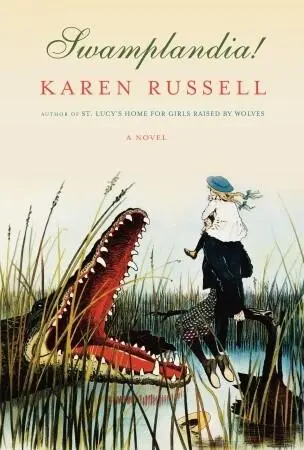
- Название:Swamplandia!
- Автор:
- Издательство:Knopf
- Жанр:
- Год:2011
- ISBN:нет данных
- Рейтинг книги:4 / 5. Голосов: 1
-
Избранное:Добавить в избранное
- Отзывы:
-
Ваша оценка:
Swamplandia!: краткое содержание, описание и аннотация
Предлагаем к чтению аннотацию, описание, краткое содержание или предисловие (зависит от того, что написал сам автор книги «Swamplandia!»). Если вы не нашли необходимую информацию о книге — напишите в комментариях, мы постараемся отыскать её.
Ava, a resourceful but terrified twelve year old, must manage seventy gators and the vast, inscrutable landscape of her own grief. Her mother, Swamplandia!’s legendary headliner, has just died; her sister is having an affair with a ghost called the Dredgeman; her brother has secretly defected to the World of Darkness in a last-ditch effort to keep their sinking family afloat; and her father, Chief Bigtree, is AWOL. To save her family, Ava must journey on her own to a perilous part of the swamp called the Underworld, a harrowing odyssey from which she emerges a true heroine.
Swamplandia! — читать онлайн бесплатно полную книгу (весь текст) целиком
Ниже представлен текст книги, разбитый по страницам. Система сохранения места последней прочитанной страницы, позволяет с удобством читать онлайн бесплатно книгу «Swamplandia!», без необходимости каждый раз заново искать на чём Вы остановились. Поставьте закладку, и сможете в любой момент перейти на страницу, на которой закончили чтение.
Интервал:
Закладка:
For dinner, the Bird Man cooked up some fatty hamburger meat on his one-burner camper stove and sliced two small, golden onions into the oil. “Eat up, kid,” he said, “because this stuff will spoil rotten by tomorrow night.” ( Tomorrow night? ) We ate in silence at a gimpy three-legged table. It was the only piece of furniture left in the kitchen. The original chairs were long gone but the Bird Man had scavenged two from the adjacent house and they were unexpectedly beautiful, a matched set with swirly black rails painted with pink roses. We both sat down gingerly at opposite ends of the table; when the chairs held our weight our eyes met, surprised. Maybe he will dance with me later , I thought out of nowhere, and felt a quick flulike joy. Back home I never got to dance during our mock proms that we girls held after hours in the café; Ossie always made me be the disc jockey. Being the DJ meant feeding a black poker chip on a string to the jukebox. Ossie and her invisible partner twirled in front of the windows, her purple skirt going full as a balloon as she spun around the empty tables. Once a ghost had tried to dip her near the fryer and she’d fallen and given herself a shiner.
“Hey, Bird Man?” I asked him abruptly. “Do you have another name that I could call you? Like, I don’t know, Alan or Paul or something? Stanley? A regular name?”
The Bird Man glanced up as if this were a shockingly rude question. “I had a name when I was your age. Not anymore. I guess I don’t see enough people in my line of work that I feel a name is necessary, kid. Who would I need to distinguish myself from?”
“I don’t know. Other men?”
“Not too many other men out here in the first place, and my customers aren’t much interested in getting to know me. Generally speaking, I mean.” He gave me a small smile. He was garnishing a third hamburger with slick onions and green slices of tomato. “So I don’t mind being the Bird Man to them.”
I nodded, but I felt hurt — here he had a name like an ace in his pocket and he didn’t want to show it to me. Didn’t he know that a Bigtree alligator wrestler was trustworthy?
But I guess the Bird Man was right to keep the secret of his name from me, because later that night I broke my promise to Ossie. I told him the story of the Dredgeman’s Revelation. It happened by accident — I was only planning on asking him if he knew or had known a man named Louis Thanksgiving, and then I watched as one sentence after another exited my mouth like those knotted magician’s scarves. Louis’s death story came out unstoppably; I didn’t even feel so guilty about breaking Ossie’s trust. As I babbled onward the Bird Man removed his gloves and settled his warm, bald hands on my knees, as if this were the polite thing to do. The whole time I spoke his slate eyes were liquid and dog-kind above the camp lantern. He didn’t tease me like my brother would have done but instead regarded me with an attentiveness that felt wonderful, like relaxing into a net over a wide ocean. When I got to the part about the buzzards he whistled softly and began to nod, and it occurred to me with a cold wonderment that he might have seen this species of bird himself; in the underworld he might have sailed beneath the very flock that got Louis.
“What an ending,” the Bird Man said when I finished. “A vanishing point. And what do you think the Dredgeman’s Revelation means, kid?”
I paused. Is he testing me? I wondered, and wished that I could crane around and peek at what the Bird Man knew, as if he might have an answer card hidden behind his back.
“Oh, I think it means that …”
I thought about Louis Thanksgiving’s hands, Louis’s freckled knuckles curled around the dredge railing at the end of his story. I could see the black dredge in greenish storm light, and how brave he’d been then, staring down that darkness. I thought of how he’d left his surname “Auschenbliss” floating miles behind him like molt feathers or snakeskin.
“My mom had a name that she tore off, too,” I heard myself saying. “Like Louis. She had a mainland name — her maiden name, it’s called. She used to be Hilola Owens. So she wasn’t always a Bigtree. And then she only got to be a Bigtree for eighteen years, you know, and now she’s nothing.”
Why had Louis died so young, before he could even become anybody? On Swamplandia! my sister and I found the dredge crane’s bucket frozen at a noon tilt, filling with sunlight and moonlight. That light, I felt like it belonged to Louis Thanksgiving. The world owed it to him, it was his child’s inheritance. He should get to drink that pink light through every pore and every follicle, every cell, the way our basking Seths ate the sun through their wet skin! Death is a theft, a crime, a cry in the sky, that’s what the story means to me, Bird Man . But as soon as I opened my mouth I sounded like a dumb kid again.
“I guess I don’t know what it means.” I tugged on my shoelaces like tiny reins, embarrassed. My sense of it had dissolved back into the old hurt in my chest. “I wish that Louis had never died. I wish that Louis and Hector and Gideon Tom and all the rest of them could have finished digging their road to the Gulf of Mexico. Then Louis Thanksgiving could have gotten married, and had a wife and a son — not to my sister, you know? But maybe married to some nice lady from his, ah, his own time. And he’d grow up to know for sure that he was handsome and good. And he would be an old man now.”
I paused. I hadn’t known that I wanted all that for the ghost.
“So you wish that the dredgeman Louis was still flesh and blood?” the Bird Man asked. It was a serious question. He took me seriously, and I did feel taken up by his musing tone and carried, lifted onto the ledge of adults.
“Right. That’s not really a revelation though, is it?”
That night we unrolled our bright blue tarps onto the floor of the central room, which gave the wrecked wood a planetary look. I wanted to play the End of the World, a cheery game Ossie and I had invented in our bedroom, back when the worst threat we faced was Mom’s Spaghetti Surprise. We rolled blankets down the stairs and pretended that we were reupholstering the dead world. The towels were the grass and the seas. Ossie always wanted to be the Creator and fluff the prairies, and then I’d burst in as the Destroyer and kick at stuff and roll everything up again. Mom hated this game because all her towels ended up on the floor. Before the ghosts showed up, we played all kinds of silly games like that, doing a theater of personalities for each other. Ossie liked to be the sweet and kind one: saints, princesses, Vanna White. Not me! Even in games I liked to play myself: Ava Bigtree, World Champion Alligator Wrestler. I was as strong as ten men, ferocious. Ossie always let me be the hero.
The Bird Man grumbled that he wasn’t in a great mood for pretending. He shuffled inside the foil of his bedroll. On the sill behind him, the wind kept trying to pluck the orange petals of our fires. Mosquitoes waved angrily just beyond them. Through the saw-cut boards I could see the empty neighborhood of Stiltsville. Pilings bolted down the water, where the moon boiled.
“What the hell are you doing over there, kid?”
“Nothing. Can’t sleep. Just praying.”
“New rule, kid: don’t fall out.”
“Dear God,” I prayed awkwardly, unrolling the tongue of my bedroll, “let me not veer away from this darkness amen.”
Our mother grew up in a churchgoing family on the mainland, and Grandma Risa was an Italian Catholic who collected these truly spooky Virgin Marys carved out of raw abalone on her trips to Key West, but we kids were never raised to religion. “God” was a word I used as a spell-breaker. Sometimes it worked, and sometimes it didn’t. “God,” I’d whisper, feeling sometimes an emptiness and sometimes a spreading warmth. If a word is just a container for feeling, or a little matchstick that you strike against yourself — a tiny, fiery summons — then probably I could have said anything, called any name, who knows? I didn’t have a normal kid’s ideas of the Lord as an elderly mainland guy on a throne. The God I prayed to I thought of as the mother, the memory of love. She was my own mother sometimes, baggy-eyed and smiling in the Chief’s heavy canvas work clothes in the morning, one of the Chief’s cigarettes hanging from her mouth. The Our Father and the Hail Mary I’d picked up somehow by osmosis but it was her name I invoked out there, her memory I summoned like a wind I could lean into, and I liked this prayer much better:
Читать дальшеИнтервал:
Закладка:
Похожие книги на «Swamplandia!»
Представляем Вашему вниманию похожие книги на «Swamplandia!» списком для выбора. Мы отобрали схожую по названию и смыслу литературу в надежде предоставить читателям больше вариантов отыскать новые, интересные, ещё непрочитанные произведения.

Обсуждение, отзывы о книге «Swamplandia!» и просто собственные мнения читателей. Оставьте ваши комментарии, напишите, что Вы думаете о произведении, его смысле или главных героях. Укажите что конкретно понравилось, а что нет, и почему Вы так считаете.