Karen Russell - Swamplandia!
Здесь есть возможность читать онлайн «Karen Russell - Swamplandia!» весь текст электронной книги совершенно бесплатно (целиком полную версию без сокращений). В некоторых случаях можно слушать аудио, скачать через торрент в формате fb2 и присутствует краткое содержание. Год выпуска: 2011, Издательство: Knopf, Жанр: Современная проза, на английском языке. Описание произведения, (предисловие) а так же отзывы посетителей доступны на портале библиотеки ЛибКат.
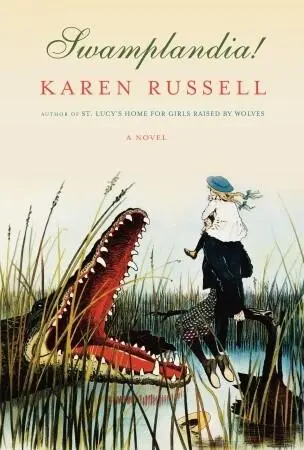
- Название:Swamplandia!
- Автор:
- Издательство:Knopf
- Жанр:
- Год:2011
- ISBN:нет данных
- Рейтинг книги:4 / 5. Голосов: 1
-
Избранное:Добавить в избранное
- Отзывы:
-
Ваша оценка:
Swamplandia!: краткое содержание, описание и аннотация
Предлагаем к чтению аннотацию, описание, краткое содержание или предисловие (зависит от того, что написал сам автор книги «Swamplandia!»). Если вы не нашли необходимую информацию о книге — напишите в комментариях, мы постараемся отыскать её.
Ava, a resourceful but terrified twelve year old, must manage seventy gators and the vast, inscrutable landscape of her own grief. Her mother, Swamplandia!’s legendary headliner, has just died; her sister is having an affair with a ghost called the Dredgeman; her brother has secretly defected to the World of Darkness in a last-ditch effort to keep their sinking family afloat; and her father, Chief Bigtree, is AWOL. To save her family, Ava must journey on her own to a perilous part of the swamp called the Underworld, a harrowing odyssey from which she emerges a true heroine.
Swamplandia! — читать онлайн бесплатно полную книгу (весь текст) целиком
Ниже представлен текст книги, разбитый по страницам. Система сохранения места последней прочитанной страницы, позволяет с удобством читать онлайн бесплатно книгу «Swamplandia!», без необходимости каждый раз заново искать на чём Вы остановились. Поставьте закладку, и сможете в любой момент перейти на страницу, на которой закончили чтение.
Интервал:
Закладка:
Around six o’clock we got doused by a nasty chop on the narrow bay. A strong wind was blowing in out of the northeast and sending four-inch swells over the skiff’s low gunwales. The Bird Man showed me how to roll the boat with each wave, keeping our hull as parallel as possible to the waves. We couldn’t tack straight and the Bird Man took the brunt of the swells; within minutes his coat was soaked through, its outer feathers slimily adhered to his arms. He grimaced when the waves hit but he didn’t complain.
“Drink some water, kid. We’ll have to stop soon,” the Bird Man said from the poling platform.
“Thank you so much for doing this, Bird Man.”
“Sit down.”
“Thank you for taking me to find her. Thank you. Are you tired?”
“No.”
“If you’re tired I can pole, I’m much stronger than I look.” I waited two minutes and then I was spitting words at him again. Fits of grateful or fearful language kept rising in my throat, embarrassing but unstoppable — they felt almost like knots of phlegm that I had to cough up.
“Really, thank you so much. You’re sure you’re not tired? If you hadn’t showed up, I don’t even like to think about …”
“Sit down, kid. Calm down. If your sister’s smart she’s not on the water now. She and her friend are making camp somewhere.”
“But did she come this way, you think?”
I leaned into the hull: I saw nothing. Rain fizzing in the near distance. A vague red sun behind the trees.
Seven o’clock: we were on a drift slough now, small oak trees and cocoplums rising along the water’s edge. Butterflies flecked the air in pale triangles, so pretty that I concluded we must still be a long ways off from the underworld. The sun was lowering itself behind the tree line at an angle, as carefully as a round man descending a ladder. Two bullnose turtles craned their black caramel necks at us from a rock.
Instead of camping on a hammock, the Bird Man said we were going to spend the night in a “sky house” at Stiltsville. “Stiltsville is our Swamp Roanoke,” the Chief liked to say, giving the place a black-ice twinkle for the tourists. (“Stephen, did you hear that! Everybody disappeared . Oh, it gives me the chills to think about it! What a morbid riddle!”) The truth is a lot less interesting: Stiltsville emptied out when Park Services took over this part of the swamp. Residents of Stiltsville abandoned their platform houses and moved to townships on the sloping rock of the continent. The sky people had mailboxes now, elms and gardens; their houses no longer resembled arks. The last family moved out of Stiltsville in the dry season of 1952; in the intervening decades it devolved into a wooden rookery. The name “Stiltsville” had always made me picture a cloudland of these acrobatic palaces, but the reality was pretty modest: just a collection of ten or twelve houses mounted on fourteen-foot support pilings.
“Do you think anybody lives here anymore?” I asked the Bird Man. “Do you think there are any ghosts here?”
“We’ll find out.”
Each house had a shadow beneath it, a sort of liquid basement. Small waves rose midway up the platform supports and collapsed into a thin foam. The temperature dropped tens of degrees whenever we poled beneath a house. Above us, the rotted planks and greenish white cross-boards looked like they’d been nailed shut by some lunatic carpenter — I saw the glint of what seemed at a distance to be hundreds and hundreds of nailheads. Barnacles . Not nails but shells, dark red horns spiraling out of every surface. Some of the houses had disintegrating dinghies tethered in their “garages.” Some had holes in the floor that aligned with holes in the ceiling, and you could see the sun pinwheeling cheerfully above the ruined kitchens and bedrooms.
“Know any good knock-knock jokes, kid?” the Bird Man asked, and for some reason this made me laugh hysterically. “This whole place looks like a joke that got knocked over, doesn’t it?” He touched a support where tiny brown-and-red crabs clung like bottle caps to the wood.
Be alive, Ossie , I beamed over the monotony of water. Be safe .
We poled under a porch where a bobcat was shouldering through a cracked blue door frame. For a second it paused to look at us. Ancient blue and red flowerpots sat all over the deck, heavy enough to have survived who knows what. I saw spiders, the long absence of flowers. The bobcat slunk around the maze of ceramics, broke free, leapt through a gray space in the porch slats, and easily cleared the six-foot channel between two of the houses, its white belly fur flying above our skiff. The creature landed soundlessly in front of a second doorway, bulled its flat head through the screen, disappeared into another house. All told this took maybe twelve seconds tops.
The Bird Man sucked air between his teeth.
“We’ll make sure to find an empty house tonight, kid. No ghosts or cats.”
Above us a hundred birds screamed. I watched a snow cloud, a pale blue cloud, a black and crimson-edged cloud, a green cloud, a nickel cloud explode into the sky.
“Are you making them do that?” I asked the Bird Man. “That’s you, isn’t it?”
The Bird Man didn’t answer me and I hadn’t heard him chirrup or whistle, as he’d done back on Swamplandia! but the birds danced in a weird clockwork above us and I guessed that he had something to do with it. The sun was a low, red ball behind gray clouds. I felt scared, watching the cormorants and the ibis obey his secret commands, but this was a wonderful kind of fear. It was nothing like the metal-in-your-mouth terror I got thinking about Ossie and Louis. It was an exhilaration, the way you feel when you are wrestling a Seth and it nearly knocks you loose. Kiwi, my smug brother — I wanted to tell him that I was watching real magic.
We paddled zags through Stiltsville until the Bird Man found a house he said was good for us to sleep in. He tied off on one of the southern pilings. Wooden steps rose eleven or twelve feet to the front door.
“Okay, pal. Up, up, and such.”
“You first. Please.” I was still thinking about the bobcat.
Inside the house was bare wood. Smells bloomed in the dark, a mix of salt and bird droppings and deep rot, but the structure itself was in surprisingly good condition. No Seths, no hawks, no raccoons, no trespassing felines. The main room was about three hundred square feet, and the roof was low enough to scrape back the Bird Man’s hat. There was almost no furniture, but what remained was arranged in the patterns you’d expect: a dining table, twin beds bunked in an alcove that opened like a walnut mouth behind what had been the kitchen, a small black desk that looked so weak that I didn’t even like to rest my eyes on it. Black and white specklings covered the walls, these grim starbursts of mold on the pale wood that made me miss with a random stab my acned brother. A huge hole in the middle of the ceiling opened onto a clear night sky: it looked as if some great predator had peeled the thatched roof back, sniffed once, and lost interest.
Immediately the Bird Man began setting small smudge fires in pots along the holes in the wall to smoke the mosquitoes out. I climbed down to the river again to change out my Seth’s water dish. Outside I watched clouds sail over the neighboring houses, which stood on tall and lemon-gray legs like a flock of herons in the shallows. From the bottom of the ladder I watched the sun fall behind the many wooden legs of Stiltsville; you could almost hear the splash. Soon afterward the river became a looking glass for stars. Now it was our first night on the water. I climbed the ladder to a plank where I could see the Bird Man hunched over our Coleman in a yellow round of light, his shadow flung far back against the wall. I paused there for a while, watching him.
Читать дальшеИнтервал:
Закладка:
Похожие книги на «Swamplandia!»
Представляем Вашему вниманию похожие книги на «Swamplandia!» списком для выбора. Мы отобрали схожую по названию и смыслу литературу в надежде предоставить читателям больше вариантов отыскать новые, интересные, ещё непрочитанные произведения.


Обсуждение, отзывы о книге «Swamplandia!» и просто собственные мнения читателей. Оставьте ваши комментарии, напишите, что Вы думаете о произведении, его смысле или главных героях. Укажите что конкретно понравилось, а что нет, и почему Вы так считаете.