Richard Ford - The Sportswriter
Здесь есть возможность читать онлайн «Richard Ford - The Sportswriter» весь текст электронной книги совершенно бесплатно (целиком полную версию без сокращений). В некоторых случаях можно слушать аудио, скачать через торрент в формате fb2 и присутствует краткое содержание. Год выпуска: 1995, Издательство: Vintage Books, Жанр: Современная проза, на английском языке. Описание произведения, (предисловие) а так же отзывы посетителей доступны на портале библиотеки ЛибКат.
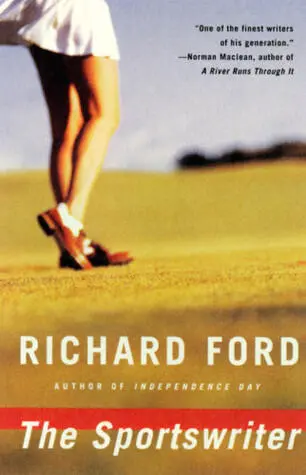
- Название:The Sportswriter
- Автор:
- Издательство:Vintage Books
- Жанр:
- Год:1995
- ISBN:нет данных
- Рейтинг книги:3 / 5. Голосов: 1
-
Избранное:Добавить в избранное
- Отзывы:
-
Ваша оценка:
The Sportswriter: краткое содержание, описание и аннотация
Предлагаем к чтению аннотацию, описание, краткое содержание или предисловие (зависит от того, что написал сам автор книги «The Sportswriter»). Если вы не нашли необходимую информацию о книге — напишите в комментариях, мы постараемся отыскать её.
The Sportswriter — читать онлайн бесплатно полную книгу (весь текст) целиком
Ниже представлен текст книги, разбитый по страницам. Система сохранения места последней прочитанной страницы, позволяет с удобством читать онлайн бесплатно книгу «The Sportswriter», без необходимости каждый раз заново искать на чём Вы остановились. Поставьте закладку, и сможете в любой момент перейти на страницу, на которой закончили чтение.
Интервал:
Закладка:
Sweet Lou isn’t around at the moment, but when I sit down at the bar, a heavy pale-skinned woman in her fifties with beehive hair and elastic slacks comes out from a swinging door to the back and begins to clean an ashtray.
“Where’s Lou today,” I ask after I’ve ordered a whiskey. I would, in fact, like to meet him, maybe set up a Where Are They Now feature: “Former Giant lugnut Lou Calcagno once had a dream. Not to run a fumble in for a touchdown or to play in a league championship or to enter the Hall of Fame, but to own a little watering trough in his downstate Jersey home of Bamber, a quiet, traditional place where friends and fans could come and reminisce about the old glory days….”
“Lou who?” the woman says, lighting a cigarette and blowing smoke away from me out the corner of her mouth.
I widen my grin. “Sweet Lou.”
“He’s where he is. How long since you been in?”
“A while, I guess it’s been.”
“I guess too.” She narrows her eyes. “Maybe in your other life.”
“I used to be a big fan of his,” I say, though this isn’t true. I’m not even sure I ever heard of him. To be honest, I feel like an idiot.
“He’s dead. He’s been dead maybe, thirty years? That’s approximately where he is.”
“I’m sorry to know that,” I say.
“Right. Lou was a real nunce,” the woman says, finishing wiping out the ashtray. “And he was a big nunce. I was married to him.” She pours herself a cup of coffee and stares at me. “I don’t wanna ruin your dreams. But. You know?”
“What happened?”
“Well,” she says, “some gangsters drove over here from Mount Holly and walked him into the parking lot out there like it was friends and shot him twenty or thirty times. That did it.”
“What the hell had he done to them?”
She shakes her head. “No idea. I was right here where I am behind this bar. They came in, three of them, all little rats. They said they wanted Lou to come out and talk, and when he did, boom. Nobody came back in to explain.”
“Did they catch the people?”
“Nope. They did not. Not one was caught. Lou and I were getting divorced anyway. But I was working for him afternoons.”
I look around the dark bar where Sweet Lou stares down at me from long ago and life, surrounded by his smiling friends and fans, an athlete who left sports a success to achieve a prosperous life in Bamber, which was no doubt his home, or near it, yet came to a bad end. Not the way these things usually turn out and not exactly what you’d want to read about before dinner behind a chilled martini.
Someone else, I see, is in the bar, an older gray-haired man in an expensive-looking silverish suit sitting talking to a young woman in red slacks. They are in the corner by the window. Above them is a huge somber-looking bear’s head.
I cluck my tongue and look at Lou’s widow. “It’s nice you keep the place this way.”
“He had it in his will that all these had to be left up, or I’d have changed it, what, a hundred years ago? It has to stay a B’ar, too, and buy from his distributorship. Otherwise I lose it to his guinea cousins in Teaneck. So I ignore him. I forget whose picture it is, really. He wanted to run everybody’s life.”
“Do you still own the distributorship?”
“My son by my second marriage. It fell in his lap.” She sniffs, smokes, stares out the small front door glass which casts a pale inward light.
“That’s not so bad.”
“It was the best thing he ever did, I guess. After he was in the ground he did it. Which figures.”
“My name’s Frank Bascombe, by the way. I’m a sportswriter.” I put my dollar on the bar and drink up my whiskey.
“Mrs. Phillips,” she says and shakes my hand. “My other husband’s dead, too.” She stares at me without interest and opens a saltine packet from a basket of them on the bar. “I haven’t seen one of you guys in years. They used to come all the time to interview Fatso. From Philly. He kept ’em in stitches. He knew jokes by the hundreds.” She drops the little red saltine ribbon into the clean ashtray and breaks the cracker in two.
“I’m sorry I didn’t know him.” I’m on my feet now, smiling, sympathetic, but ready to go.
“Well, I’m sorry I did. So we’re even.” Mrs. Phillips stubs out her cigarette before biting the saltine. She looks at it curiously as if considering Lou Calcagno all over again. “No, I take it back,” she says. “He wasn’t so awful all the time.” She gives me a sour smile. “Quote me. How’s that. Not all the time.” She turns and walks stoutly down the bar toward a TV that is dark. The other two patrons are getting up to go, and I am left with my own smile and nothing to say but, “Okay. Thanks. I’ll do it.”
Outside in the white-shell parking lot there is the promise of approaching new weather — Detroit weather — though the sun is shining. A wet wind has arrived over Bamber Lake, unsettling the dust, bending the pines along the row of empty lake cottages, sending the Sportsman’s B’ar sign wagging. The older man and the young woman in slacks climb into a red Cadillac and drive away toward the west, where a bank of quilty clouds has lowered the sky. I stand beside my car and think first of Lou Calcagno coming to his sad end where I am parked, and that this is exactly the place for such things, a place that was something once. I think about the balloonists I saw this morning, and if they will get down and moored before the stiff blow comes. I am glad to be away from home today, to be off in the heart of a landscape that is unknown to me, glad to be bumping up against a world that is not mine or of my devising. There are times when life seems not so great but better than anything else, and when you’re happy to be alive, though not exactly ecstatic.
I run the top up now against a chill. In a minute’s time I’m fast down the road out of scrubby Bamber, headed for my own rendezvous on Double Trouble Road.
Vicki’s directions, it turns out, are perfect. Straight through the seaside townlet of Barnegat Pines, cross a drawbridge spanning a tarnished arm of a metallic-looking bay, loop through some beachy rental bungalows and turn right onto a man-made peninsula and a pleasant, meandering curbless street of new pastel split-levels with green lawns, underground utilities and attached garages. Sherri-Lyn Woods, the area is named, and there are streets like it along other parallel peninsulas nearby, though there are no woods in sight. Most of the houses have boat docks out back with a boat of some kind tied up — a boxy cabin-fisherman or a sleek-hulled outboard. All in all it is a vaguely nautical-feeling community, though all the houses down the street look Californiaish and casual.
The Arcenaults’ house at 1411 Arctic Spruce is vaguely similar to the others, though hanging on its front at the place where the two levels join behind beige siding there is a near life-size figure of Jesus-crucified that makes it immediately distinctive. Jesus in his suburban agony. Bloody eyes. Flimsy body. Feet already beginning to sag and give up the ghost. A look of redoubtable woe and calm. He is painted a lighter shade of beige than the siding and looks distinctly Mediterranean.
The Arcenaults —the swaying plaque out front says — and I wheel in just ahead of unkind weather and come to rest beside Vicki’s Dart.
“Lynette just had to have ole Jesus hung out there,” Vicki whispers, when we’re only half in the door, where she has met me looking put out. “I think he’s the tackiest thing in the entire world and I’m a Catholic. You’re thirty minutes late, anyway.” She is a vision in a pink jersey dress, serious rose-colored heels, snapping stockings and crimson fingernails, her black hair uncurled and simplified for home.
Читать дальшеИнтервал:
Закладка:
Похожие книги на «The Sportswriter»
Представляем Вашему вниманию похожие книги на «The Sportswriter» списком для выбора. Мы отобрали схожую по названию и смыслу литературу в надежде предоставить читателям больше вариантов отыскать новые, интересные, ещё непрочитанные произведения.




Обсуждение, отзывы о книге «The Sportswriter» и просто собственные мнения читателей. Оставьте ваши комментарии, напишите, что Вы думаете о произведении, его смысле или главных героях. Укажите что конкретно понравилось, а что нет, и почему Вы так считаете.