Richard Ford - The Sportswriter
Здесь есть возможность читать онлайн «Richard Ford - The Sportswriter» весь текст электронной книги совершенно бесплатно (целиком полную версию без сокращений). В некоторых случаях можно слушать аудио, скачать через торрент в формате fb2 и присутствует краткое содержание. Год выпуска: 1995, Издательство: Vintage Books, Жанр: Современная проза, на английском языке. Описание произведения, (предисловие) а так же отзывы посетителей доступны на портале библиотеки ЛибКат.
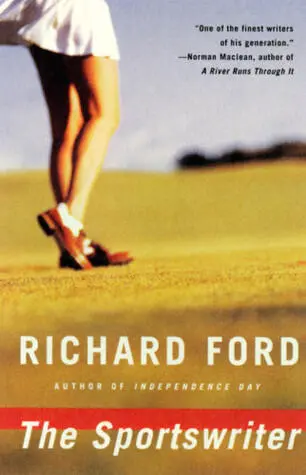
- Название:The Sportswriter
- Автор:
- Издательство:Vintage Books
- Жанр:
- Год:1995
- ISBN:нет данных
- Рейтинг книги:3 / 5. Голосов: 1
-
Избранное:Добавить в избранное
- Отзывы:
-
Ваша оценка:
The Sportswriter: краткое содержание, описание и аннотация
Предлагаем к чтению аннотацию, описание, краткое содержание или предисловие (зависит от того, что написал сам автор книги «The Sportswriter»). Если вы не нашли необходимую информацию о книге — напишите в комментариях, мы постараемся отыскать её.
The Sportswriter — читать онлайн бесплатно полную книгу (весь текст) целиком
Ниже представлен текст книги, разбитый по страницам. Система сохранения места последней прочитанной страницы, позволяет с удобством читать онлайн бесплатно книгу «The Sportswriter», без необходимости каждый раз заново искать на чём Вы остановились. Поставьте закладку, и сможете в любой момент перейти на страницу, на которой закончили чтение.
Интервал:
Закладка:
“I’ve got too much worldly business.”
“Well then, today’s the day for it,” he says. He raises his empty hand in a wave and starts up the stairs two at a time. “God is smiling for you today,” he calls from the gloomy upper story.
“Good,” I say. “I’m smiling back at him.” I go back to the kitchen first to find Frisker, and then to be on my way.
On the way through town I cruise up Seminary Street, which dead-ends on the Institute grounds and the small First Presbyterian, its white steeple pointing at the clouds. The Square is church-empty (though plenty of cars are parked). A man in an orange jacket, seated in a wheelchair, peers into the closed ice cream shop, and our one black policeman stands on the curb, heavy with police gear. The De Tocqueville minibus rumbles out ahead of me and disappears down Wallace Road. Both traffic lights click to green in the watery sunlight. It is a perfect time for a robbery.
I turn south toward Barnegat Pines, but after a block I make a sweeping U-turn — what Ralph used to call a “hard left”—and pull back into the empty Disabled slot at the side of the Presbyterians.
Leaving the motor on, I duck in a side door at the back. Ushers are milling, holding sheafs of special deckle-edged vanilla Easter Service bulletins. They are local businessmen, in brown suits and tie clasps, ready to whisper a “gladjerhere” as if they’d known you all your life and had your pew picked out. No seating during prayers, doxologies and Holy Communion. Slip in during hymns, announcements and, of course, collection.
This is my favorite place in church, the very farthest back door. This is where my mother used to stand with me the few times we ever went in Biloxi. I cannot sit still in a pew, and always have to leave early, disturbing people and feeling embarrassed.
The fellow who greets me has on a name tag that says “Al.” Someone has written “Big” before it in a red marker. I recognize him from the hardware store and The Coffee Spot. He is in fact a big man in his fifties, who wears big clothes and smells of Aqua Velva and cigarettes. When I edge in close to his door, which is open revealing rows of praying heads, he eases over by me, puts a giant hand on my shoulder and whispers, “We’ll put you right in there in a minute. Plenty of good seats in front.” Aqua Velva washes over me. Big Al wears a big purple and gold Masonic knucklebuster, and his hairy hand is as wide as a stirrup. He slips me a bulletin and I hear him breathe down deep in his troubled lungs. The other ushers are all praying, staring ferociously at their toes and the bright red carpet, their eyes resolutely open.
“I’ll just stand a minute, if it’s all right,” I whisper. We are old friends after all, both lifelong Presbyterians.
“Sure-you-bet, Jim. Stay right there.” Big Al nods in complete assurance, then eases back with the other ushers and bows his head dramatically. (It is not surprising that he thinks of me as someone else, since nothing here could matter less than my own identity.)
The sanctuary is swimming in permanent, churchy light and jam-packed with heads and flowered hats bowed in beseechment. The minister, who seems a half-mile away, is a hale and serious barrel-chested, rambling-Jack type with a bushy beard and an Episcopal bib — without any doubt a seminary prof. He gives in to the old bafflement in a loud actor’s voice, his arms raised so his gown makes great black bat wings over the lilied altar. “And we take, Oh Lord, this day as a great, great gift. A promise that life begins again. Here we are on this earth … our day to day comings….” Predictably on and on. I listen wide-eyed, as if hearing a great new secret revealed, a promised message I must deliver to a faraway city. And I feel … what, exactly?
A good ecumenist’s question, for a well-grounded fellow like me. Though the answer is plain and simple, or I wouldn’t be here at all.
I feel just as I wanted to feel, and knew I would when I made that hard left and came barreling back to the parking lot — a sweet and expanding hieratic ardor and free elevation above low spirits, a swoony, hot tingle right down to my toe tips, something akin to what sailors in the brig must feel when the president visits their ship. Suddenly I’m home, without fear, anxiety, or for that matter even any burdensome reverence. I’m not even in jeopardy of being bested at religion here — it’s not that kind of place — and can feel damn pleased with both myself and my fellow man. A rare immanence is mine, things falling back and away in the promise that more’s around here than meets the eye, even though it is of course a sham and will last only as far as my car. Better this than nothing, though. Or worse. To have hollow sorrow. Or regret. Or to be derailed by the spiky fact of being alone.
Then suddenly: “Rise my soul and stretch thy wings, thy better portion trace; Rise from transitory things toward heaven, thy destined place….” My voice springs forth strong and unequivocal, with Big Al’s baritone behind me in the chorus of confident, repentant suburbanites. (I can never think what the words mean or even imply.) The organ rattles the windows, raises the roof, tickles the ribs, sends a stirring through all our bellies — Jim’s, the ushers’, the preacher’s.
And then I’m gone.
A secret high sign to big Al, who understands me and everything perfectly and clasps his big stirrupy hands in front of him in a Masonic one-man handshake. It is time for the “Race to the Tomb,” and I am in no need of messages, having taken in all I want and can use, am “saved” in the only way I can be (pro tempore) , and am ready to march on toward dark temporality, my banners all aflutter.
10
Under the visor I have a Johnny Horizon Let’s-Clean-Up-America map, printed for the Bicentennial, and taped to the dash a page of directions in Vicki’s own hand on the “smart way” to get to Barnegat Pines. 206-A to 530-E to 70-S and (swerving briefly north) to an unnumbered county road referred to only as Double Trouble Road, which supposedly delivers you neat as a whistle to where you’re going.
Her directions route me past the most ordinary but satisfying New Jersey vistas, those parts that remind you of the other places you’ve been in your life, but in New Jersey are grouped like squares in a puzzle. It is a good time to put the top down and let in the winds.
Much of what I pass, of course, looks precisely like everyplace else in the state, and the dog-leg boundaries make it tricky to keep cardinal points aligned. The effect of driving south and east is to make you feel you’re going south and west and that you’re lost, or sometimes that you’re headed nowhere. Clean industry abounds. Valve plants. A Congoleum factory. U-Haul sheds. A sand and gravel pit close by a glass works. An Airedale kennel. The Quaker Home for Confused Friends. A mall with a nautical theme. Several signs that say HERE! Suddenly it is a high pale sky and a feeling like Florida, but a mile farther on, it is the Mississippi Delta — civilized life flattened below high power lines, the earth laid out in great vegetative tracts where Negroes fish from low bridges, and Mount Holly lumps on the far horizon just before the Delaware. Beyond that lies Maine.
I stop in the town of Pemberton near Fort Dix, and put in another call to X to express Easter greetings. Her recording talks in the same brassy business voice, and this time I leave a number — the Arcenaults’—where she can reach me. I also put in a call to Walter. He is on my mind today, although no one answers at his house.
In Bamber — a town that is no more than a post office and small lake across Route 530—I stop for a drink in a cozy rough-pine roadhouse with yellow lowlights and log tables. Sweet Lou’s Sportsman’s B’ar, owned — the signs inside all say — by a famous ex-center on the ’56 Giants, Sweet Lou Calcagno. Jack Dempsey, Spike Jones, Lou Costello, Ike and a host of others have all been close friends of Sweet Lou’s and contributed pictures to the walls, showing themselves embracing a smiling, crewcut bruiser in an open collar shirt who looks like he could eat a football.
Читать дальшеИнтервал:
Закладка:
Похожие книги на «The Sportswriter»
Представляем Вашему вниманию похожие книги на «The Sportswriter» списком для выбора. Мы отобрали схожую по названию и смыслу литературу в надежде предоставить читателям больше вариантов отыскать новые, интересные, ещё непрочитанные произведения.


Обсуждение, отзывы о книге «The Sportswriter» и просто собственные мнения читателей. Оставьте ваши комментарии, напишите, что Вы думаете о произведении, его смысле или главных героях. Укажите что конкретно понравилось, а что нет, и почему Вы так считаете.