Richard Ford - The Sportswriter
Здесь есть возможность читать онлайн «Richard Ford - The Sportswriter» весь текст электронной книги совершенно бесплатно (целиком полную версию без сокращений). В некоторых случаях можно слушать аудио, скачать через торрент в формате fb2 и присутствует краткое содержание. Год выпуска: 1995, Издательство: Vintage Books, Жанр: Современная проза, на английском языке. Описание произведения, (предисловие) а так же отзывы посетителей доступны на портале библиотеки ЛибКат.
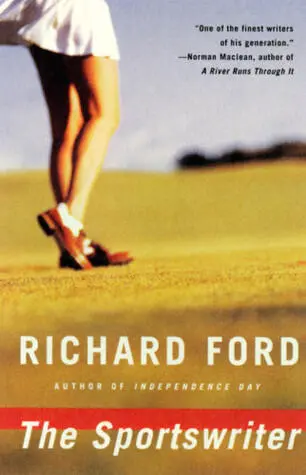
- Название:The Sportswriter
- Автор:
- Издательство:Vintage Books
- Жанр:
- Год:1995
- ISBN:нет данных
- Рейтинг книги:3 / 5. Голосов: 1
-
Избранное:Добавить в избранное
- Отзывы:
-
Ваша оценка:
The Sportswriter: краткое содержание, описание и аннотация
Предлагаем к чтению аннотацию, описание, краткое содержание или предисловие (зависит от того, что написал сам автор книги «The Sportswriter»). Если вы не нашли необходимую информацию о книге — напишите в комментариях, мы постараемся отыскать её.
The Sportswriter — читать онлайн бесплатно полную книгу (весь текст) целиком
Ниже представлен текст книги, разбитый по страницам. Система сохранения места последней прочитанной страницы, позволяет с удобством читать онлайн бесплатно книгу «The Sportswriter», без необходимости каждый раз заново искать на чём Вы остановились. Поставьте закладку, и сможете в любой момент перейти на страницу, на которой закончили чтение.
Интервал:
Закладка:
Vicki turns over on the big bed and faces the other wall, the white sheet clutched up under her chin and the crisp hotel percale stretched over her like a winding. I have hit the tender spot. A day and a night with me has made even Everett look good. Something else is needed, and I don’t fit the bill even with champers, a demi-suite, bachelor buttons and a view of Canada. Maybe that isn’t even surprising when you come down to it, since by scaling down my own pleasures I may have sold short her hopes for herself. I, however, am an expert in taking things like this lying down. For writers — even sportswriters — bad news is always easier than good, since it is, after all, more familiar.
“I don’t want to be friends. Not just,” Vicki says in a tiny, mouse voice from a mound of white covers. “I really thought I was gettin a new start with you.”
“Well, what happened to make you think you weren’t? Just because you caught me going through your purse?”
“Shoot. That didn’t matter,” she says, smally. “Live and let die, I say. You can’t help yourself. Yesterday wasn’t the tiptop day for you in the year.”
“Then, what’s the matter?” I wonder, in fact, how many times I have said that or something equal to it to a woman passing palely through my life. What’re you thinking? What’s made you so quiet? You seem suddenly different. What’s the matter? Love me is what this means, of course. Or at least, second best: surrender. Or at the very least, take some time regaling me with why you won’t, and maybe by the end you will.
Outside a wind makes a sharp oceanic woo around the corner of the hotel, then off into the cold, paltry Detroit afternoon. By five it could as easily turn to rain, by six the stars could be out and by nighttime Vicki and I could be strolling down Larned for a steak or a chop. You can never completely count on things out here. Life is counterpoised against a mean wind that could suddenly cease.
“Well,” Vicki says, and turns over to face me out of a grotto of pillows and sheets. “When I went downstairs, you know, when you were gone? I just went to be a part of something. I didn’t need anything. And I went in the little newsstand down there, and I picked up this paperback. How To Take On The World , by Doctor Barton. Because I felt like I was starting over in one way, like I said. You and me. So I stood there at the rack and read one chapter called ‘Our New-Agers.’ Which was about these people who won’t eat potato chips and who join these self-discovery groups, and drink mineral water and have literary discussions every day. People that think it oughta be easy to express their feelings and be how you seem. And I just started cryin, cause I realized that that was you, and I was someplace way off the beam. Back with the potato chips and people who aren’t inner-looking. Here we’d come all the way out here, and all I could do was eat shrimp and watch TV and cry. And it wasn’t working out. So I thought maybe we could be friends if you wanted to. I called up Everett because I knew I could bring it off with him and quit crying. I knew I was better off than him.” A big handsome tear leaves her eye, goes off her nose and vanishes into the pillow. I have managed to make two different people cry inside of two hours. I am doing something wrong. Though what?
Cynicism.
I have become more cynical than old Iago, since there is no cynicism like lifelong self-love and the tunnel vision in which you yourself are all that’s visible at the tunnel’s end. It’s embarrassing. Likewise, there’s nothing guaranteed to make people feel more worthless than to think someone is trying to help them — even if you’re not. A cynical “New-Ager” is exactly me, a sad introspecter and potato chip avoider with a queasy heart-to-heart mentality — though I would give the crown jewels not to be, or at least not be thought to be.
My only hope now is to deny everything — friendship, disillusionment, embarrassment, the future, the past — and make my stand for the present. If I can hold her close in this cold-hot afternoon, kiss her and hug away her worries with ardor, so that when the sun is down and the wind stops and a spring evening draws us, maybe I will love her after all, and she me, and all this will just have been the result of too little sleep in a strange town, schnapps and Herb.
“I’m not really a New-Ager,” I say and take a seat on the bed shoulder, where I can touch her cheek, warm as a baby’s. “I’m just an old-fashioned Joe who’s been misunderstood. Let’s pretend we just got here and it’s late at night, and I had you in my old-fashioned arms to love.”
“Oh my.” She puts a tentative hand on my shoulder and gives it a friendly pat. “I bet you think I got it all wrong.” She gives a stout sniff. “That I can’t even make myself miserable and do it right.”
“You’re just no good at messin up.” I put a heavy hand on her soft breast. “You just have to let good things be good if they will. Don’t worry about more than you have to.”
“I shouldn’t read, is what it is. It always gets me in trouble.” She reaches both hands around my neck and pulls hard, so hard once again a crippling pain goes down my back clear to my buttocks.
“Oh,” I say, involuntarily. On TV a skier is just about to push out the timer gate onto a slope longer and higher than any I’ve ever seen. Snow is falling wherever he is. I wouldn’t do what he’s doing for a million dollars.
“Oh my,” she says, for I have found her in the lemony light. “My, my, my.”
“You sweet girl,” I say. “Who wouldn’t love you?”
Outside in the cold city the wind goes woo again and I can, I think, hear the tufted snow dashing against the window, sending shivers through every soul in Detroit who thinks he knows a thing or two and who is willing to bet his life on it. I leave the TV on, since even now, in its prying presence, I still find it consoling.
By five o’clock, we have taken a cab trip up Jefferson to the Belle Isle Botanical Garden, and are back in the room suffering a case of the wall-stare willies, something sportswriter’s know a lot about. We are like the family of a traveling salesman, come along for the adventure and diversion, but who find themselves with too much time to kill while business gets conducted; too many unfamiliar streets leading too far away; too little going on in the hotel lobby to make people-watching all that rewarding.
The Botanical Garden turned out to be cold and alien-feeling, though we trudged down aisles of ferns and succulents and passion flowers until Vicki announced a headache. The most interesting rooms all seemed to be closed — in particular a re-creation of an eighteenth-century French herb garden, which we could see through the glass door and that caught both our fancies. A sign hung in the window saying Detroit was not generous enough in its tax attitudes to support this century properly. And in less than an hour we were back out in the cold and snow of afternoon on the windy concrete steps. A muddy playing field stretched away from us toward the boat basin, with the big river invisible and low behind a crescent-line of poplar saplings. Public places can sometimes let you down no matter how promising they start out.
Delivered back outside our hotel, I offered a short walk down Larned to “a great little steak house I know about.” Though when we had gone as far as Woodward, everyone we saw had become black and vaguely menacing, the taxis and police all unexplainably disappeared, and Vicki clung to me ashiver from the wintry norther that’d dropped in on us from bland Canada.
“I’m not really dressed for this, I don’t think,” she said beneath my arm, and smiled a daunted smile. “I’d settle for a Tuna Alladin at the coffee shop, if that’s okay with you.”
Читать дальшеИнтервал:
Закладка:
Похожие книги на «The Sportswriter»
Представляем Вашему вниманию похожие книги на «The Sportswriter» списком для выбора. Мы отобрали схожую по названию и смыслу литературу в надежде предоставить читателям больше вариантов отыскать новые, интересные, ещё непрочитанные произведения.




Обсуждение, отзывы о книге «The Sportswriter» и просто собственные мнения читателей. Оставьте ваши комментарии, напишите, что Вы думаете о произведении, его смысле или главных героях. Укажите что конкретно понравилось, а что нет, и почему Вы так считаете.